
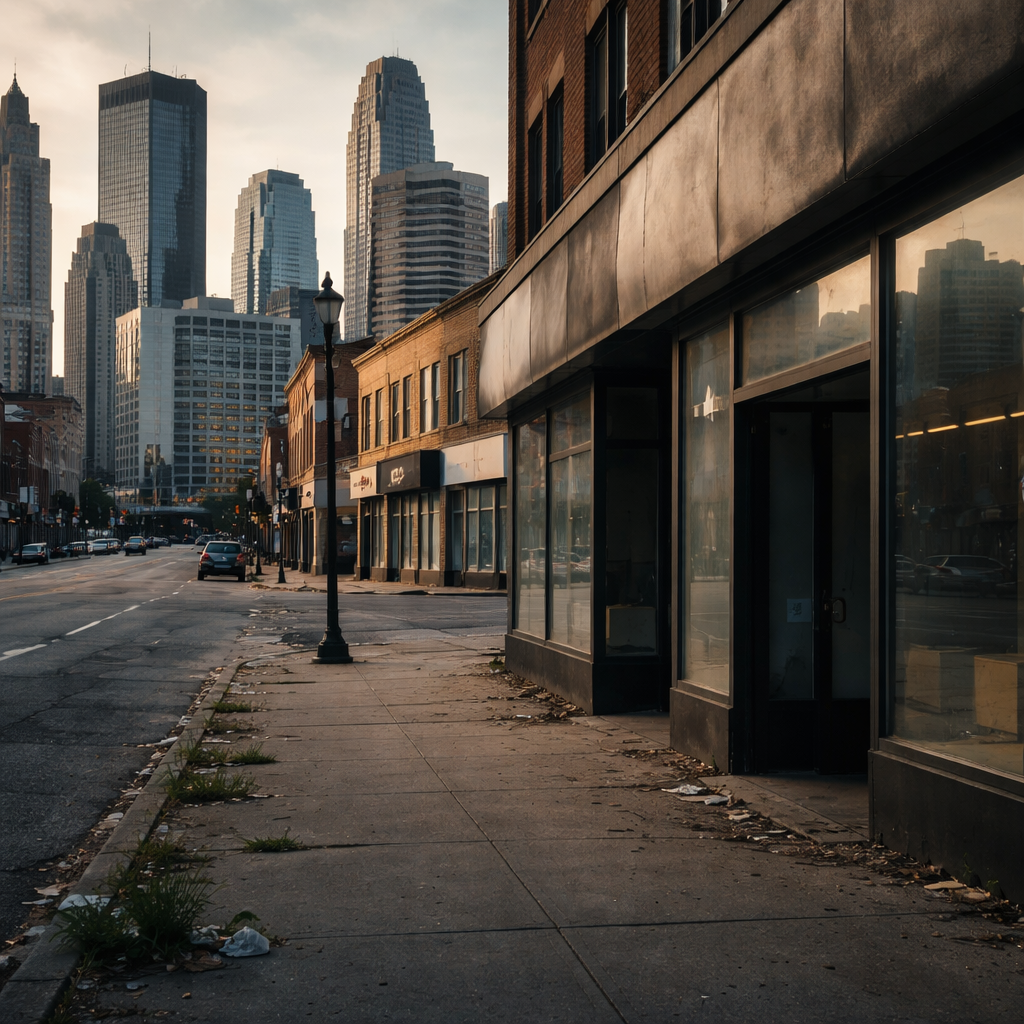
Downtown Minneapolis commercial building values have dropped 45% in just five years, falling from $7.5 billion in 2021 to $4.1 billion in 2026, according to a report published this week by the Center of the American Experiment. The analysis, written by Public Safety Policy Fellow David Zimmer and released June 18, 2026, argues that the city's leadership has prioritized "nonsense" over economic fundamentals while the tax base collapses and homeowners shoulder an increasing burden.
The decline is accelerating rather than stabilizing, despite six years having passed since the COVID-19 downturn. City data shows the five highest-valued buildings downtown lost 20% of their value in the past year alone. The iconic IDS Center dropped from $135 million to $107 million in that period. Meanwhile, the percentage of property taxes that Minneapolis homeowners are responsible for has increased by 6.2 percentage points since 2021, now approaching 56%. The city faces a $30 million budget deficit heading into 2027.
Council member Michael Rainville, described in the report as "one of the few reasonable members," called the situation "terrible" in remarks to KSTP. When reporters previously asked about the impact of declining commercial values on homeowners, a city spokesperson dismissed concerns in April 2026, saying that claims of "declining market values = homeowners will pay more" can be "misleading because it implies a direct, automatic shift which is not how the system works." The report notes that response "didn't age well" given the subsequent data on homeowner tax burden increases.
The report argues the City Council has focused "too much energy on nonsense" while commercial real estate collapsed, pointing to a council "comprised of too many 20 and 30 something councilmembers who lack real world experience." The analysis lists what it calls misplaced priorities, including reducing main roadways like Hennepin Avenue to one lane in each direction, which "hastened the demise of once bustling areas like Uptown," and spending $1.4 million on a contract to provide coaching between councilmembers and the mayor's office "to help these 'leaders' govern more civilly." Other cited examples include time spent on resolutions denouncing federal policies on Cuba, Gaza, and ICE enforcement, opposition to reopening George Floyd Square to traffic after six years, resistance to rebuilding the burned Third Precinct police station, and hosting the first-ever transgender drag show in City Hall during Pride month 2026. The report also highlights the council's opposition to both former police chief Brian O'Hara and Community Safety Commissioner Toddrick Barnette, noting that O'Hara's recent resignation makes it "unlikely the position will be viewed favorably by many quality candidates."
The report's central conclusion is direct: "When the city's leaders are mired in high-profile infighting and symbolic social activism, they lose the ability to focus on the issues that matter—providing for public safety, establishing a business-friendly environment, and ultimately enhancing the tax base." The analysis frames the economic decline as a direct consequence of voter choices, stating that "Minneapolis voters are facing the direct consequences of the progressive council members they have repeatedly elected." With downtown values in free fall, homeowner taxes climbing, and a budget deficit looming, the report suggests the city's trajectory won't change unless leadership priorities shift from symbolic gestures to economic fundamentals.