
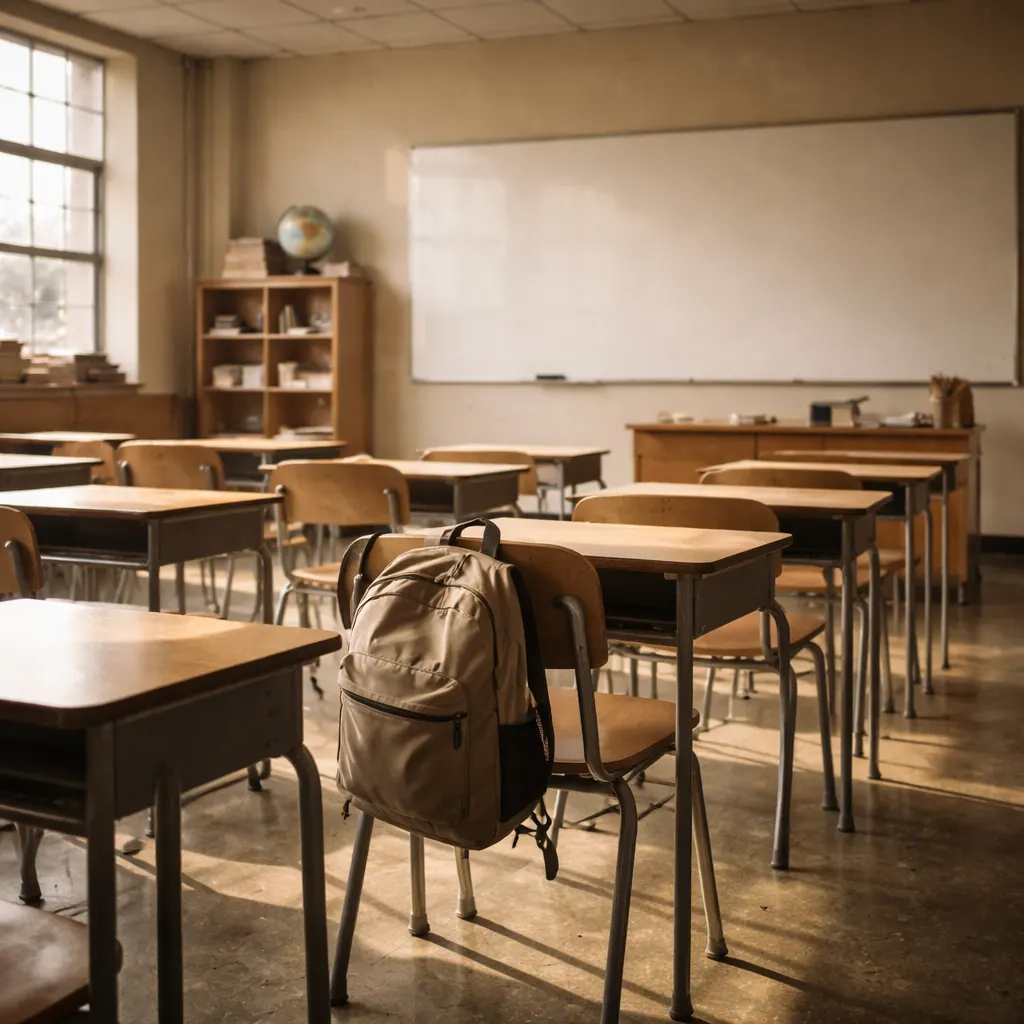
Public school enrollment dropped by an average of 3.8% across 40 states between 2019 and 2024, representing nearly 1.5 million fewer students, according to data published by the National Center for Education Statistics and analyzed in a new education newsletter from Reason Foundation. The declines were driven by falling birth rates, migration patterns, and rising competition from private schools and homeschooling. Projections from NCES forecast an additional 2.6 million students will leave the public system nationwide by 2031.
The data reveals stark geographic differences in how states were affected. West Virginia, Hawaii, and New Hampshire saw the steepest declines, with student counts dropping 8.1%, 7.7%, and 7.4% respectively. Four populous states—New York, California, Illinois, and Michigan—accounted for nearly half the national decline, losing 738,000 students combined, though this represented a 5.4% decrease on average. Birth rates fell 6.8% on average in the 40 states with enrollment losses when comparing 2019 to 2014. In states where enrollment dropped 3% or more, births for the corresponding kindergarten cohorts declined 7.7% on average, compared to just 5.4% in states with smaller enrollment losses. Meanwhile, U.S. Census Bureau estimates indicated that private school enrollment increased nearly 12% nationwide in 2024 compared to 2019, while Johns Hopkins University reported homeschooling grew at an average annual rate of about 5% between 2019 and 2024.
The analysis notes that public schools haven't experienced a sustained enrollment decline of this magnitude since the 1970s and '80s, when student counts dropped 14%—roughly 6.5 million students—and didn't fully recover for nearly two decades. Stanford University's Thomas Dee found that changing demographics or transitions to private schools and homeschooling didn't account for about one-third of the 1.2 million students who exited public schools after the pandemic. The report also points to 17 states that have launched universal private school scholarship programs since 2021, including Texas and Florida, though non-public school enrollments increased even in states without choice programs like California and New York.
The declining birth rate represents the primary engine behind the losses. Fewer births directly translate to smaller kindergarten cohorts five years later, shrinking the pipeline of incoming students. Migration patterns offered some cushion—states where enrollment losses stayed below 3% saw their general populations increase 2.5% on average, more than double the rate in harder-hit states. International migration backfilled domestic population losses in 15 of the 22 states that experienced net outbound migration. But the report emphasizes that states need substantial population gains to reverse the trend; in the 10 states where enrollment increased or held steady, populations grew 5.6% on average. Even that's no guarantee—North Carolina and Arizona saw large population increases but still lost students.
Looking ahead, the report argues that lower student counts are here to stay for the near future, forcing districts nationwide to rightsize. It recommends that state policymakers eliminate declining-enrollment provisions that fund "ghost students" no longer in public schools. Missouri's provision inflated enrollments by nearly 45,000 students in 2021-22, costing an estimated $197 million that year. Oklahoma offers a reform model: lawmakers reduced ghost students from more than 55,000 in 2020-21 to about 3,800 in 2022-23, a 93% reduction that saved taxpayers an estimated $184 million. With smaller cohorts and stiffer competition now defining the education landscape, the report concludes, such reforms will push districts to adapt and manage public resources more effectively.