
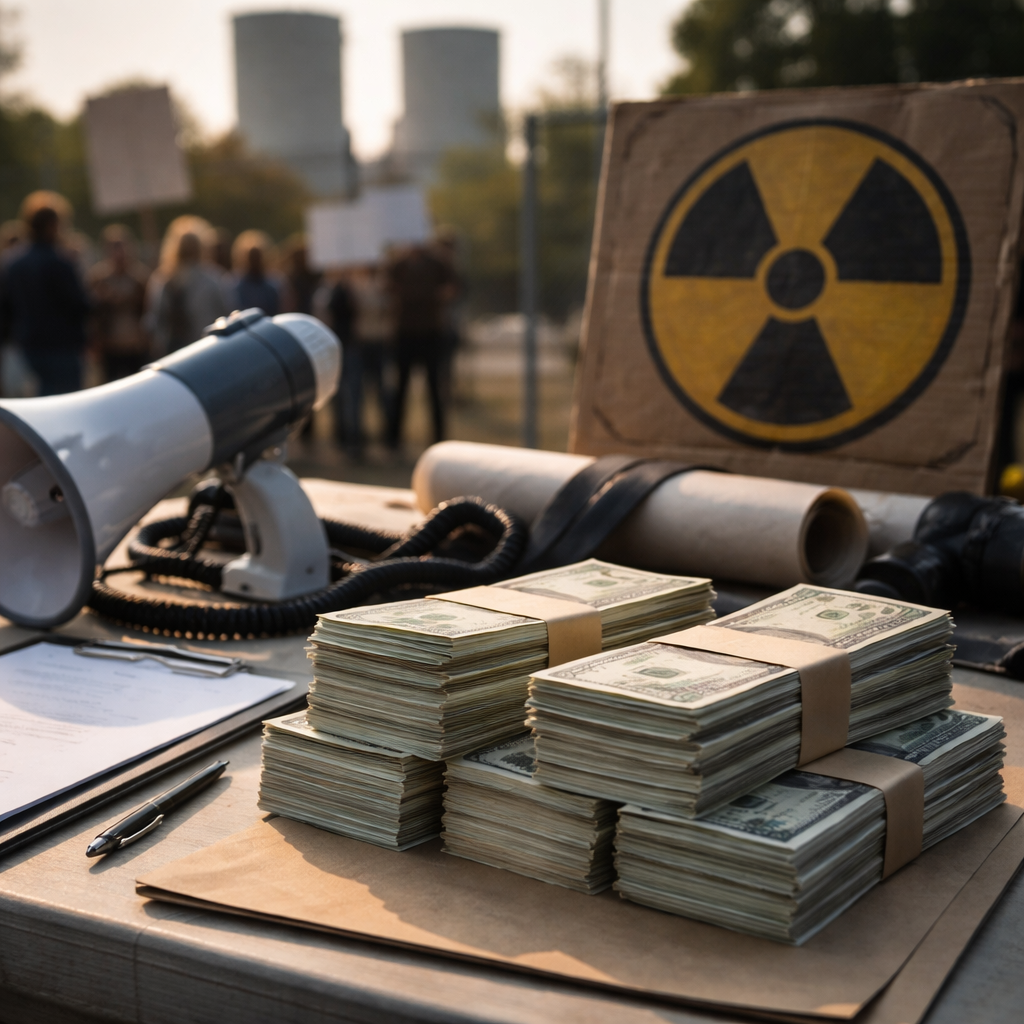
A coalition of more than 300 American environmental organizations opposing nuclear power now collects over $3.4 billion annually—an average of $9.3 million per day—while blocking what data shows is the nation's safest and most reliable zero-emissions energy source, according to a new report from the Capital Research Center. The report, titled "Enemies of Energy" and published June 3, 2026, argues that groups like the Sierra Club have led a decades-long campaign against nuclear power based on claims that "do not match reality," causing America to abandon its energy leadership while China rapidly expands its nuclear capacity.
Nuclear power currently generates less than 20 percent of U.S. electricity despite being the country's single largest emissions-free source—producing more annual kilowatts than wind and solar combined. France, by contrast, produces 70 percent of its electricity from nuclear stations and consequently has lower CO2 emissions per person than nearly any other major economy. China is now building more than 41,000 megawatts of nuclear capacity, equal to 42 percent of current American nuclear capacity, while the U.S. has no reactors under construction and total capacity has remained flat for over two decades. Nuclear ranks as the second-largest worldwide generator of CO2-free electricity, behind only hydroelectric dams and ahead of both wind and solar.
The report challenges the Sierra Club's characterization of nuclear power as "uniquely dangerous," citing safety data that reveals remarkably few fatalities across the technology's entire history. According to the analysis, one person died of radiation-related lung cancer following the 2011 Fukushima incident in Japan, while all other reasonably-claimed radiation deaths trace back to the 1986 Chernobyl disaster in the Soviet Union. A 2017 Our World in Data analysis found the "confirmed death toll from Chernobyl is less than 100," with best estimates placing the true figure between 300 and 500. A June 2024 U.S. Department of Energy report stated that "in the nearly 70-year history of civil nuclear power generation, with over 20,000 cumulative reactor-years of operation across 36 countries, there have been three significant accidents at nuclear power plants resulting in fewer than 30 deaths due to radiation exposure."
The report contextualizes nuclear's safety record by comparing it to other energy sources, noting that 29 people died in a single 2010 coal mine explosion in West Virginia, while a 1975 hydro dam failure in China killed tens of thousands immediately and 100,000 more from subsequent flooding. A February 2020 Our World in Data analysis concluded that "nuclear energy results in 99.9% fewer deaths than brown coal; 99.8% fewer than coal; 99.7% fewer than oil; and 97.6% fewer than gas." The report also addresses waste concerns, citing Department of Energy findings that all used nuclear fuel produced by the U.S. industry over 60 years "could fit on a football field at a depth of less than 10 yards"—and that this material can be reprocessed and recycled. France already obtains 17 percent of its electricity from recycled nuclear fuel, leading the report to argue "there is no such thing as 'nuclear waste.'"
The report concludes that if America matched France's nuclear commitment and generated 70 percent or more of its electricity from reactors, the country could dramatically reduce emissions while maintaining reliable baseload power that wind and solar can't provide. Author Ken Braun argues that anti-energy nonprofits deserve blame for "America's abandonment of its nuclear energy leadership over the last half century," despite the U.S. creating the first reactor and operating the world's largest nuclear fleet. With the will and wealth already in place, the report suggests the primary obstacle isn't technical or economic—it's the daily influence of well-funded organizations opposing what the data shows is America's cleanest, safest energy option.