
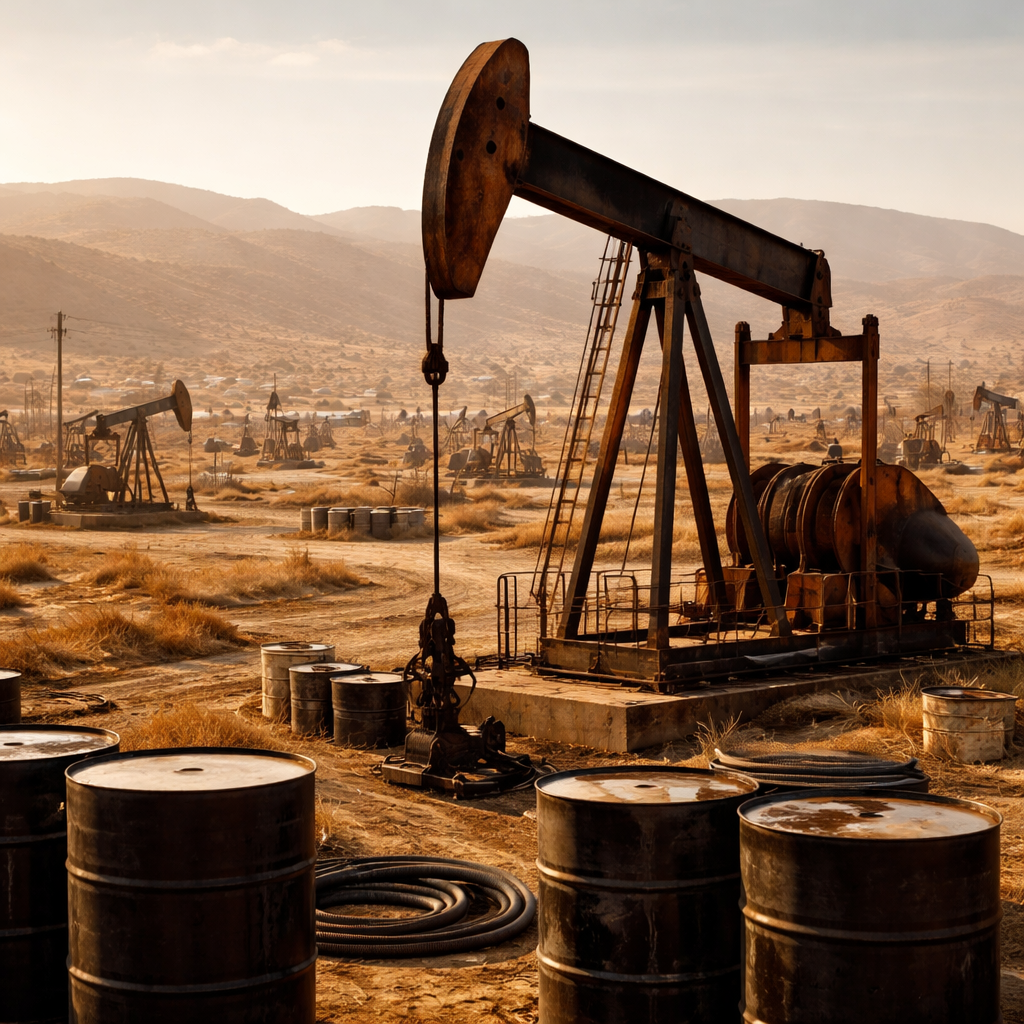
Californians will consume at least another five billion barrels of crude oil before the state achieves its official "clean energy future" goal, even under the most aggressive scenarios. That's the central finding of a new analysis published June 3, 2026 by Edward Ring, Director of Water and Energy Policy at the California Policy Center. The report argues that state policies aimed at eliminating oil dependence by 2045 ignore the mathematical reality of how much oil the state will need during the transition, raising serious questions about California's decision to dismantle its domestic oil industry.
The data breakdown reveals the scale of California's oil challenge. In 2025, Californians consumed 484 million barrels of crude oil, down from 655 million barrels in 2006. That 20-year decline represents an annual decrease of just 1.6 percent per year. To eliminate oil consumption entirely by 2045, the state would need to reduce consumption by 6.8 percent annually—more than four times the historical rate. Meanwhile, California's domestic oil production has plummeted to 110 million barrels in 2025, filling only 23 percent of demand despite the state sitting on reserves estimated at 30 billion barrels. The state now imports 77 percent of its crude oil and 20 percent of its refined gasoline, with in-state refinery capacity dropping below demand as two major plants shut down this year alone.
According to Ring, the expectation that California can accelerate its decline rate by a factor of four is "absurd" given that current policies are already "pushing available technology and economic constraints to their limits." The report notes that electric vehicles still constitute only 6 percent of California's automotive fleet, and even exponential growth in EV adoption would require decades to develop the necessary power generation capacity, distribution infrastructure, and charging networks. Ring asks why California is "doing everything in its power to drive the in-state industry into terminal decline" when demand will persist for at least another 20 years, arguing the state is instead exporting "the jobs and the environmental impact to nations with minimal standards."
The report traces California's refinery crisis to 13 years of cap-and-trade policies that forced oil companies to buy permits for CO2 emissions. Over $33 billion has been allocated through the state's "cap and invest" program, including $7.5 billion to high-speed rail, $5.9 billion to affordable housing, and $6.3 billion to various California Air Resources Board programs. Ring argues that siphoning "tens of billions out of an industry that operates on thin margins" has created a deferred maintenance debt that puts refineries on a "potentially irreversible trajectory toward permanent shutdown." While CARB recently offered billions in free emissions permits to refineries that invest in clean energy—enacted "over the objections of environmental groups"—the report questions whether this alone can reverse the damage.
Ring calls for state regulators to accept that California's remaining oil consumption will be at least five billion barrels, and possibly twice that amount. Starting from that premise, he argues officials should engage financial experts to determine exactly how much regulatory relief is needed to convince oil companies that investments with 20-year payback horizons remain rational in California. The bottom line: destroying domestic production while demand continues doesn't eliminate environmental impact—it just moves the drilling somewhere else.