
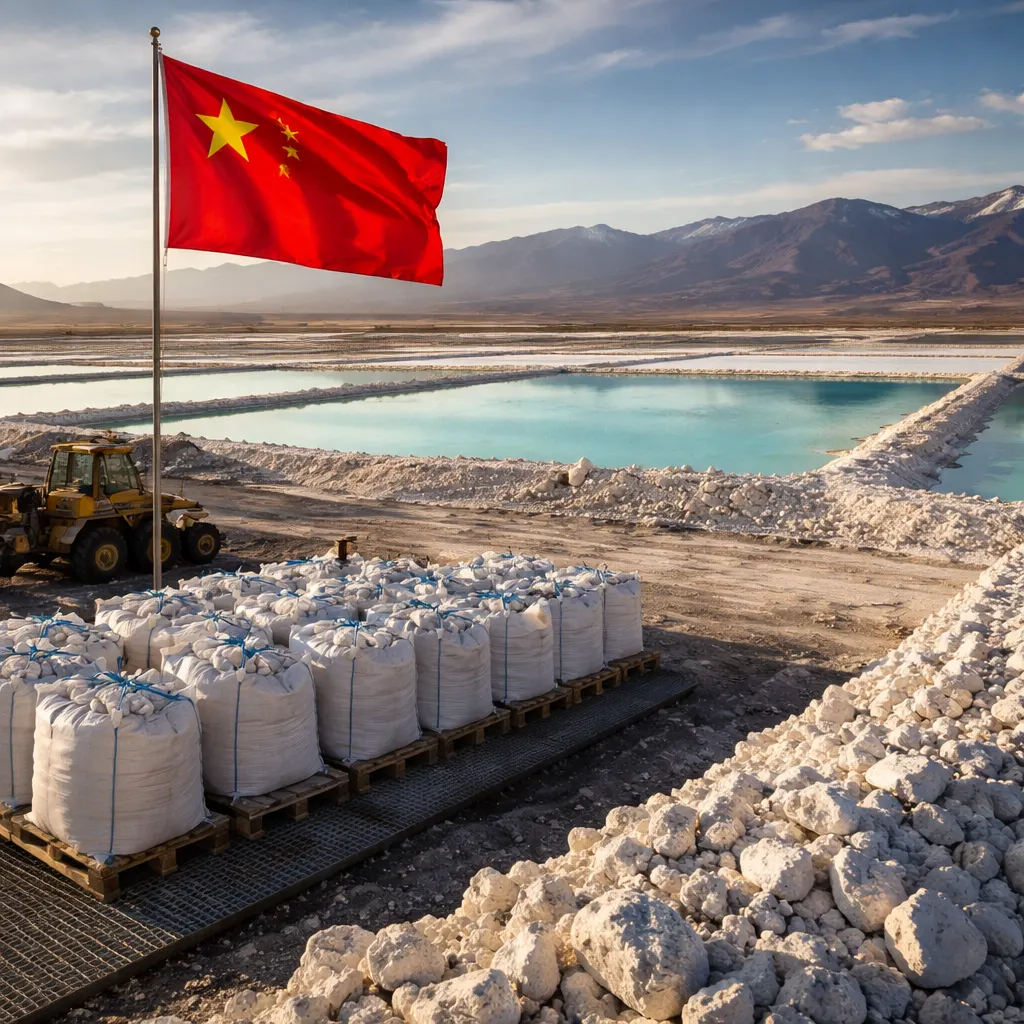
The so-called Lithium Triangle—Argentina, Bolivia, and Chile—contains 50–60% of the world's lithium reserves, making South America the decisive battleground for who will control the clean energy transition, according to a recent analysis published by the Foundation for Economic Education. China has already positioned itself as the dominant player, consuming approximately 55% of global lithium supply while producing roughly 70% of the world's electric vehicles. The report warns that liberal democracies risk replacing their fossil fuel dependencies with a new authoritarian energy supply chain unless they act fast.
In 2024, lithium production in the triangle accounted for 29% of global supply, with the main export destinations including China as the world's largest consumer, followed by the United States and Europe. Chinese companies like Tianqi moved aggressively to secure access, betting on Chilean lithium producer SQM in 2018, though the investment later created financial stress when commodity prices didn't meet expectations. Beyond raw lithium extraction, China dominates the entire supply chain—mining, refining, battery production, manufacturing, subsidies, and exports—creating a vertically integrated system that connects every step from ground to finished product. Every electrical appliance, from phones and computers to solar panels, depends on lithium-ion batteries to function, making this resource central not just to electric vehicles but to the entire technology ecosystem.
The report finds that "China's dominance of these markets matters for several reasons, including the ongoing geopolitical competition with Western economies and the documented impact of Chinese political and economic pressures." In Bolivia and Peru, Beijing's growing influence has increasingly resembled what the authors call "coercive economic statecraft," with Chinese firms creating dependencies that limit local policy autonomy and reduce the bargaining power of host countries. According to the analysis, "Chinese firms do not operate in isolation from the strategic priorities of the Chinese state," meaning their expansion serves external industrial priorities over local development. Chile demonstrates the most advanced version of this challenge—as a leading lithium producer with stronger institutions, it has tried to avoid becoming merely a raw materials exporter, yet controversy over Chinese participation in extraction and processing projects reveals the difficulty of attracting investment without surrendering strategic control.
The report argues that liberal democracies are repeating the central mistake of the fossil fuel era by building prosperity on energy systems vulnerable to authoritarian suppliers and geopolitical blackmail. The green transition was supposed to reduce that vulnerability, but if lithium extraction, battery processing, and EV supply chains become concentrated in the hands of a single authoritarian power, the shift to clean energy will simply replace one dependency with another. The issue isn't just whether Chinese companies should participate in South American lithium projects, but under what conditions—with what safeguards, technological transfer, local value-added production, and democratic oversight. Electric vehicles may shape public perception and grab headlines, but lithium itself shapes the balance of power. The true contest is over who controls the inputs, standards, financing, processing capacity, and industrial ecosystems behind electrification.
Liberal democracies need a coordinated lithium strategy that includes long-term investment in extraction and refining, support for environmentally responsible mining, partnerships with Latin American democracies, technology transfer, and credible financing that doesn't force countries into dependency, the report concludes. This means helping partners like Chile move beyond raw extraction toward processing, battery components, and higher-value industrial participation. The countries that control lithium supply chains will shape the next era of mobility, energy storage, and technological competition—making this no longer a niche commodity question but a test of whether democracies can secure the material foundations of the next energy order without reproducing the political dangers that made fossil fuel dependency so costly.