
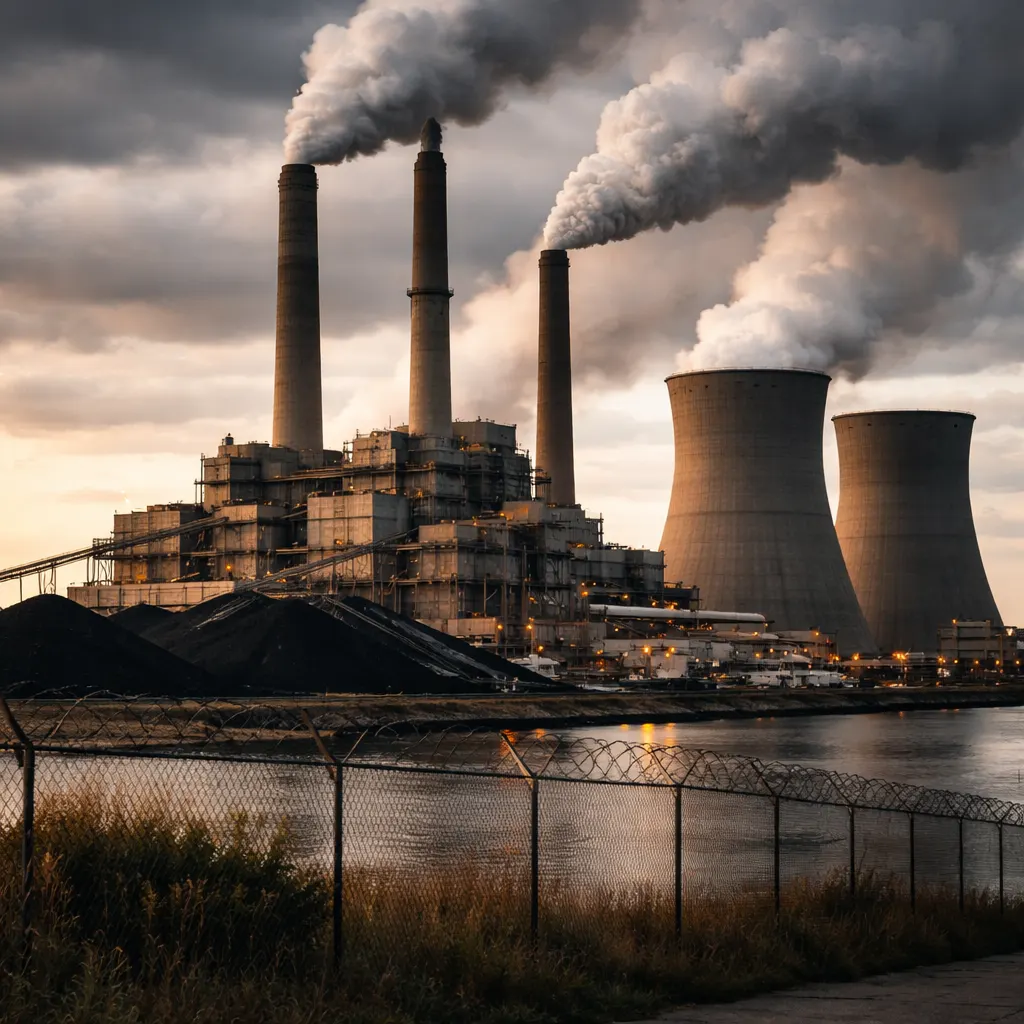
A federal appeals court has struck down the U.S. Department of Energy's emergency order that forced the operators of a coal-fired power plant in Michigan to postpone its planned closure, ruling on Friday that the federal government overstepped its authority into state jurisdiction. The U.S. Appeals Court for the District of Columbia Circuit found that the DOE lacked the power under the Federal Power Act to require Consumers Energy to operate its majority-owned, 1,420-megawatt J.H. Campbell power plant beyond its scheduled May 31, 2025, retirement date. The ruling represents one of the first court decisions on legal challenges to DOE orders that have prevented fossil-fueled power plants from shutting down.
The court noted that the federal government has historically issued temporary generation orders only in response to short-term emergencies triggered by war, severe weather events, market manipulation, or unexpected unavailability of specific generation units. Since the DOE issued its initial 90-day order blocking the Campbell plant's retirement, it has issued comparable orders affecting six additional power plants — all but one burning coal. The DOE has renewed all the orders before their expiration. Through June 30, the net expense of complying with the DOE emergency orders reached $259 million for Consumers Energy, after applying $239 million in revenues from the Midcontinent Independent System Operator, according to a July 28 filing with the Securities and Exchange Commission.
The court rejected the DOE's "sweeping conception" of its emergency authority under section 202(c) of the Federal Power Act, stating that an "emergency" under the statute means a grid reliability risk requiring immediate DOE action — a standard not satisfied in the Campbell plant case. "The Department's position would empower it to pick its preferred power sources in Michigan — or, presumably, any other state — and order them to operate without regard to the multiple procedural and substantive constraints built into state reliability planning processes," the court wrote. The court found that the DOE justified its order by citing "fragments" of two documents and a MISO presentation it claimed demonstrated that the region faced an emergency. The suit was filed by Earthjustice on behalf of the Sierra Club and Urban Core Collective, with the Michigan attorney general arguing the case for Illinois, Michigan and Minnesota.
The ruling explained that section 202(c) provides the DOE with a "limited backstop mechanism" to address certain electricity supply emergencies, not broad authority to intervene in state planning processes. The court emphasized that states — guided by federal, regional, and utility assessments of available supply and reliability requirements — carry the responsibility to plan for and prevent reliability risks on an ongoing basis, noting that both the Michigan Public Service Commission and MISO had approved the plant's retirement after thorough reviews. The court warned that the DOE's interpretation of "emergency" would enable frequent federal interventions unsupported by the statute and threaten energy market stability. Generally, the department has argued the plants needed to continue operating due to medium- to long-term potential for electric supply shortfalls.
A DOE spokesperson said the agency's emergency orders, including at Campbell, prevented blackouts and likely saved hundreds of lives during peak capacity events over the past year, calling them "essential" for maintaining electricity during Winter Storm Fern in January. At the height of the severe cold, coal-fired generation in affected regions jumped 25% compared to the same period last year, and the Campbell plant ran at over 650 megawatts every day between Jan. 21 and Feb. 1. The DOE could appeal the court's ruling to the U.S. Supreme Court. Michael Lenoff, an Earthjustice attorney, said in a press release that "the court rebuked the Trump administration's abuse of emergency powers," adding that preventing the market-driven retirements of coal plants to advance a coal-friendly agenda isn't a proper use of emergency powers.