
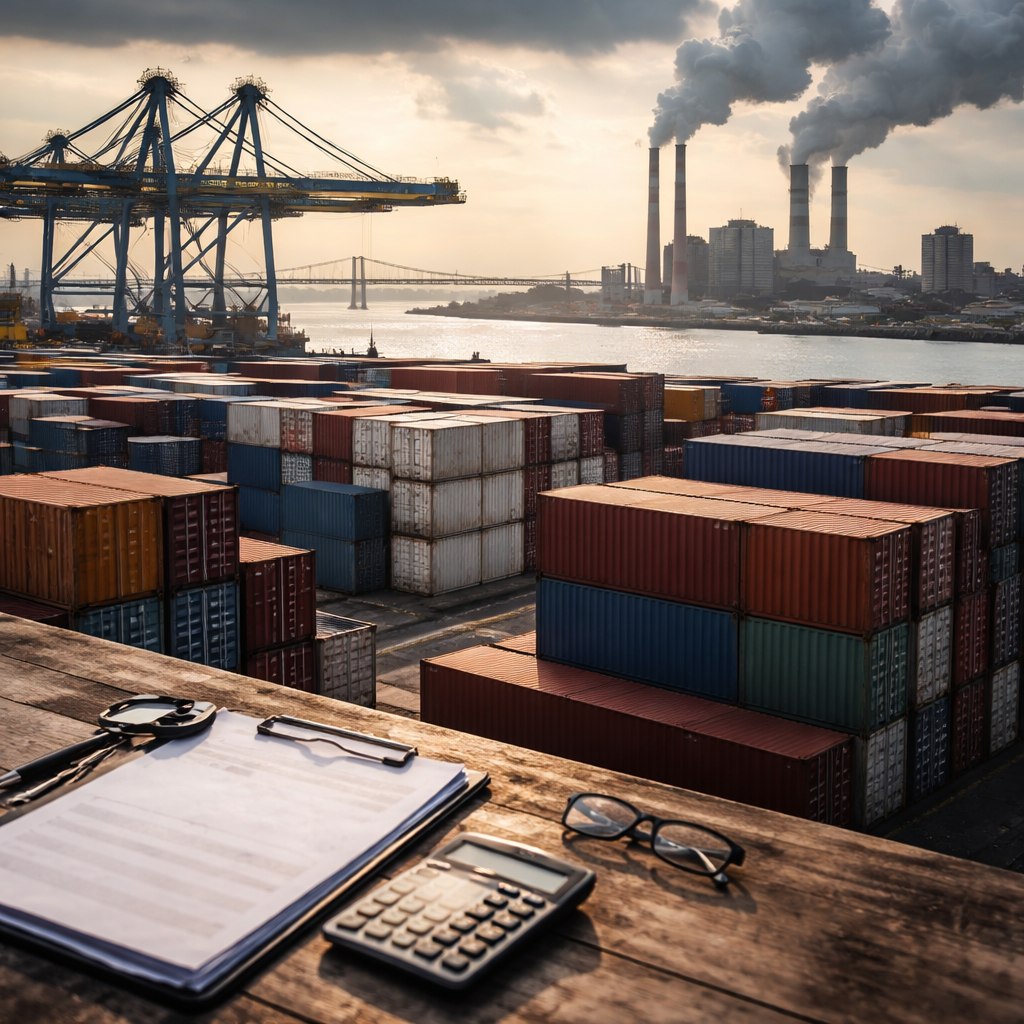
American exporters stand to lose $231 million this year to the European Union's new carbon tariff, with the three-year bill climbing to $752 million by 2028 if Congress doesn't act. The Niskanen Center published a detailed analysis on June 17, 2026, tracking how the EU's Carbon Border Adjustment Mechanism (CBAM) is draining revenue from U.S. heavy industry—money Washington could have collected first if it had put a domestic carbon price in place. The report warns that this is just the beginning, with more countries designing similar policies and the EU considering expanding its tariff to cover products like home appliances and vehicle parts.
The numbers break down starkly across sectors. At the official first-quarter 2026 carbon price of €75.4 ($88 USD) per metric ton of CO₂, the calculator estimates U.S. exposure at roughly $231 million for 2026. By 2028, the annual hit grows to about $271 million as the EU's mark-up penalties escalate and free allowances for European producers phase out. The tariff covers five carbon-intensive sectors: steel, aluminum, cement, fertilizer, and hydrogen. Early trade data from 2026 shows U.S. exporters are already pulling back—iron and steel shipments are running 85 percent below the 2022-2025 baseline, while aluminum is down 63 percent. The report notes these figures represent either firms avoiding the tariff or losing the EU market entirely, and both outcomes count as economic losses for American industry.
The report describes CBAM as a charge applied to imports from countries that haven't priced carbon emissions domestically. European importers must purchase emission permits called CBAM certificates at the same price EU producers pay under the bloc's Emission Trading System. The Niskanen Center's calculator uses confirmed Eurostat trade volumes, EU-assigned default emission values, and quarterly carbon prices to estimate what U.S. exporters owe. The authors emphasize their figures are an upper bound because default emissions values are intentionally conservative—designed to push companies toward submitting verified data from their actual facilities. According to the analysis, U.S. steel and aluminum producers running cleaner operations than EU baselines could cut their exposure significantly by reporting verified emissions, but that requires a monitoring and verification system the United States doesn't yet have.
The report identifies two pathways for protecting U.S. revenue and market access. A domestic carbon price would let American producers demonstrate they've already paid for their emissions at home, reducing their CBAM bill to nearly zero and keeping the revenue in Washington instead of sending it to Brussels. Senator Sheldon Whitehouse's Clean Competition Act, a border-adjusted carbon fee on heavy manufacturing, is the only current legislation aimed at this goal. The lighter alternative is a federal Monitoring, Reporting, and Verification system that would endorse a credible emissions accounting standard, allowing exporters to submit verified data and dodge the EU's punitive default values. The report warns that at least four other economies are designing similar border carbon policies, and the EU is finalizing regulations that will determine whether state-level carbon prices like California's count toward deductions. Without concrete policy or solid data, the United States lacks leverage in bilateral negotiations, and the cost of arriving late will be paid through tariffs, lost market share, or both.