
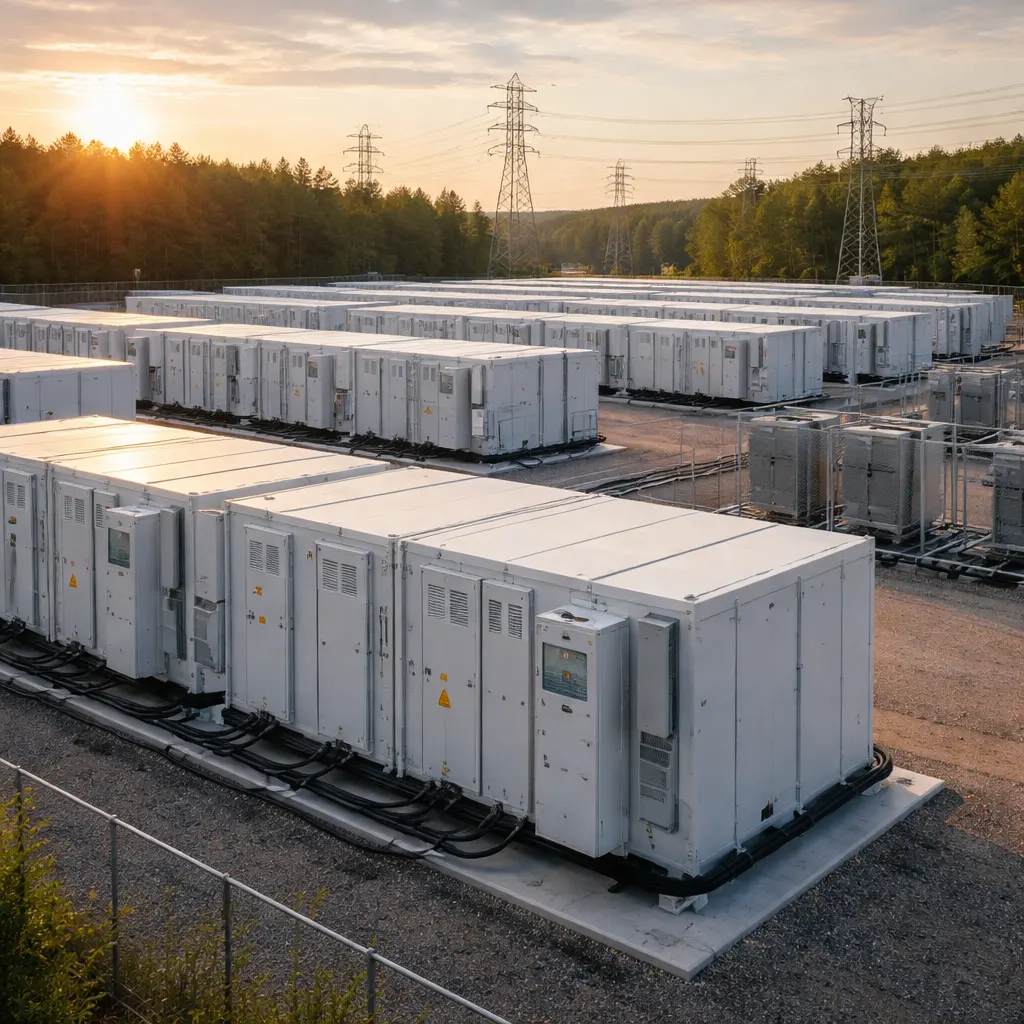
Three Massachusetts utilities have filed long-term contracts for utility-scale energy storage projects that will deliver 1,068 MW of power capacity and 4,472 MWh of energy storage to the state by 2030, Eversource Energy, National Grid, Unitil, and the Massachusetts Department of Energy Resources announced last week. The projects emerged from the first solicitation in a state procurement process targeting up to 1,500 MW of battery capacity in large transmission-connected installations. When operational, they'll provide clean peaking capacity and ease transmission congestion in Greater Boston and southeastern Massachusetts, supporting the state's push to deploy 5 GW of energy storage by 2030.
The three contracted projects include Jupiter Power's 700 MW/2,800 MWh Trimount facility, which will be New England's largest energy storage installation when it comes online later this decade. Flatiron Energy will develop two projects: the 250 MW/1,000 MWh Energizar and the 168 MW/672 MWh Salt Cod. Trimount's capacity contracts split 200 MW for Fitchburg Gas & Electric Light, Unitil's Massachusetts subsidiary, and 500 MW for National Grid's Massachusetts subsidiaries. A fourth project from the solicitation, Rhynland Energy's 200-MW River Mill Storage project, hasn't yet secured a long-term contract with any of the three utilities. Financial analyses filed with the Massachusetts Department of Public Utilities showed the projects would modestly reduce most customers' monthly bills over the next five to 15 years.
The agreements advance Massachusetts's ongoing effort to build out massive energy storage capacity. Earlier this year, Democratic Gov. Maura Healey announced plans to procure an additional 5 GW of energy storage by 2035 as part of a broader push to add 15 GW of non-emitting capacity to the state's grid. The second solicitation in the current request for proposal process seeks 250 MW to 300 MW of distribution-connected storage projects of at least 1 MW of power capacity. Additional RFPs will target 3,500 MW of energy storage power capacity by July 2030, according to the Massachusetts Department of Energy Resources.
The projects illustrate how former fossil fuel sites are getting new lives as clean energy infrastructure. Jupiter Power's Trimount will occupy 20 acres at a former oil terminal in Everett, just north of Boston, and connect at the nearby Mystic substation. Flatiron Energy's Energizar will take shape at a former industrial site in Chelsea, with operations expected to begin in the second quarter of 2027. The Salt Cod project sits on especially contested ground: it'll occupy an 11-acre section of the Montaup Power Plant site in Somerset, a coal- and oil-fired generator that shut down in 2010. An Italian company canceled plans last year to build a subsea cable manufacturing plant there as the Trump administration's assault on the nascent U.S. offshore wind industry dimmed hopes for a lasting boom. An earlier analysis from the Massachusetts Clean Energy Center had indicated the site would be suitable for storage and manufacturing of offshore wind equipment.
The storage projects promise multiple grid benefits beyond simple capacity expansion. Jupiter Power says Trimount will bolster reliability, alleviate demand peaks, and reduce voltage and frequency fluctuations on the regional grid. Flatiron Energy says Energizar will stabilize the grid, mitigate demand peaks, and help use locally produced renewable energy more efficiently. The projects target the same Greater Boston and southeastern Massachusetts areas where Eversource is piloting localized virtual power plants to mitigate power supply-demand imbalances. With New England's offshore wind industry stumbling under federal policy headwinds, battery storage is emerging as the state's most reliable path to its clean energy targets — and repurposing old fossil fuel sites offers a concrete symbol of the energy transition underway.