
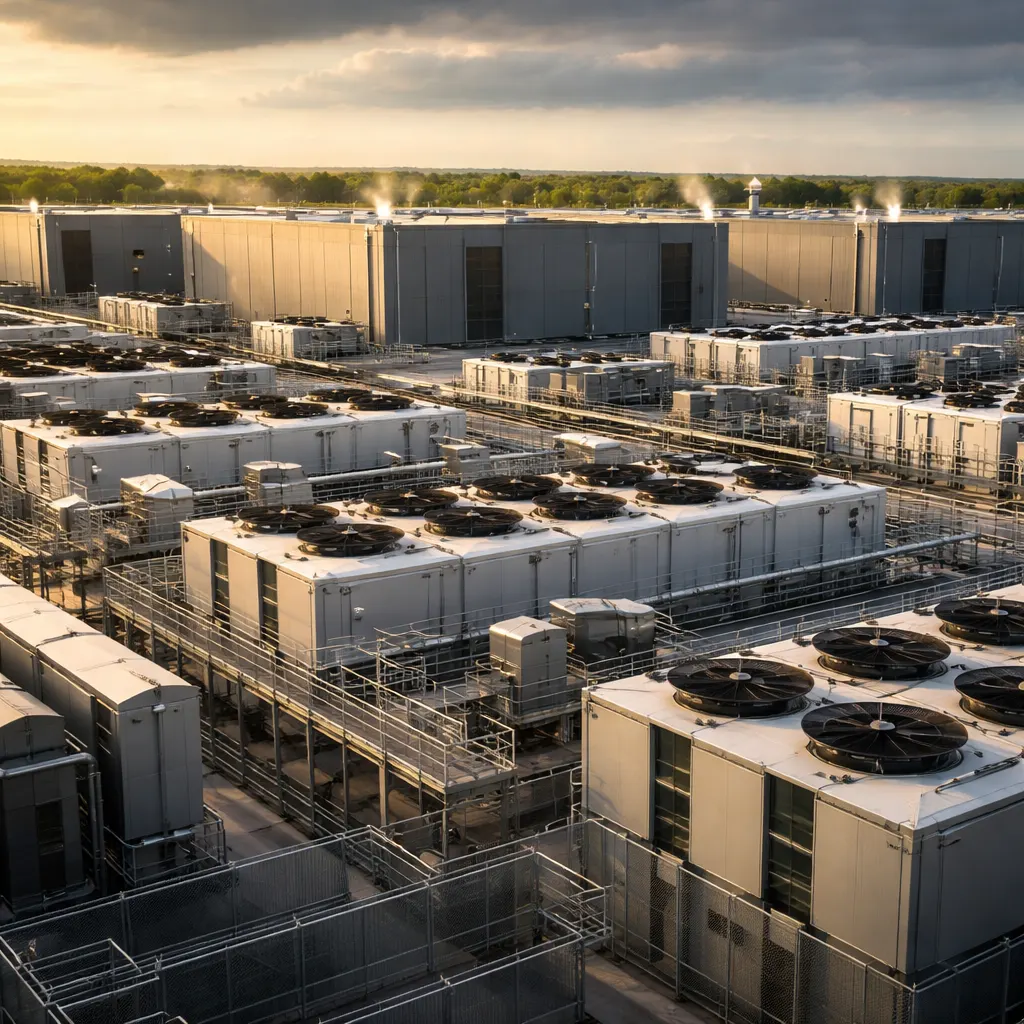
More than $170 billion in AI data center capacity has been blocked, withdrawn, or delayed by community opposition since January 2024, according to a September 2024 report from energy advisory firm Relae. That's roughly 29% of the $581 billion Goldman Sachs expects major tech companies to spend on AI infrastructure in the U.S. this year. The losses come as utilities and state regulators increasingly crack down on speculative data center proposals, with some jurisdictions implementing moratoriums on new facilities altogether.
Goldman Sachs projected in May that U.S. data center power demand will more than double from 2025 levels to hit 66 GW in 2027. Only about half of data center capacity scheduled for the next one to two years is expected to go live on time due to delays and cancellations, the investment bank said. The Electric Power Research Institute estimated in February that data centers will account for 9% to 17% of U.S. electricity demand in 2030 and as much as 20% by 2035. Texas has paused new data center interconnections while it audits a 474-GW queue—more than five times the state's recent peak demand record of just over 90 GW set this summer.
Texas Public Utility Commission Chairman Thomas Gleeson told the Energy Capital podcast in June that "the projections are extremely high, and what we know is that a lot of that load will not actually come here." Pablo Vegas, president and CEO of the Electric Reliability Council of Texas, said in an April statement that he considers the forecast "higher than expected future load growth," citing uncertainty around methods for identifying and verifying large load demand in long-range planning. Grid Strategies, a power sector consulting firm, found in November that the combined data center load forecasts utilities submitted to federal regulators came in about 40% higher than credible industry projections for data center development through 2030.
Community pushback has emerged as a major obstacle to data center expansion, the report notes, driven partly by the facilities' massive energy requirements. Other challenges include construction labor shortages, long lead times for essential electrical equipment, limited power availability in key markets, and uncertainty around consumer demand for artificial intelligence tools. Many utilities have responded by adopting large-load tariffs that require minimum contract durations, upfront payments for impact studies, exit fees, and specific ramp schedules to filter out speculative requests. Some states have introduced incentives for developers who bring their own generation capacity or agree to flexible energy use. Consumer advocates have raised concerns that vertically integrated utilities' return on equity creates incentives to build infrastructure rather than scrutinize potential loads. Karl Rábago, a former Texas Public Utility Commission member, said utilities are "promising big earnings per share growth to shareholders, and the transmission and generation to serve data centers is the only way to get that."
Texas has adopted "gating" conditions requiring large-load customers to prove site control, substantially cover grid upgrades, disclose duplicate interconnection requests, and accept curtailment during shortages. The state expects to complete its data center queue audit by December, though Bloomberg NEF estimated the interconnection pause could delay 20% of the total U.S. data center pipeline. Some investor-owned utilities are now targeting smaller data centers under 50 MW that can connect to the grid more easily and draw less community opposition. Advait Arun, senior associate for capital markets at the Center for Public Enterprise, said hyperscaler funding is "barrelling through a lot of problems" in the industry, but warned that "ratepayers will feel the bite" of necessary grid expansion.