
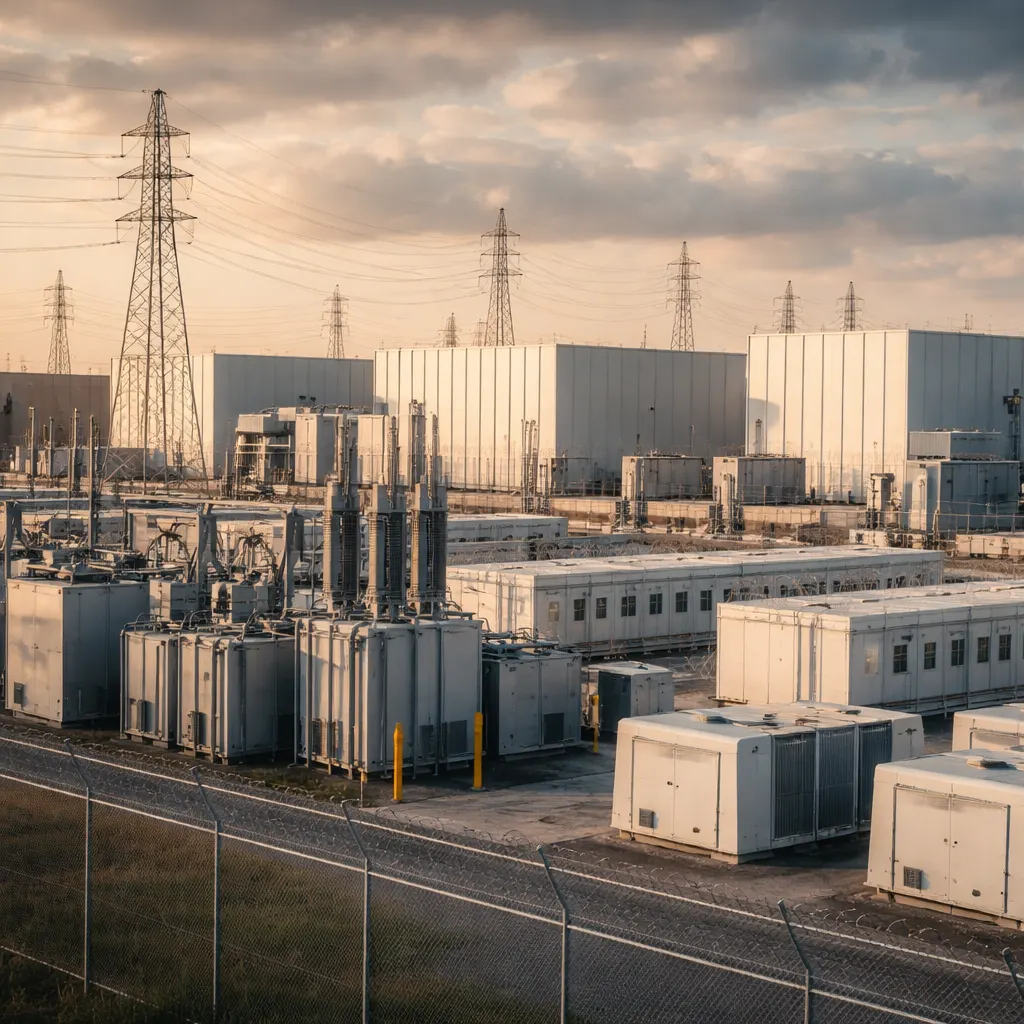
On August 3, 2026, Governor Greg Abbott ordered a mandatory audit of every data center project seeking connection to the Texas grid, effectively freezing a queue that had reached 474.7 gigawatts — more than five times the state's all-time peak demand. The directive, issued to the Public Utility Commission of Texas and the Electric Reliability Council of Texas, came after data center operators twice declined to answer voluntary surveys about their water and power consumption. A report published on Avanza Energy's Substack in September 2026 details how a state that built the nation's largest data center pipeline faster than any federally regulated market could reversed course just as quickly, using the same regulatory independence that enabled the boom to shut it down.
The numbers reveal a queue that doubled in six months and a filtering system that couldn't separate real projects from speculative ones. ERCOT tracked 474.7 GW of large-load interconnection requests as of June 2026, with data centers accounting for 420.8 GW — roughly 90.2% of the total — spread across more than 1,800 projects. That queue had stood at approximately 233 GW in January 2026. The state's own pre-pause analysis sorted applicants by maturity, finding that only about 65 GW — just 13.7% of the total — had actually cleared completed interconnection studies and earned firm grid access rights in the base-load tier. Around 205 GW qualified for Batch Zero, the state's triage system for prioritizing serious projects, despite ERCOT expecting only 100 GW to clear those screens. An independent assessment by Enverus Intelligence Research identified just 55 projects totaling roughly 21.7 GW as genuinely positioned to clear Batch Zero, with another 62 projects representing about 37 GW likely pushed to future batches.
The voluntary survey that preceded the audit drew responses from just 28 companies covering 92 of Texas's 582 operational and planned data centers — under 16%. Rep. Brad Buckley called the response rate "pretty pathetic," and PUCT staff admitted operators had no incentive to comply with a survey carrying no enforcement power. Texas reopened the survey in July at the direction of the House Committee on Natural Resources, but when that second attempt also failed, Abbott's letter drew the connection explicitly, stating that "the failure of some data centers to comply with the PUC's survey measuring water and power usage under the General Appropriations Act makes this necessary." NRG Energy's Bill Barnes captured the deeper failure in a single observation: "money did not have the culling effect that we thought it was going to." The state had set a $50,000-per-megawatt security deposit for Batch Zero eligibility — high enough in theory to weed out unserious applicants — but access to capital turned out not to be the same thing as a real project.
The report argues that ERCOT's independence from federal oversight is exactly what allowed both the rapid buildup and the instant freeze. While six FERC-regulated grid operators face years of contested dockets and comment periods to reform their interconnection rules, Texas needed six weeks and a governor's signature. Senate Bill 6, signed in June 2025, required every load above 75 MW to prove site control and post financial security before ERCOT would study the connection — a price-based filter designed to make speculation expensive. But when roughly 205 GW cleared those screens against a mature base-load tier of just 65 GW, the mechanism failed. The audit replaces a voluntary disclosure Texas asked for twice and couldn't get with a mandatory one tied directly to grid access: developers who don't comply won't connect. Abbott's letter includes no deadline for completing the audit or reopening the queue, making the freeze open-ended rather than date-certain. ERCOT's Independent Market Monitor had already warned the agency's load-growth projections represented "an upper bound" and that actual installations would come in considerably lower given AI business uncertainty, rising equipment costs, and local opposition — the funnel was never secret, but it took a governor's order to force the state to act on it.