
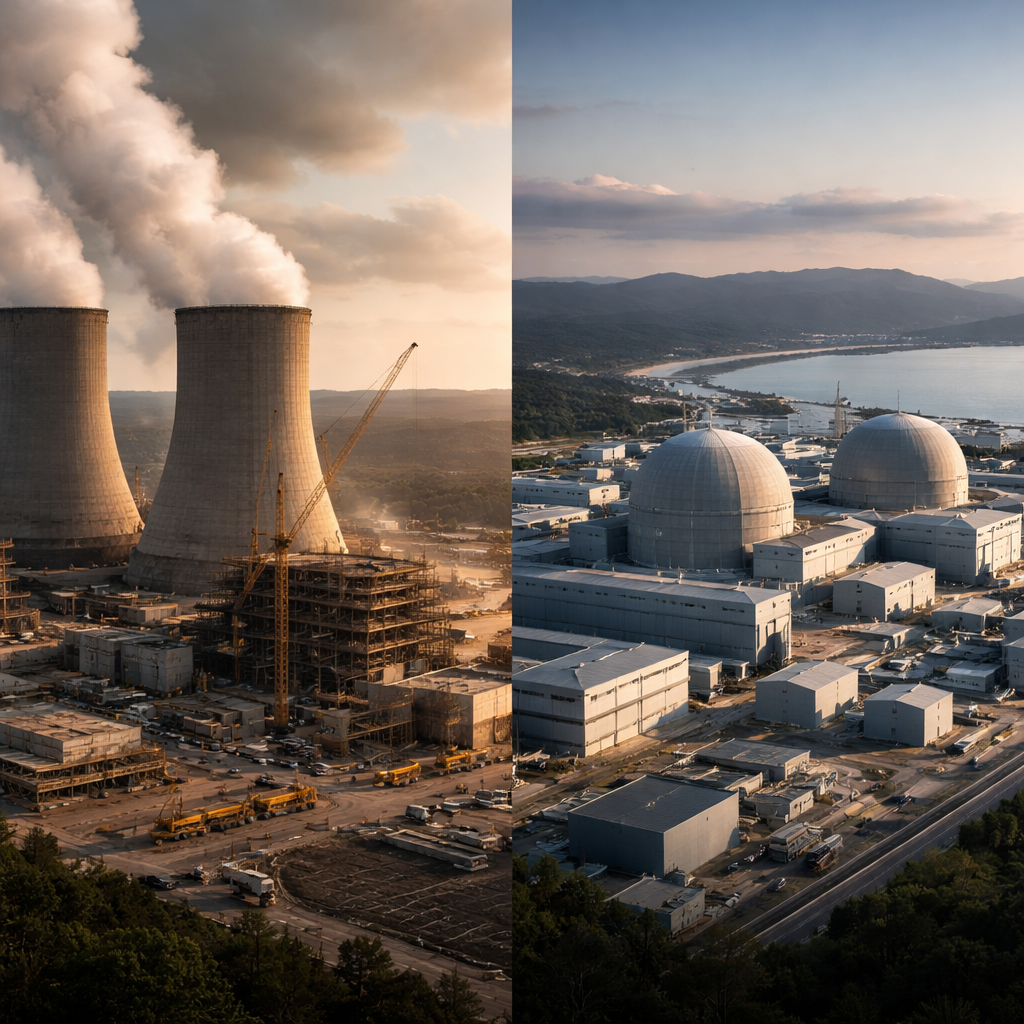
Nuclear power plant construction costs in the United States climbed from roughly $1,000 per kilowatt in the 1960s to nearly $11,000 per kilowatt for plants completed after the 1979 Three Mile Island accident—a dramatic escalation that wasn't inevitable or universal. A new analysis by Roger Pielke Jr. at the American Enterprise Institute, published June 15, 2026, argues that this cost explosion resulted from specific policy choices, not fundamental technological barriers. Some countries avoided the same fate entirely, and their experiences offer a roadmap for reviving America's nuclear industry.
The data tells two very different stories. U.S. nuclear plants completed in the 1960s took 40 to 60 months to build, but by the late 1970s the same reactor types routinely required 150 to 200 months, with several exceeding 250 months. Reactors under construction during the Three Mile Island accident and completed afterward had median overnight costs 2.8 times higher and median durations 2.2 times longer than pre-TMI plants. Meanwhile, France built its 900 MWe pressurized water reactor series with remarkable consistency—typically 65 to 90 months—at costs rising only modestly within the series. South Korea saw costs fall roughly 50% from its first commercial reactor in 1972 (approximately $3,500/kW) to a low of $1,690/kW by 1997, with even its most recent larger units costing only $1,762 to $2,061/kW. China's trajectory moved in the opposite direction from America's: its earliest reactor, Daya Bay in 1987, cost around $5,180/kW using imported French technology, while its most recent Hualong One units run approximately $1,300/kW. U.S. nuclear generation has plateaued for two decades at 769 to 809 terawatt-hours, while China's grew nearly 800% over the same period from a very low base, reaching 488 TWh by 2025—62% of U.S. output.
The report identifies mid-construction regulatory change as "the single best-documented driver of U.S. nuclear cost escalation." The number of regulatory guides governing acceptable design and construction practices grew from 21 in 1971 to 143 in 1978, with these changes often applying to plants already under construction, sometimes requiring completed work to be torn out and redone. According to the analysis, 72% of U.S. nuclear cost escalation between 1976 and 1987 came from rising indirect costs—engineering, supervision, and the regulatory reviews needed to meet evolving requirements—linked to a continuous decline in labor productivity driven partly by mid-construction design changes mandated by the Nuclear Regulatory Commission. The Vogtle 3 and 4 plants in Georgia, the only U.S. nuclear plants completed this century, cost approximately $35 billion total for 2,228 megawatts, but the report notes that "Unit 4 ran more efficiently and cost less to build than Unit 3—learning-by-doing within a two-unit program."
Why did some countries keep costs stable or even reduce them while America's skyrocketed? Pielke's analysis points to design standardization as a critical factor: South Korea's Korean Standard Nuclear Plant program froze a single design in 1984 and built it serially, while the U.S. fleet involved multiple competing vendors producing dozens of distinct designs, with each plant amounting to a first-of-a-kind project that prevented learning curves from taking hold. China's cost decline came from systematically substituting domestic components for expensive imports—Chinese-manufactured nuclear-grade components cost approximately 50% less than imported equivalents. The report finds that all cost-controlling programs shared one enabling condition: centralized decision-making authority through state-owned utilities like Électricité de France and Korea Hydro & Nuclear Power, which generated cross-project learning automatically. In contrast, the U.S. maintained a fragmented market with multiple vendors, multiple buyers, and an adversarial licensing environment. The recent Vogtle experience revealed what happens after a 30-year construction hiatus: rework on components with 40 to 80% test failure rates, late module deliveries, inadequate front-end engineering, and workforce inexperience.
The report outlines three policy lessons for reviving U.S. nuclear construction: standardize before scaling, with a committed orderbook of five to ten identical-design reactors as the minimum threshold to catalyze supply chain investment; impose regulatory stability during construction by requiring a finding of substantial hazard before mid-construction design changes can be imposed; and treat nuclear policy as industrial policy, rebuilding domestic manufacturing capacity for reactor pressure vessel forging, large casting, and instrumentation-and-control components. The bottom line is clear: America's nuclear cost escalation wasn't destiny—it was the result of specific regulatory and industrial choices that can be reversed.