
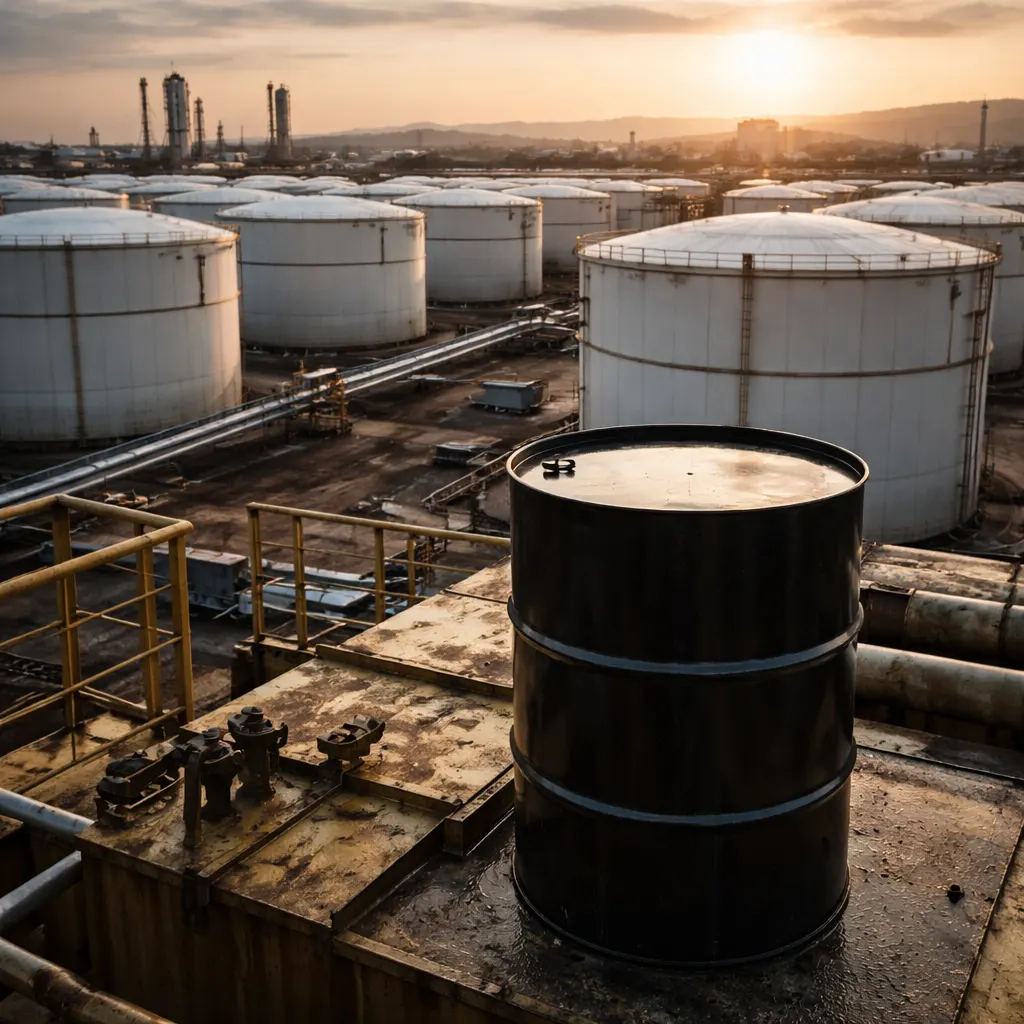
The U.S. Strategic Petroleum Reserve has dropped to 286.6 million barrels, just above the level where petroleum engineers consider the system's infrastructure in a "dangerous zone" for reliable emergency withdrawals. The reserve, which held between 540 and 727 million barrels for most of 1996 through 2021, has been drained by mandated budget sales since 2017, the 2022 emergency release, and a 2026 war-related drawdown that cut through a partial refill. The sharp decline leaves the country with far less cushion to absorb future supply shocks.
The reserve peaked at 726.6 million barrels in late 2009, then fell to 372 million by the end of 2022 and bottomed near 355 million in 2023. A partial refill brought year-end 2025 stocks to 413 million barrels, but the 2026 release erased that progress. Authorized capacity for the reserve stands at 714 million barrels. Meanwhile, Cushing, Oklahoma—the pricing hub for West Texas Intermediate crude and the nation's largest commercial tank farm—sits at 22.5 million barrels, only a sliver above the 20-million-barrel operational stress zone. When Cushing briefly dipped under 20 million earlier this summer, WTI at Cushing traded above Brent, a classic signal that available oil had nearly vanished.
Texas A&M petroleum engineering professor Siddharth Misra told Reuters that "the core mission of the reserve is to supply the market rapidly during a crisis," but operating below 250 million barrels pushes the infrastructure into a dangerous zone. The report notes that petroleum engineers and most market analysts treat 250 to 300 million barrels as the practical minimum for reliable high-rate draws, with higher water columns, lower reservoir pressure, and slower effective extraction becoming problems as inventories decline. Federal statute bars limited drawdowns from taking the SPR below 252 million barrels, though full presidential emergency releases don't carry the same numeric floor. Department of Energy cavern-mechanics studies suggest a conservative system-wide floor near 70 million barrels, below which the reserve becomes more a geological feature than a usable stockpile.
The thinning buffer has already shaped how markets respond to Middle East tensions. After the Strait of Hormuz conflict erupted in late February 2026, Brent crude spiked above $126, but talk of partial reopenings in June prompted a wave of forecast cuts—Reuters' June 30 poll slashed the 2026 Brent average to $84.50 from $90.44 the month before, while Goldman Sachs projected 2027 Brent around $75 and Citi went more aggressive with Q3 and Q4 2026 forecasts at $75 and $70. Those cuts assumed inventories could do the work one more time: OECD countries coordinated a 400-million-barrel release, with the U.S. contributing 172 million from the SPR, and China drew its own stocks down from over 1 billion barrels. The report warns that once inventories are effectively exhausted, demand destruction becomes the only remaining adjustment mechanism. The latest flare-up in early September 2026 pushed Brent back into the mid-$90s, still below the April peak but far from a market that has "looked past" the chokepoint.
The next 39 million barrels of planned SPR oil would drive the reserve through the industry operating floor, after which policy flexibility is mostly gone. President Trump has floated Venezuelan crude as a refill source, but the report highlights two obstacles: SPR caverns and draw systems were designed for lighter, sweeter grades than Venezuela's extra-heavy barrels, and Kevin Book of ClearView Energy Partners notes a sell-heavy, buy-light swap "would take years." The SPR that contained the first months of this war is not the SPR that will be available for the next shock, the report concludes—if Hormuz flows normalize and U.S. production stays high, analysts' $70 to $80 2027 forecasts may hold, but if another disruption hits while the SPR sits near 240 to 290 million and Cushing is on tank bottoms, the upside scenarios of $100 to $130 become the base case again.