
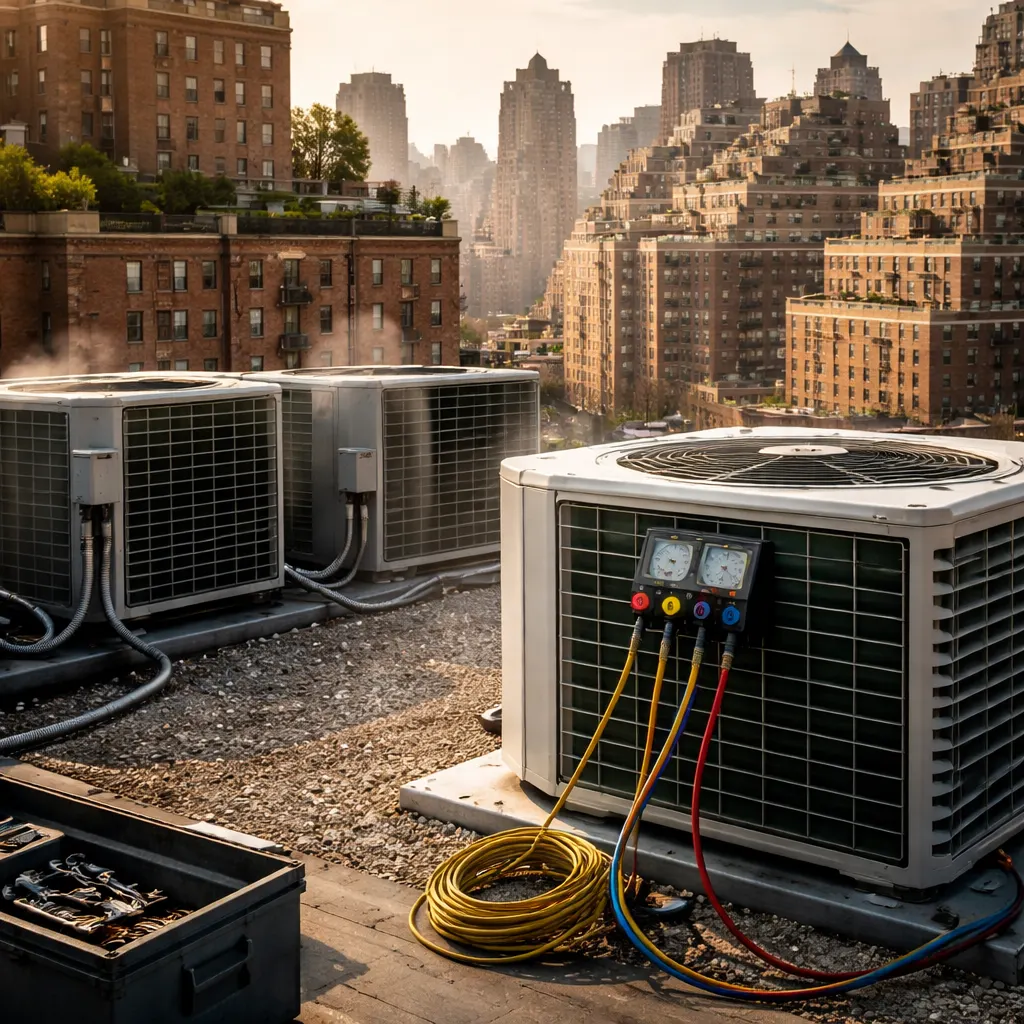
Heating and air conditioning systems that cost $10,000 per apartment a decade ago now run $25,000 to $30,000, a cost surge that's squeezing affordable housing production across New York State. The New York Fed and NYU's Furman Center released findings in August 2026 from roundtables with builders, developers, and housing experts examining why construction expenses keep climbing and what changes could bring them down. The discussions revealed that rising material costs, labor shortages, insurance burdens, and regulatory complexity are all pushing affordable housing further out of reach.
The data paints a picture of costs spiraling across multiple fronts. Insurance alone consumes 12 cents of every development dollar in New York—three to four times higher than New Jersey's 3 to 4 cents per dollar—driven primarily by the state's scaffold law that holds owners and contractors entirely liable for gravity-related accidents regardless of who's at fault. Public works projects in New York City now require prevailing wages of $42.39 per hour plus $49.01 in benefits, according to the report, while the private construction minimum wage hit $17 an hour in January 2026 for the city, Westchester, and Long Island, though actual minimum wages typically reach $20. Professional fees from architects and attorneys have tripled as projects stretch longer and grow more complicated. Meanwhile, mechanical, electrical, and plumbing systems represent the steepest cost increases overall, with modern construction standards, all-electric requirements, stormwater protection, and noise mitigation mandates all adding substantial expenses.
Participants identified several concrete opportunities to cut costs, including switching from copper to PVC pipes in New York City, replacing metal sprinkler pipes with plastic, and rethinking bulk storage requirements and full broadband mandates. Each change could shave off roughly 5%, with combined savings potentially reaching 30% in some cases, the report notes. Modular construction holds significant promise, with one developer who recently finished several modular projects expecting to cut six months off the timeline for the next one, though roundtable participants stressed the industry hasn't yet achieved the scale needed to perfect the process. Builders also highlighted growing labor market strain, particularly upstate where the gap between prevailing and non-union wages has narrowed as data centers and the massive Micron semiconductor site in Syracuse pull electricians and other skilled trades away from housing projects.
The report emphasizes that systemic reforms could unlock greater efficiency and competition. Developers stressed that spending more time in predevelopment—through strategic design like positioning bathrooms and kitchens back-to-back—delivers significant savings, while design-build models that bring architects and builders together early show superior cost control. Experts also called for reforming expensive zoning requirements, studying international best practices, expanding the pipeline of certified Minority and Women Business Enterprises through incentives, and adopting AI tools to streamline government approvals, according to the report. Without these combined efforts, rising costs will continue forcing smaller contractors out of the market and limiting the growth of minority- and women-owned firms, even as demand for affordable housing climbs.