
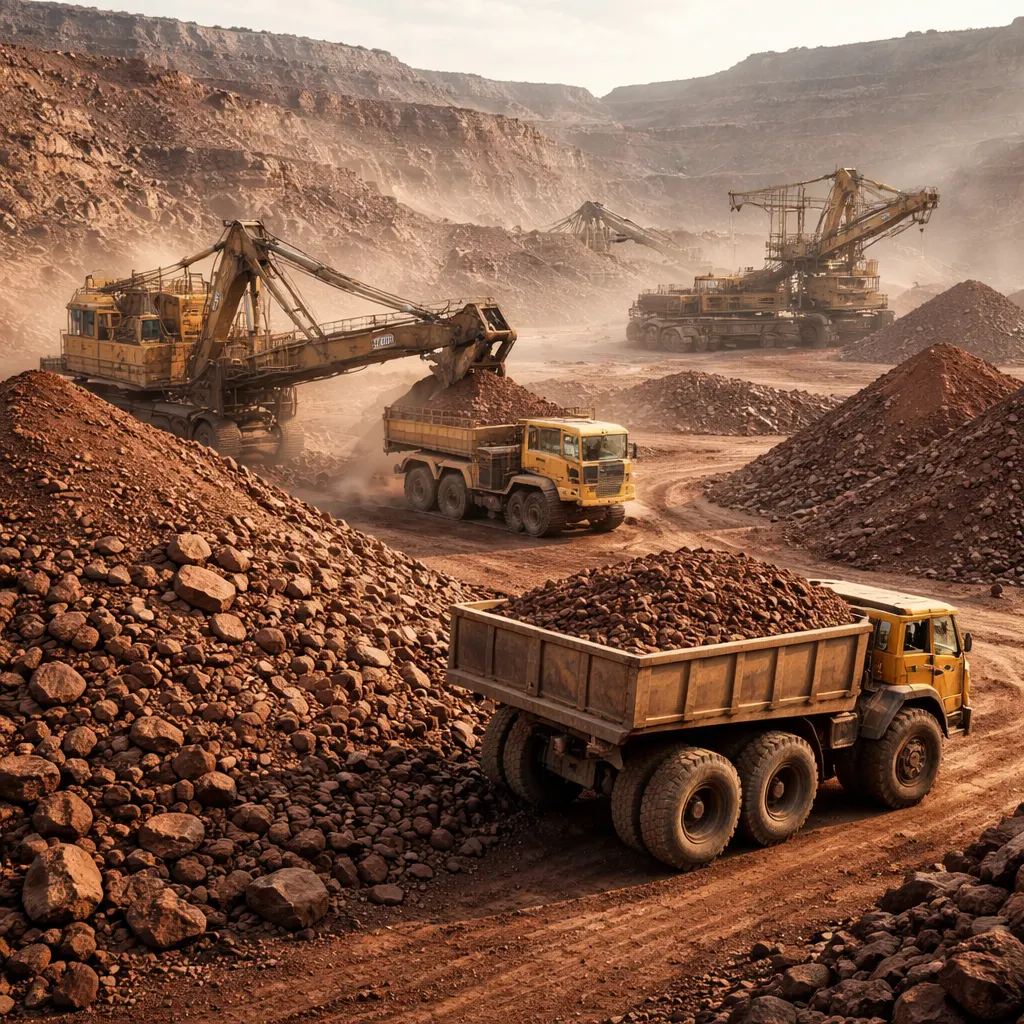
The world's largest iron ore producers have consumed 11.1 billion tonnes of marketable reserves over the past decade while replacing only three-quarters of what they extracted, according to a Wood Mackenzie report published in September 2026. Only half of the six major producers examined managed to fully replenish the reserves they mined between fiscal 2016 and fiscal 2025. The analysis reveals that the industry is depleting its resource base faster than it can find new ore, even as the expense and difficulty of replacing those reserves climbs.
Net reserve replacement ratios among the six producers ranged from 28% to 159% over the decade, driven by differences in how companies converted resources to reserves, allocated capital, and handled operational setbacks. C1 cash costs have roughly doubled for some producers since fiscal 2016, primarily because maturing ore bodies require moving more waste rock to reach the same volume of ore. Cash margins across the industry peaked in fiscal 2021 but converged to approximately $50 to $60 per tonne by fiscal 2025, narrowing the cushion companies have to absorb further cost increases or prolonged price weakness. Reserve grades have fallen by as much as 1.6 percentage points at some operations since 2016, while alumina levels in some product streams are climbing. The capital intensity of adding new reserves varied fivefold across the group, with growth capital expenditure per tonne of reserves added ranging from roughly $2 to $10 between 2016 and 2025.
"Many producers still have long reserve lives, with those carrying 15 or more years retaining a meaningful buffer," said Mihir Vora, director of research for metals and mining at Wood Mackenzie. "But the direction of travel is clear: as mine lives shorten, the margin for error narrows, and each successive tonne becomes more challenging and costly to replace." The report finds that while several producers have successfully replenished depleted tonnes, the quality of replacement resources isn't always equivalent, with some operations experiencing grade deterioration and rising impurity levels. Some producers have shifted from earning a modest premium over the 62% iron benchmark to trading at a persistent discount over the past five years, driven by falling product iron content and increasing impurities.
The report explains that as ore bodies age, producers face a structural shift in what it takes to maintain output. Higher-grade material is increasingly needed to compensate for the exhaustion of lower-grade deposits, but alumina creates specific penalties in blast furnace operations regardless of overall iron content. This means producers whose product quality is drifting toward higher impurity face a structural pricing disadvantage that compounds their rising production costs. The premium segment of the market remains concentrated among a small number of producers, and new entrants seeking to compete there face high barriers since achieving consistent benchmark quality requires operational maturity that takes time to build.
Several major producers have committed billions of dollars to brownfield expansions and sustaining projects over the coming decade, designed to replace depleting ore bodies and maintain production on a broadly similar volume basis. However, the report characterises this investment as largely sustaining in nature, intended to hold existing production levels steady as legacy ore bodies run down rather than deliver a step change in available supply. The iron ore industry is entering a period where the effort, capital, and technical complexity required to hold output flat is materially greater than a decade ago. "The main challenge for the current iron ore industry is rising costs to maintain existing production," Vora said, adding that as producers work through existing reserves, replacement is becoming more capital-intensive and in some cases the quality of what's being added is declining.