
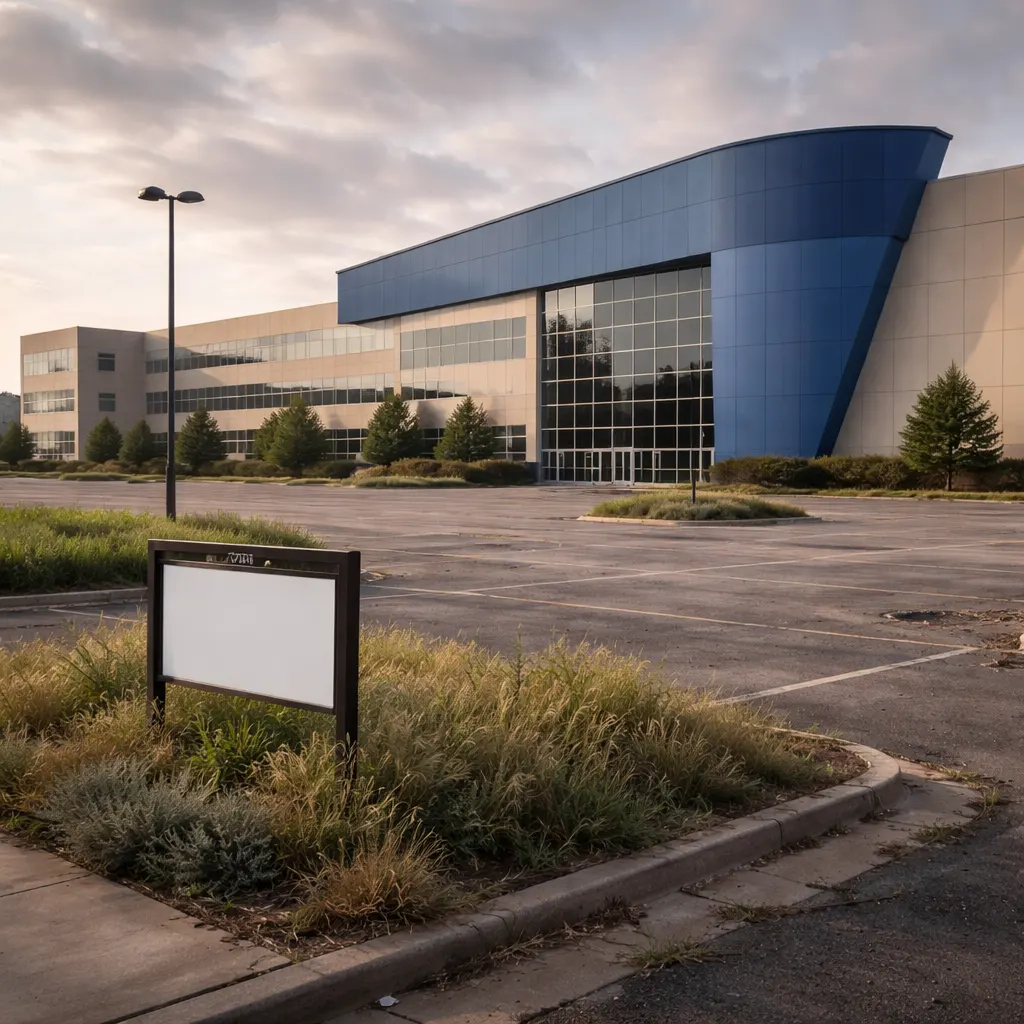
The Hennepin County-assessed value of Best Buy's corporate headquarters in Richfield, Minnesota, has fallen from roughly $63 million to $32 million in one year—a 49% drop that will increase the tax burden on other property owners in the city. The sharp decline comes two decades after the city used eminent domain to condemn three automobile dealerships to make way for the electronics retailer's $118 million corporate campus, a case that became one of Minnesota's most notorious examples of private property seizure for private development. American Experiment revisited the controversy in a report published this week, tracing the long arc from the city's initial promises of economic transformation to today's fiscal reality.
The campus was completed in 2003 as a 1.6-million-square-foot complex housing 4,500 employees at the time. Annual property tax revenues from the site rose from $700,000 to $3.2 million, but under a Tax Increment Financing (TIF) agreement, Best Buy retained the difference for 25 years. The new assessed value represents a 5% drop in Richfield's commercial tax base for taxes due in 2027. Meanwhile, one Richfield homeowner who's lived in the city for 17 years told KSTP he's never seen his property taxes go down or even stay flat—"it only goes up, and they keep on assessing our house for more, and taxes go up more."
The original seizure in 2000 pushed constitutional boundaries that had previously limited eminent domain to traditional public infrastructure. For most of the 19th and early 20th centuries, governments permitted eminent domain only for true public uses like roads, bridges, parks, and public buildings, the report notes. Courts later allowed narrow exceptions for tightly regulated utilities and railroads that provided equal public access. But over the past two decades, Minnesota courts interpreted "public use" broadly enough to include private redevelopment. When Walser Auto Sales challenged the condemnation in court, the state Supreme Court ultimately ruled that taking the dealerships was "necessary and convenient in furtherance of a redevelopment project".
The justification rested on a straightforward tax-revenue calculation: governments could seize property from owners who generated less tax revenue and transfer it to those who promised more. Richfield's community development director at the time acknowledged it was hard to quantify Best Buy's financial benefit, especially since employees were encouraged to spend within the self-contained campus featuring its own health club, pharmacy, bank, billiard tables, dry cleaner, daycare, and cafeteria. But he argued the headquarters proved its worth by changing the town's image—"Best Buy is not going to be in a town that's perceived as a loser." The case contributed to a nationwide backlash following the Supreme Court's 2005 Kelo decision, which allowed New London, Connecticut, to condemn residential properties for private economic development. In 2006, Minnesota law changed to curb cities' eminent domain powers.
Now the promised economic transformation has reversed course. The city warned Monday that as Best Buy's assessed value drops, "other property types will increase to make up the difference." The residential homeowners who watched their neighborhoods reshaped for a Fortune 100 company will now shoulder a larger share of the city's tax needs. The report's bottom line is blunt: Richfield's goose has stopped laying golden eggs.