
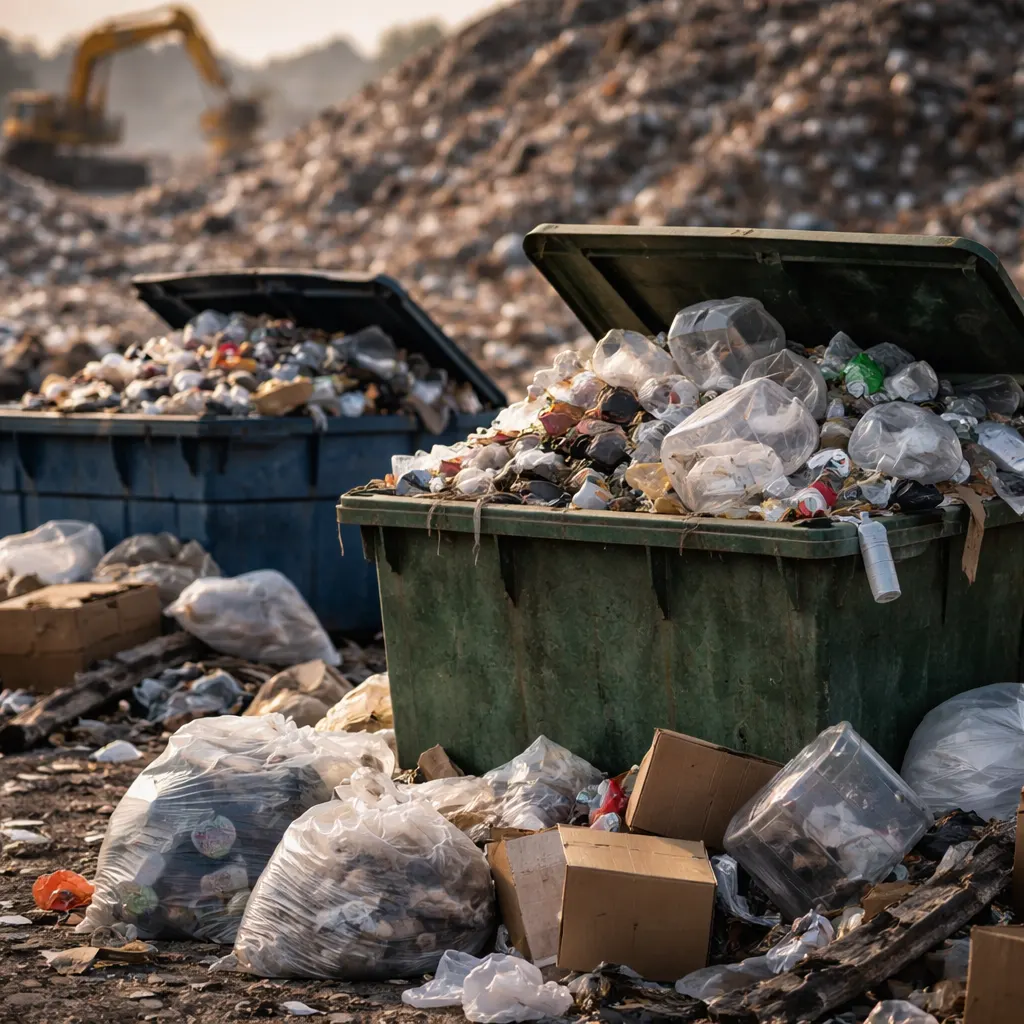
Around 88 percent of materials in the European Union are discarded rather than reused or recycled, creating enormous volumes of waste that's costly to dispose of and squanders valuable resources that could return to the economy, according to a new policy brief from the Brussels-based think tank Bruegel. The report finds that tax systems across Europe systematically favor linear "take-make-waste" practices because the environmental damage from extracting virgin materials remains largely unpriced. The brief examines how fiscal instruments could redirect producer and consumer behavior toward more efficient resource use as the European Commission prepares its Circular Economy Act for later in 2026.
The number of circular economy fiscal instruments deployed by EU countries has grown from fewer than 30 in 1990 to more than 300 by 2025, the report shows. Taxes and fees account for roughly two-thirds of all such instruments, with deposit-refund schemes and environmentally beneficial subsidies added more recently. However, circular economy-tagged taxes represent only 11 percent to 20 percent of total environment-related tax revenue, substantially exceeding the shares from solid waste taxation (4 percent to 7 percent) and minerals taxation (0.2 percent to 0.3 percent). Landfill waste sent to disposal sites declined by about 21 percent between 2010 and 2022 across the EU, coinciding with progressively higher landfill taxes and broader waste policy reforms. Meanwhile, motor vehicle taxes account for more than two-thirds of revenues classified under the circular economy category in OECD data.
The research finds that upstream price signals applied so far are too weak to change behavior and must be combined with downstream measures. Ireland's 2002 levy of €0.15 per plastic shopping bag cut consumption by over 90 percent within a year, dropping from roughly 328 bags per capita to 21, according to the brief. In England, single-use bag sales at major retailers fell by more than 98 percent after the 2015 charge, to about two bags per person annually. A €29-per-tonne landfill tax increase in Catalonia reduced landfill disposal by 12 percent and increased recycling rates by six percentage points. European deposit-refund systems with full coverage routinely exceed 85 percent collection for targeted packaging. However, reduced VAT rates for repair services show only partial and highly variable price pass-through, ranging from 25 to 77 percent of the reduction, with modest behavioral responses.
The report identifies several reasons why fiscal instruments haven't driven stronger circular outcomes. High labor taxation creates a structural bias favoring the linear economy by raising the relative cost of extending product lifetimes, since circular activities like repair and reuse are substantially more labor-intensive than virgin material extraction. EU environmental subsidies reached €45 billion in 2023, up 39 percent from 2022, but remain dominated by energy and renewables rather than circular economy measures. Fossil fuel subsidies continue to reduce the cost of carbon in many European countries, making virgin materials relatively cheaper than secondary materials and directly contradicting the goals of circular economy instruments. The EU's plastic packaging levy, operational since January 2021 at €0.80 per kilogram of unrecycled plastic waste, functions as a budget contribution paid by member states rather than a direct producer tax, meaning its environmental impact depends entirely on complementary national measures. Extended producer responsibility fees can change behavior similarly to taxes, but in countries like Hungary and Croatia where fees are collected as state taxes and spent primarily on conventional disposal rather than circularity, recycling rates remain below European averages.
The brief recommends that the forthcoming Circular Economy Act require extended producer responsibility revenues be used only for circularity, closing the loophole that allows spending on activities like municipal street cleaning. It calls for extending the EU emissions trading system to incineration and landfilling, paired with minimum recycled-content requirements, to prevent a shift toward landfill as incineration becomes more expensive. The report urges EU countries to reduce the tax burden on labor, prioritizing relief for repair and reuse services, to correct the bias that currently makes replacement cheaper than repair. End-of-life instruments like landfill taxes and deposit-refund systems have delivered the strongest results, but their effectiveness depends on complementary policies including separate collection systems and adequate recycling alternatives to prevent illegal dumping.