
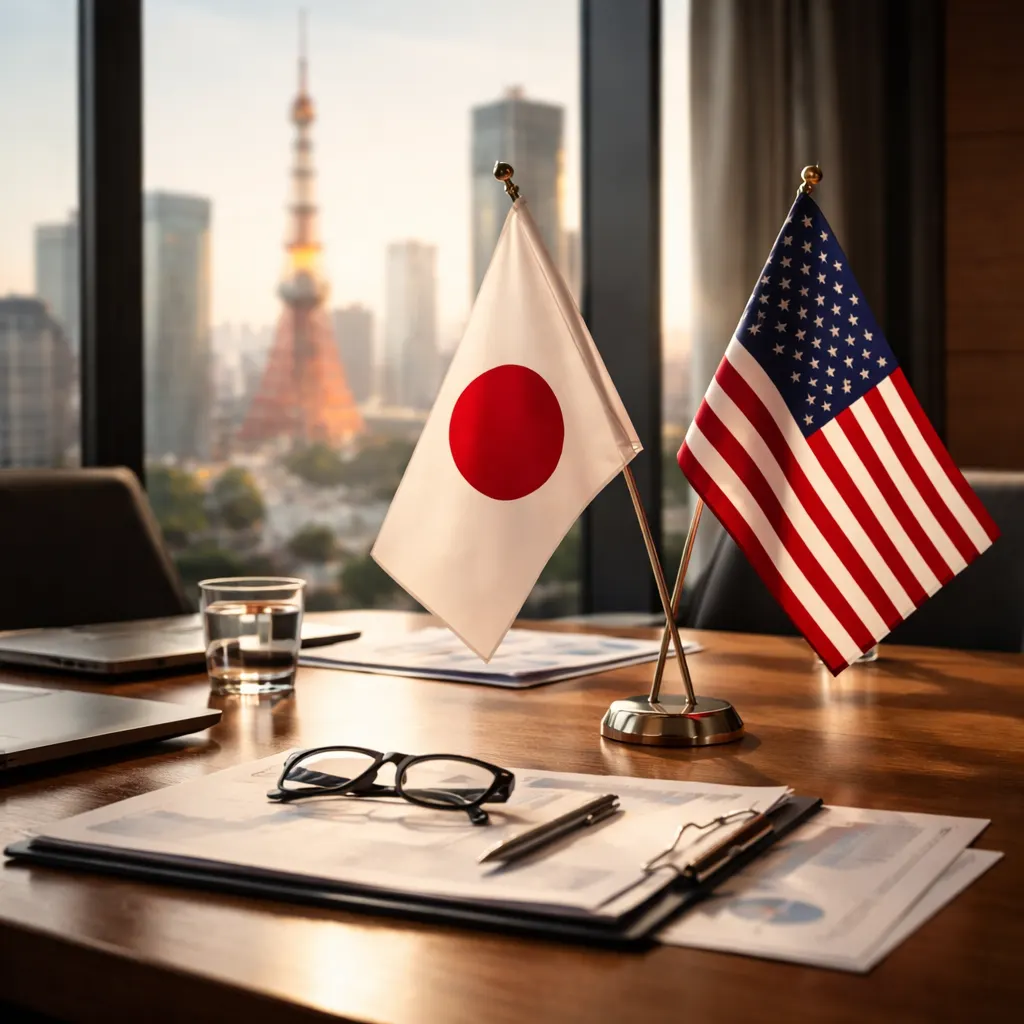
Japan's parliament passed legislation in May that significantly broadens the government's power to screen foreign investments for national security threats, including oversight of holding companies and indirect investors for the first time, according to a report published by the Hudson Institute. The amendment to Japan's Foreign Exchange and Foreign Trade Act represents Tokyo's effort to build an investment review system that resembles the Committee on Foreign Investment in the United States. The changes arrive as Beijing expands its control over outbound Chinese investments and extraterritorial activities, the report notes, creating new legal risks for companies operating across borders.
The updated law allows Japanese regulators to review foreign holding companies seeking to acquire more than 50 percent of voting rights in designated or core designated sectors, which now include cybersecurity, utilities, semiconductors, critical minerals, and dozens of other sensitive industries. Proxy investors and indirect investments—including Japanese entities investing on behalf of foreign parties—now fall under government scrutiny. Japan also created a cross-ministerial Foreign Investment Committee that held its first meeting on June 29 at the prime minister's office, mirroring the broader composition of CFIUS, which permanently includes nine federal departments and agencies. Separately, Tokyo established a National Intelligence Council and National Intelligence Bureau on May 27, positioning both within the prime minister's office to elevate intelligence sharing across agencies and assist with investment reviews.
The report highlights Japan's demographic pressures as a major driver behind the regulatory update. More than half of Japan's 3 million small and medium-sized enterprises are now owned by someone over age 60, with the average owner staying in business until age 71.5—up from a decade ago. Annual closures of these businesses have climbed 13 percent compared to ten years earlier, and the report warns Japan risks losing a significant number of companies unless it finds solutions, including foreign mergers and acquisitions. Meanwhile, Japan's inward foreign direct investment remains among the lowest among major economies relative to GDP. The government has set a target to increase its inward FDI position to JPY 150 trillion by the end of 2030, more than doubling the JPY 58.5 trillion it held in 2025.
The amendments respond to China's growing legal reach over private investors, the report explains. New regulations announced by Beijing elevate oversight of outbound investments to the State Council, which can now punish entities in China that comply with foreign laws—such as Japanese and American investment screening—if the council deems those laws a threat to China's sovereignty, security, or development interests. Penalties include visa restrictions, property seizures, commerce prohibitions, and fines. This creates a bind for Chinese investors hoping to invest in Japan or the U.S., especially if mitigation agreements required by Tokyo or Washington clash with Beijing's political priorities. The report also points to uncertainty around a new U.S.-China board of investment agreed to in May, led by Treasury Secretary Scott Bessent and Vice Premier He Lifeng, noting that while no evidence suggests the board will influence CFIUS, it signals Chinese investment is welcomed and Tokyo will likely want clarity on what standards Washington sets.
The report recommends the U.S. designate Japan as an "excepted foreign state" under CFIUS, a status currently reserved for Australia, Canada, New Zealand, and the United Kingdom, to expedite reviews of Japanese investments—the largest source of foreign direct investment in America. It also calls for Japan to establish prioritization for American investments under its review process, given the U.S. is Tokyo's only treaty ally. Both countries should pursue a workforce exchange between investment screening teams to share best practices and adjust to local conditions, the authors argue. The bottom line: as hundreds of billions in cross-border investments flow between the two nations, maintaining a secure and open investment environment depends on tighter coordination and regulatory alignment in the face of China's expanding legal and economic influence.