
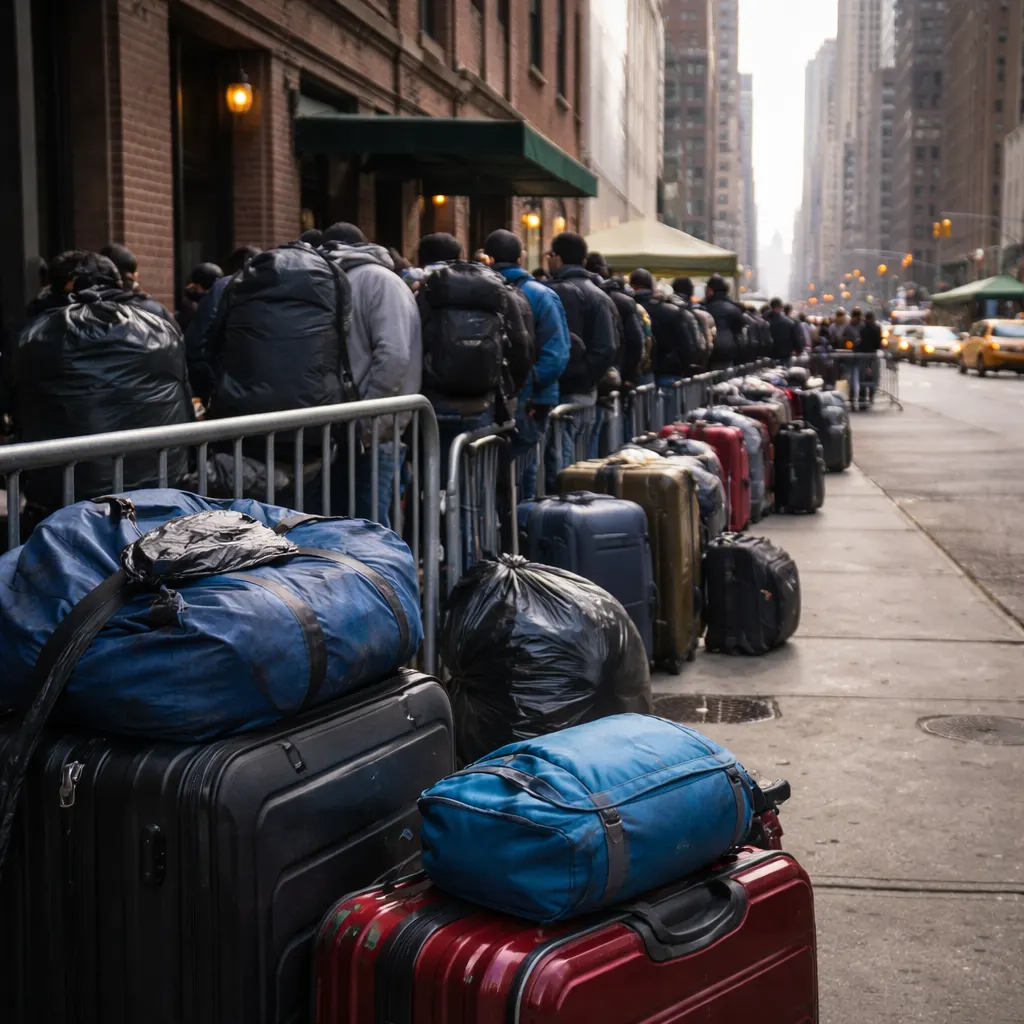
Nearly 250,000 migrants arrived in New York City between spring 2022 and the end of 2025, primarily from Central and South America, according to a new study published by the Manhattan Institute in 2025. The report argues that the city's uniquely expansive "right to shelter" policy—which guarantees on-demand housing year-round to families and single adults regardless of immigration status—functioned as a powerful magnet that drew migrants to New York in disproportionate numbers compared to other American cities. The analysis presents New York's migrant crisis as a case study demonstrating that generous public benefits can, in certain circumstances, shape migration flows.
The influx placed severe strain on the city's homeless services system, with shelter costs accounting for the vast majority of the $9 billion the city spent responding to the crisis. New York's homeless shelter census, which had been declining when Mayor Eric Adams took office in January 2022, reached historic highs in 2023 and 2024 due to migrant arrivals. At the crisis's peak, 4,000 individuals were arriving weekly. The city's Department of Homeless Services operated with a fiscal year 2026 budget of roughly $4 billion—equal to the federal government's main homelessness grant program—with per-year costs reaching $98,630 per family with children and $56,487 per single adult. Venezuela was the most common country of origin for migrants in city shelters in June 2024, representing 37.6% of the total, followed by Ecuador at 19.3% and Colombia at 9.4%.
Traditional explanations for migrant settlement patterns don't account for New York's disproportionate burden, the report states. The city isn't near the border, lacks affordable housing—with vacancy rates of just 0.39% for units renting below $1,100 as of 2023—and doesn't have a fast-growing economy, ranking 32nd out of 51 major metros in job growth over the decade preceding the crisis. While Republican governors' busing programs were initially blamed, Texas buses accounted for only about 45,000 arrivals, roughly 18% of the total, and participation in these programs was voluntary. The authors note that migrants themselves mentioned shelter availability, "sometimes even the guarantee of it," directly to reporters when discussing their reasons for choosing New York.
The welfare magnet effect became evident when the Adams administration imposed limits on shelter access for newly arrived migrants in January 2024—a 60-day cap for families and 30-day cap for single adults—and the shelter census immediately began dropping. The report emphasizes that New York's shelter policy offers not just guaranteed placement but notably high-quality accommodations, with the city often placing arrivals in hotel rooms, including at the 1,000-room Roosevelt Hotel in midtown Manhattan, which served as the central intake center for homeless families. This stands in stark contrast to typical American homeless shelters. Left-leaning immigration experts and media outlets, which traditionally resist welfare magnet arguments, largely accepted the administration's claim that the right to shelter created a "huge pull factor" explaining why migrants chose New York over other destinations.
The study concludes that while border policy remains primarily a federal concern, state and local benefit programs create pull effects that will shape where immigrants settle as American communities increasingly diverge in their immigration approaches. About 30,000 migrants remained in New York shelters as of spring 2026—a number larger than the entire homeless population of every U.S. community except Los Angeles. The report warns that generous local benefits may reinforce immigrant enclave formation, potentially hindering assimilation and creating increased competition for jobs and housing between migrants and native low-income residents. As blue cities expand benefits for migrants, they may inadvertently increase the burden on their own homelessness services systems.