
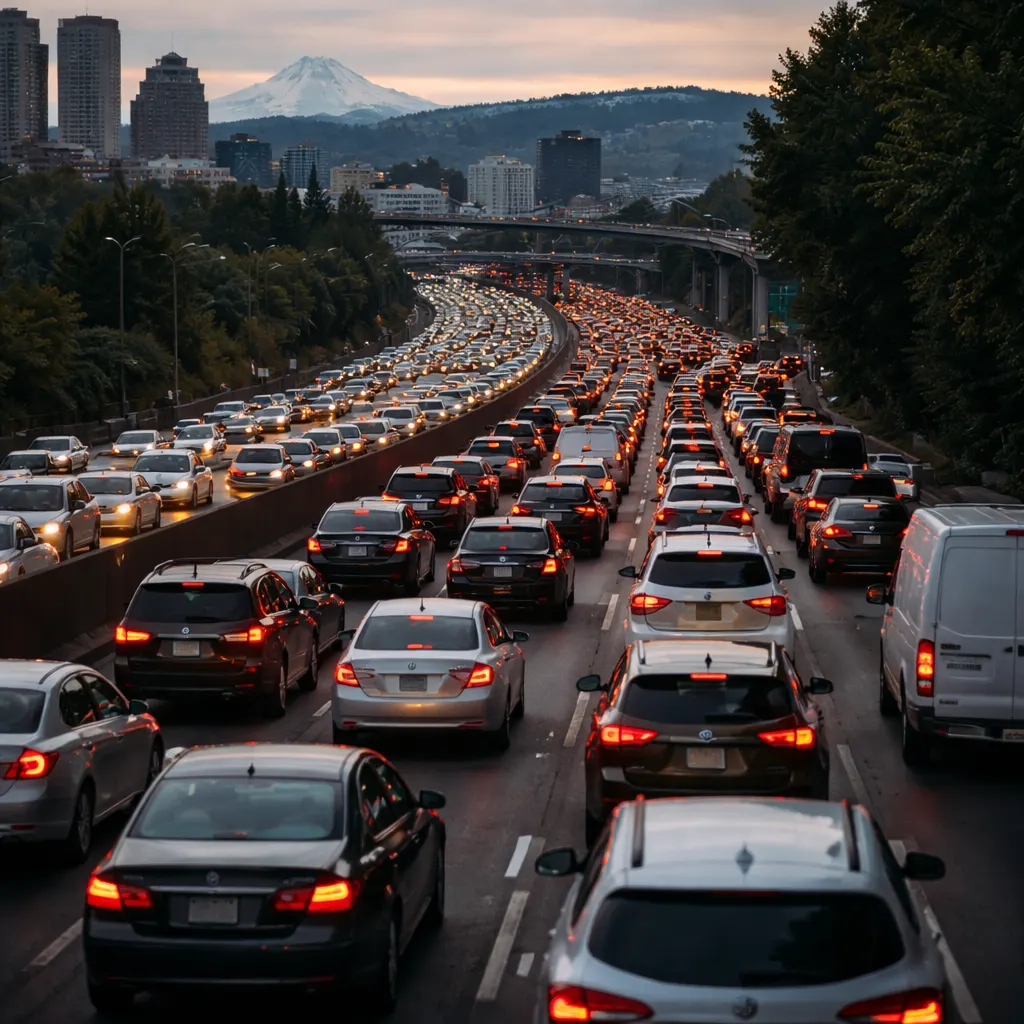
Portland's decades-long effort to reduce automobile use has backfired, with commuters now wasting triple the time stuck in traffic compared to 1982, according to a new report published this July by the Cascade Policy Institute. The study, titled "The Portland Transportation Disaster: The High Cost of Anti Auto Planning in Portland" and authored by adjunct scholar Randal O'Toole, concludes that the region's strategy to discourage driving through infrastructure limits has imposed massive costs without achieving its goals. Despite billions spent on transit alternatives, Portland and Metro are "losing their war on the automobile," the report states.
The data paint a picture of failure on multiple fronts. Since regional leaders decided in 1982 to stop building freeways after I-205's completion, fuel wasted in congestion has increased sixfold—from 5.7 million gallons to 34.7 million gallons—generating 250,000 tons of additional greenhouse gases annually. Driving has more than doubled during this period, and per capita driving has grown 16 percent. The region's share of commuters driving alone to work reached its highest level ever in 2024. Meanwhile, transit ridership per resident has fallen from 42 trips in 1982 to 36 in 2024, even after Portland built over 80 miles of rail transit including five light rail lines, three streetcar lines, and one commuter rail line. Bicycle commuting has collapsed since 2014, dropping more than 40 percent among Portland-area workers, while the annual number of bicycle fatalities in the city has nearly tripled since the early 2010s.
According to O'Toole, Portland is now converting traffic lanes on major arteries like Foster Road and 82nd Avenue into exclusive bus lanes, dedicating space that once carried up to 1,000 automobiles per hour to "at most—8 buses per hour." The report finds no evidence that this will boost bus ridership, but states it will make auto travel more difficult. The author notes that while the city has expanded its bike route system to over 400 miles, "most bicycle fatalities take place at intersections, where bike lanes disappear," not from rear-end collisions that protected lanes prevent. The region's planning has been "guided by the same delusion for half a century," the report states—that personal vehicles can be regulated or inconvenienced out of existence.
The report traces Portland's transportation problems to a fundamental misunderstanding of how people travel. The Portland Bureau of Transportation's 2035 plan explicitly aims to shift 70 percent of residents into "shared vehicles" and prioritize walking, bicycling, and transit over personal automobiles. But this vision ignores revealed preferences: commuters have chosen driving in overwhelming numbers even as officials deliberately manufactured congestion through lane reductions and road diets. The result, according to the report, is an overbuilt, financially unsustainable transit system and a planning model that has failed by every measurable metric. The added costs include not just wasted time and fuel, but increased expenses for transporting goods throughout the region.
By continuing to fight a war they can't win, Portland and Metro are imposing huge costs on residents without improving mobility, the report concludes. The study suggests that five decades of anti-automobile planning have produced the opposite of their intended effects: more driving, worse congestion, higher emissions, and declining use of the transit alternatives that billions of dollars were spent to build. Until planners acknowledge that personal vehicles remain essential to how people actually move through cities, the report implies, Portland's transportation disaster will only deepen.