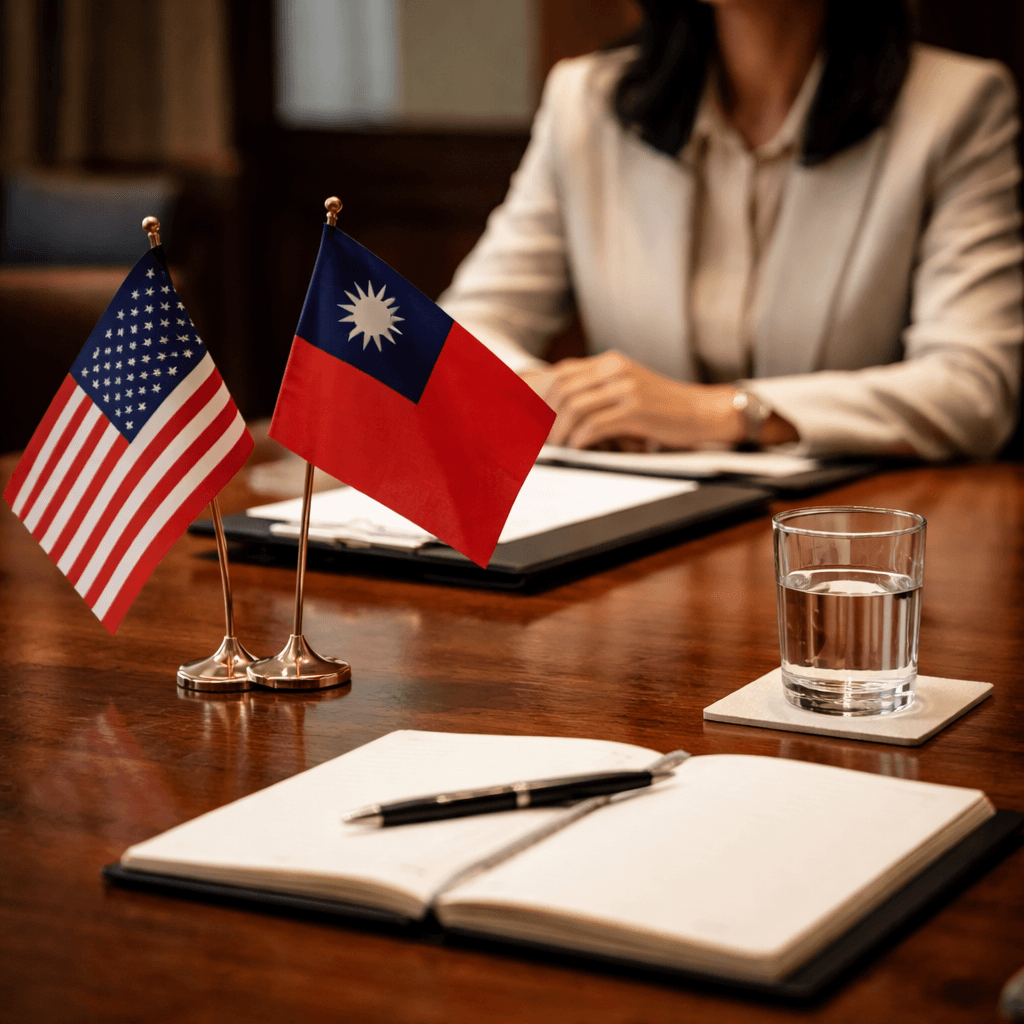
Taiwan's main opposition leader Cheng Li-wun made her first stop at the Hoover Institution on June 2 to launch a two-week tour of the United States. The Chairwoman of Taiwan's Kuomintang party (KMT) met with scholars and Stanford students to discuss Taiwan-China relations, regional security, and the role the US can play in promoting peace across the Indo-Pacific. The visit comes just weeks after Cheng made headlines for becoming the first KMT leader to meet with a Chinese leader in Beijing since 2016.
In April, Cheng met with Chinese President Xi Jinping in a meeting that carried extra weight because it happened just weeks before a summit between Xi and US President Donald Trump. Cheng became leader of Taiwan's main opposition party last fall. Her Hoover session drew participation from several fellows, including Larry Diamond and Adm. James O. Ellis Jr., who co-lead Hoover's Taiwan in the Indo-Pacific Region research initiative. Also present were Hoover fellows Kharis Templeman, Glenn Tiffert, David Fedor, Michael McFaul, and Eyck Freymann, along with retired Taiwan ambassadors Jason Yuan and Victor Chin.
According to the Hoover Institution report, participants discussed "her alternative approach to improving relations between Taiwan and the mainland" and "the role other states in Asia can play in ensuring regional security." The group also explored "the importance of avoiding great-power conflict in Asia" and "the need for continued cooperation across the nations of the Pacific to ensure shared prosperity for decades to come." The discussions included a call to reimagine the "first island chain" concept, envisioning it as more than just "a defense-oriented containment mechanism aimed at the People's Republic of China" and instead framing it "as a vehicle for those nations to pursue shared economic prosperity."
Cheng's decision to launch her US tour at Hoover reflects the strategic timing of her visit. By meeting with Xi weeks before the US-China summit, she positioned herself as a potential bridge between Washington and Beijing at a moment of heightened tension. Her push to reframe the first island chain from a military barrier into an economic partnership signals a shift in opposition thinking about Taiwan's role in the region. Rather than viewing cross-strait relations purely through a security lens, the KMT leader appears focused on economic integration and regional cooperation as paths to stability. The conversation at Hoover suggests that Taiwan's opposition sees its future not in choosing sides, but in building connections that make conflict too costly for everyone involved.