
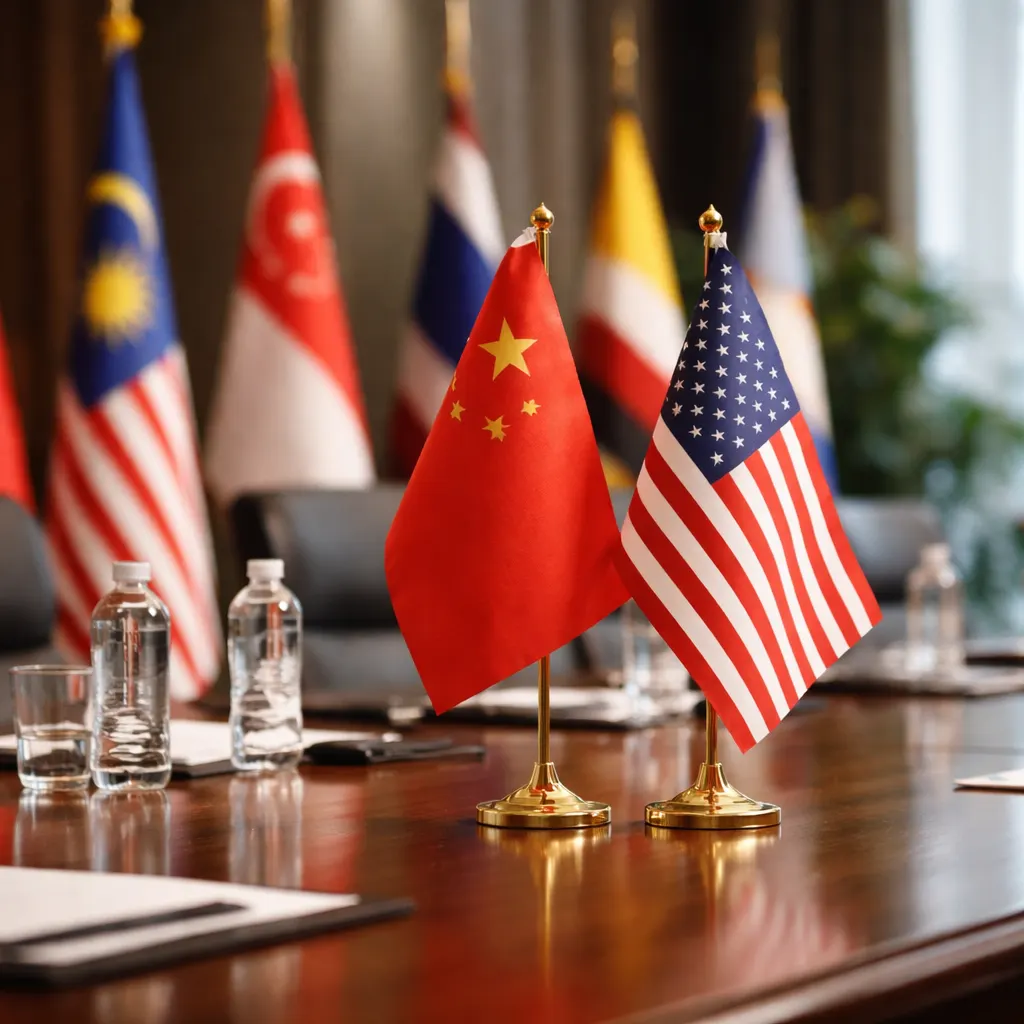
Southeast Asian countries increasingly view China's regional dominance as inevitable and worry more about being forced to pick sides than about Chinese assertiveness itself, according to a new report from the Hudson Institute. The study, which examined Indonesia, Singapore, Malaysia, Vietnam, Thailand, and the Philippines, finds that elites across the region believe the U.S.-China rivalry is structural and permanent—and that most smaller nations lack the power to shape the outcome. Rather than align irreversibly with either superpower, these countries are focused on negotiating the best possible terms from both Washington and Beijing in what they see as an emerging "hybrid order" that blends liberal, hierarchical, and authoritarian features.
The report reveals sharp differences in how these nations are hedging their bets. Vietnam stands out as the most willing to sacrifice "blood and treasure" to resist Chinese encroachment, with elites viewing Beijing as an immense threat and pursuing indirect balancing through defense partnerships with the United States, Japan, and India. The Philippines under President Bongbong Marcos has restored closer ties with Washington and granted the U.S. military access to four bases, reversing the more China-friendly stance of the Duterte administration. In contrast, Thailand and Malaysia are moving closer to Beijing: Thai elites describe China as a wise "big brother" and see the contest for economic leadership as already over, while Malaysian governments remain structurally dependent on Chinese investment and trade, suppressing news of maritime incursions to avoid jeopardizing economic benefits. Singapore, long considered the region's most strategically sophisticated state, is also shifting in troubling directions, according to the authors' interlocutors.
The report finds that many Southeast Asian elites define the regional status quo not as preserving current boundaries but as a "dynamic state in which Chinese power and presence are growing 'naturally.'" Several interlocutors expressed the view that resisting China's expansion too directly could be destabilizing and that an unsuccessful attempt to deter Beijing might produce a worse outcome than never properly attempting deterrence in the first place. The authors note that for many in the region, "the risk of US and allied overreach in deterring and containing Chinese expansionism is almost as significant an issue as the expansionism itself." This perspective helps explain why neighbors criticized the Philippines for hosting American military assets likely to be used in a Taiwan contingency—many see such commitments as dangerous entrapment rather than effective deterrence.
The report attributes these differing approaches to how Southeast Asian countries define strategic agency and assess risk versus opportunity. Unlike Western traditions that emphasize shaping the strategic environment, most Southeast Asian elites start from the premise that their nations lack the power to influence major outcomes. For them, statecraft means maximizing rights, privileges, and gains within an imposed order—not changing the order itself. Many believe they might secure better deals in a Chinese-led hierarchy than in a liberal system, provided they're cunning negotiators. This explains the widespread resentment of being "forced to choose": the act of choosing eliminates flexibility and undermines their ability to extract concessions from both powers. The report notes that Chinese officials understand this dynamic and are negotiating ad hoc bilateral arrangements while Washington pushes for broader commitments, leading many Southeast Asians to conclude that "China is winning."
Looking ahead, the authors warn that Southeast Asian states will likely continue distancing themselves from Taiwan diplomatically as U.S.-China tensions deepen, and that a fractured regional order benefits Beijing more than Washington. As the permanent resident power, China enjoys natural economic and military advantages, while the United States must work harder to maintain relevance. Most interlocutors dismissed the possibility that middle powers could form an effective concert to manage great-power competition, believing such a grouping would either be irrelevant or would favor China by offering ever-more concessions to keep the peace. The report concludes that the region's future will be defined by messy, overlapping bilateral and minilateral deals rather than a unified rules-based order—and that smaller states will thrive or struggle based on how well they master "the art of the deal" with more powerful nations.