
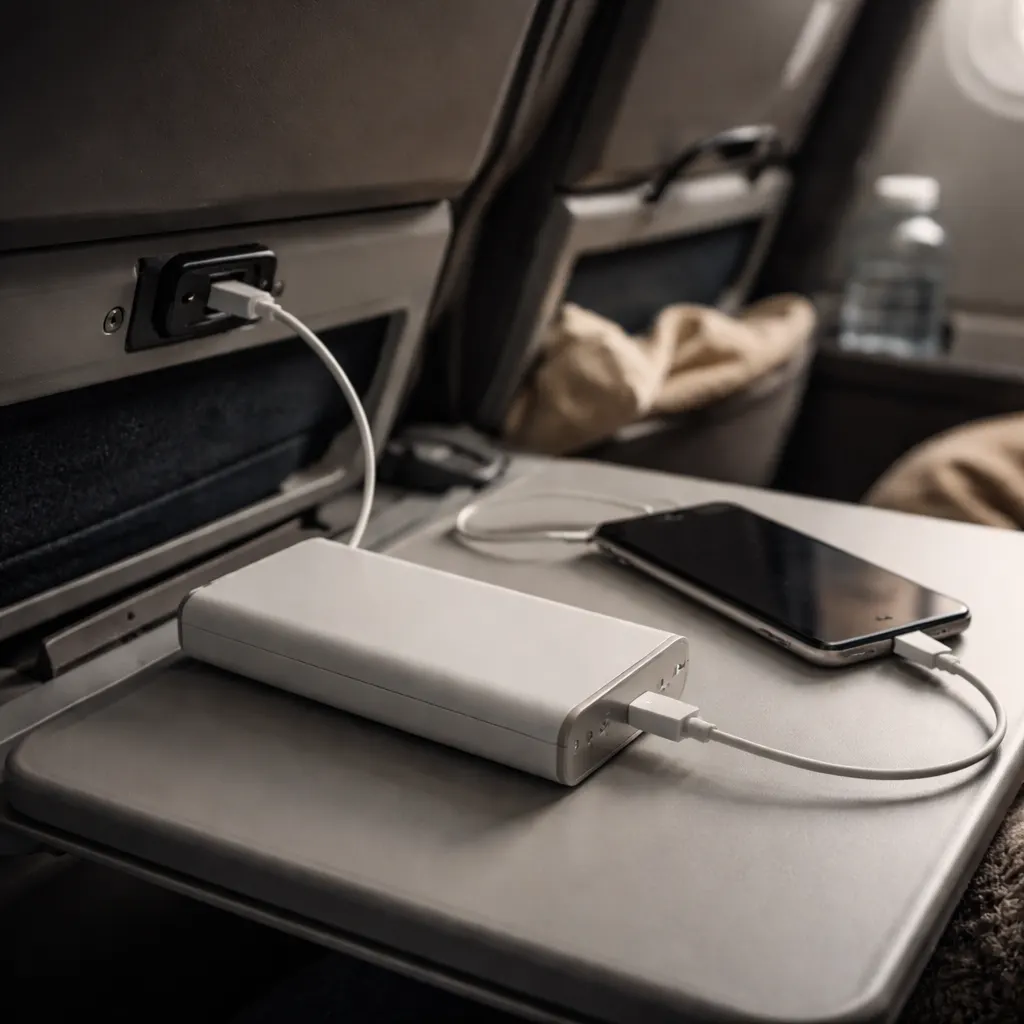
International aviation authorities have determined that power banks are too dangerous to use during flights, prohibiting passengers from charging devices or recharging power banks while airborne, according to a March 2026 addendum to the International Civil Aviation Organization's Technical Instructions for the Safe Transport of Dangerous Goods by Air. The regulations, which also ban overhead-bin storage of the devices, stem from three thermal runaway incidents in 2025 where power banks overheated and caught fire on Air Busan, Virgin Australia, and Air China flights. While no deaths occurred, the Air Busan incident on January 28 injured 27 people and created holes in the aircraft fuselage.
The new rules cap power bank capacity at 100 watt-hours per device, equivalent to roughly 27,000 milliamp-hours, with a maximum of two power banks allowed per passenger. Devices between 100Wh and 160Wh currently require operator approval, though some carriers like easyJet automatically grant it for lithium-ion batteries up to that threshold. Starting January 1, 2027, all power banks exceeding 100Wh will be completely prohibited when new International Air Transport Association dangerous goods regulations take effect. Chinese airlines have already implemented stricter standards, banning any uncertified power banks or those missing visible China Compulsory Certification marks.
The report notes that lithium battery fires have reached an all-time high, with fire departments in the United Kingdom responding to one lithium-ion battery fire every five hours. The Federal Aviation Administration specifies that damaged or recalled batteries and battery-powered devices must not be carried aboard aircraft. According to the analysis, end users of power banks have become "horribly" complacent about devices that store significant amounts of energy, with common dangerous practices including keeping power banks permanently attached to devices, shoving charging gadgets into pockets or bags, and leaving them to overheat under blankets or other materials.
The report explains that these unsafe behaviors create thermal runaway risks both in the air and on the ground, where a power bank catching fire in a pocket at the gym, in a car, or next to someone's head while sleeping would prove equally dangerous. The analysis attributes the problem to users treating power banks as permanent expansion batteries rather than devices meant only for topping up charge, a habit that causes overheating and wastes stored power. Heat becomes trapped when power banks are buried under paper, clothing, or furnishings, providing fuel if thermal runaway occurs. The report recommends that users keep power banks visible during charging, disconnect all cables when not in use, and choose smaller capacity devices—noting that a 10,000mAh power bank suffices for most people while a 5,000mAh unit handles typical daily needs.
The analysis concludes that consumers should prioritize quality over quantity when selecting power banks, immediately stop using damaged or recalled devices, and dispose of them safely rather than continuing to carry them. The report stresses that while aircraft present particularly dangerous environments for lithium fires due to hundreds of people confined in a pressurized tube at high altitude, the same thermal runaway hazards exist in everyday settings. Users should avoid carrying oversized power banks when smaller ones meet their needs and never leave the devices charging unattended in bags or under piles of combustible materials. The bottom line: treating these energy-dense devices with the same respect in homes and gyms as aviation regulators now require in the air could prevent fires before they start.