
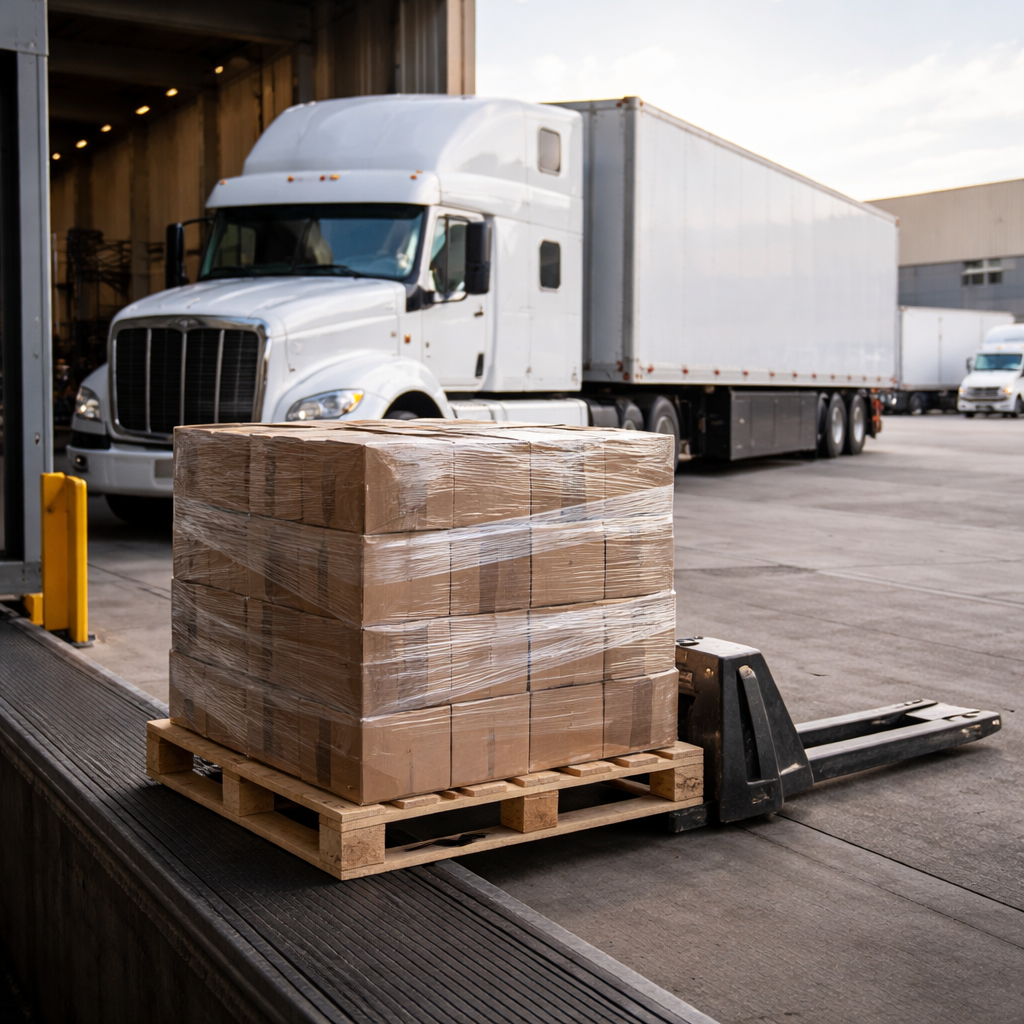
Amazon announced Wednesday it's expanding its less-than-truckload shipping service to all businesses, offering door-to-door pallet delivery to third-party warehouses, distribution centers, and retail stores nationwide. The move marks a significant upgrade from the company's previous inbound-only model, which only served Amazon facilities, and adds another layer to its new Amazon Supply Chain Services initiative launched last month. The retail giant now operates what it describes as a traditional hub-and-spoke LTL network, touting a fleet of 80,000 trailers and 24,000 intermodal containers.
The service allows businesses to ship one to six pallets, or between 150 to 15,000 pounds, to any destination nationwide. Key features include next-day live pickup for orders placed by 5 p.m., same-day pickup using a drop-trailer method, and standing daily pickups for high-volume shippers. The drop-trailer service uses a unified pool of trailers for both LTL and truckload shipments that are dropped at customer facilities instead of being unloaded upon arrival. Shippers also get real-time GPS tracking, automated appointment scheduling, electronic proof-of-delivery, and a sensor-equipped fleet for cargo security.
According to Jim Ruiz, director of Amazon Freight, the expansion came directly from customer demand: "The feedback from Amazon selling partners using our LTL service was clear: the technology, visibility, and reliability were exactly what they needed — and they wanted to use it more broadly." Amazon says it's offering this service at a lower cost than legacy LTL carriers like FedEx Freight, Old Dominion, Saia, and Estes. The company had launched a limited LTL offering in April 2025 for inbound delivery to Amazon facilities only, where goods were broken apart and later shipped individually through its package delivery network.
Industry analysts say Amazon's network configuration remains unclear and its initial scale will be limited. Satish Jindel, president of ShipMatrix, told FreightWaves that Amazon appears to be operating more like a freight broker than an asset-based carrier, competing with companies like C.H. Robinson rather than traditional trucking firms: "They don't have drivers. They don't have trucks. They don't have terminals to sort and load and deliver and pickup." TD Cowen analyst Jason Seidl noted the service seems skewed toward economy lanes with three-to-four-day delivery windows, heavily relying on intermodal for middle-mile transport. As of the first quarter of 2025, Amazon had only about 74 cross-dock facilities, compared to the roughly 115 facilities where it accepts inbound freight — many of which are simply fulfillment centers without full truck-to-truck transfer capability.
Despite the limited infrastructure, analysts believe Amazon could still capture meaningful market share through its flexible operating model. Morgan Stanley equity analyst Ravi Shanker wrote that while LTL likely represents only a small piece of Amazon's overall logistics footprint, "Amazon has repeatedly demonstrated an ability to gain traction in transportation markets through a flexible and iterative operating model." The emphasis on using intermodal containers suggests the offering will primarily compete in the economy sub-segment of the LTL market, which is predominantly served by ArcBest, TFI International, and FedEx Freight. Amazon's move into full-scale LTL is the latest step in externalizing its massive internal logistics network, and while it may not immediately threaten established carriers, the company's track record of growing market share over time has the industry watching closely.