
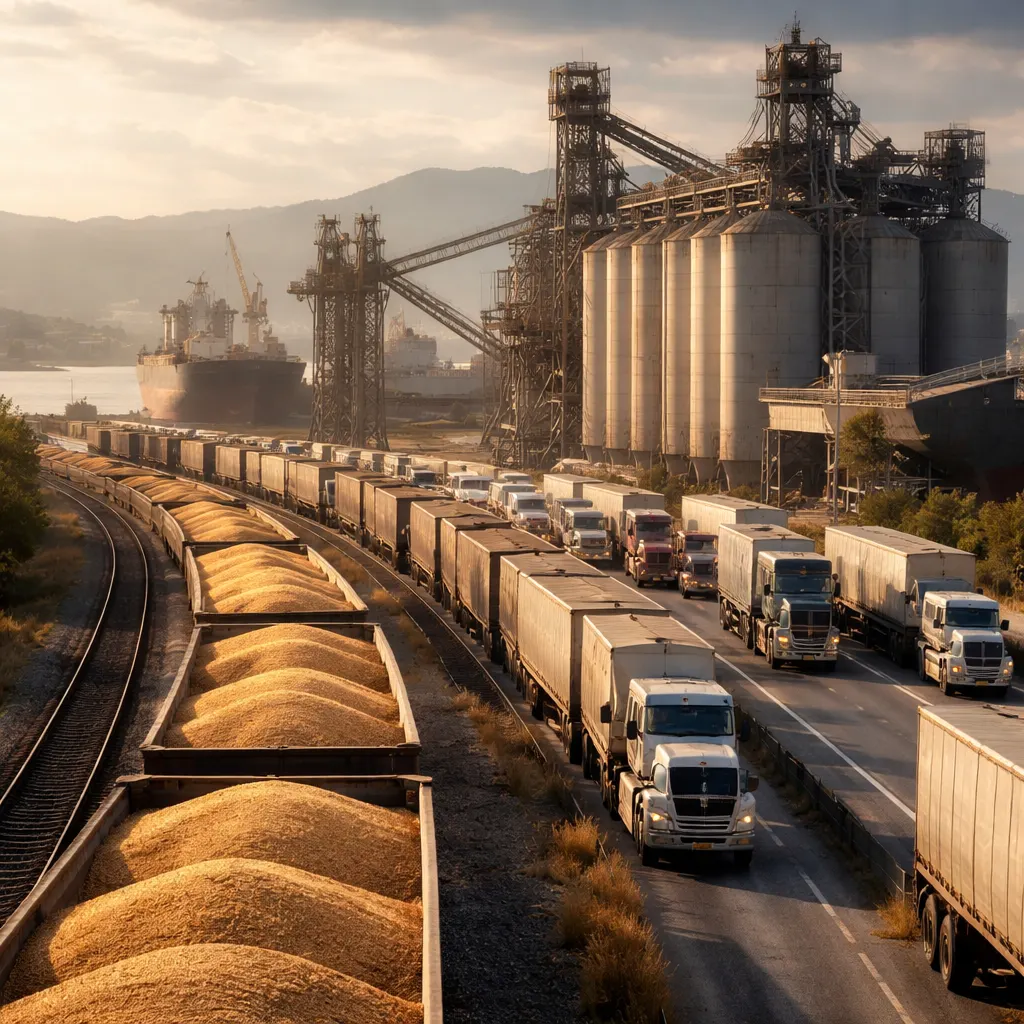
Canada needs an estimated $394 billion in rail and port investments by 2070 to keep its grain export system running, even as a single bridge carries half the country's grain production to market. An analysis published by RBC warns that infrastructure—especially railways and port terminals—isn't keeping up with bulk commodity growth, leaving farmers' profits on the table and scaring off international buyers. The agriculture and agri-food sector generates over $150 billion for GDP and sustains 2.3 million jobs, but its export-dependent model is hitting physical limits at critical choke points.
The Port of Vancouver handled a record 170 million metric tons of cargo in 2025, including 30 million metric tons of bulk grains, according to the report. Prince Rupert processed 26 million metric tons that same year, up 14% from 2024. Canadian wheat output has climbed at an annual average rate of 3.9% since 2000, while canola yields have grown 3.4% annually, meaning farmers are squeezing more production from the same acreage. But Canada's overall infrastructure deficit ranges between $110 billion and $270 billion, and the ratio of infrastructure spending to trade volumes has been dropping, the report notes. Railways alone require $284 billion in investment through 2070, with seaports needing another $110 billion.
The 57-year-old Second Narrows Rail Bridge serves as the crossing point for 50% of Canada's grain production moving through the port and nearly a third of all cargo, the report finds. In February 2026, a mechanical failure locked the bridge in its down position for four days, blocking ships from reaching the inlet. The report warns that if either Canadian National Railway or Canadian Pacific Kansas City shuts down for a single week, the grain industry could suffer $250 million in losses from cancelled sales, contract penalties, and other costs. A four-day Grain Workers Union strike in 2024 cost the sector roughly $35 million per day in stalled shipments. Bulk Canadian grain moves almost exclusively through Canadian ports for overseas markets, creating vulnerabilities that U.S. export terminals don't face for commodities like potash.
The report explains that these bottlenecks force some Canadian businesses to consider building large terminals on U.S. shores instead of in Canada, drawn by better labour conditions and less port congestion. More than 60% of Canada's agri-food exports currently go to the U.S., but as the country tries to reduce reliance on a single customer, more sales will need to flow to Asian and European markets through west coast ports. New projects are starting to help: the Trans Mountain Expansion Pipeline's growth to 890,000 barrels per day cut Canadian crude-by-rail to its lowest level since 2012, freeing up capacity for grains, pulses, and oilseeds. The newly announced Canada-British Columbia Cooperative Prosperity Agreement includes $10 billion in federal funding to upgrade Roberts Bank Terminal 2 in Delta, along with potential investments at Prince Rupert further north.
The report concludes that rail and port infrastructure decisions made over the next few years will determine how productivity gains translate into stronger export growth, and whether supply chains stay anchored in Canada. Addressing these acute risks should be core to the nation-building conversation, and large capital investments are needed alongside supply chain efficiency improvements, the authors write. Farmers have already done their part to boost production—the systems moving that output need to catch up.