
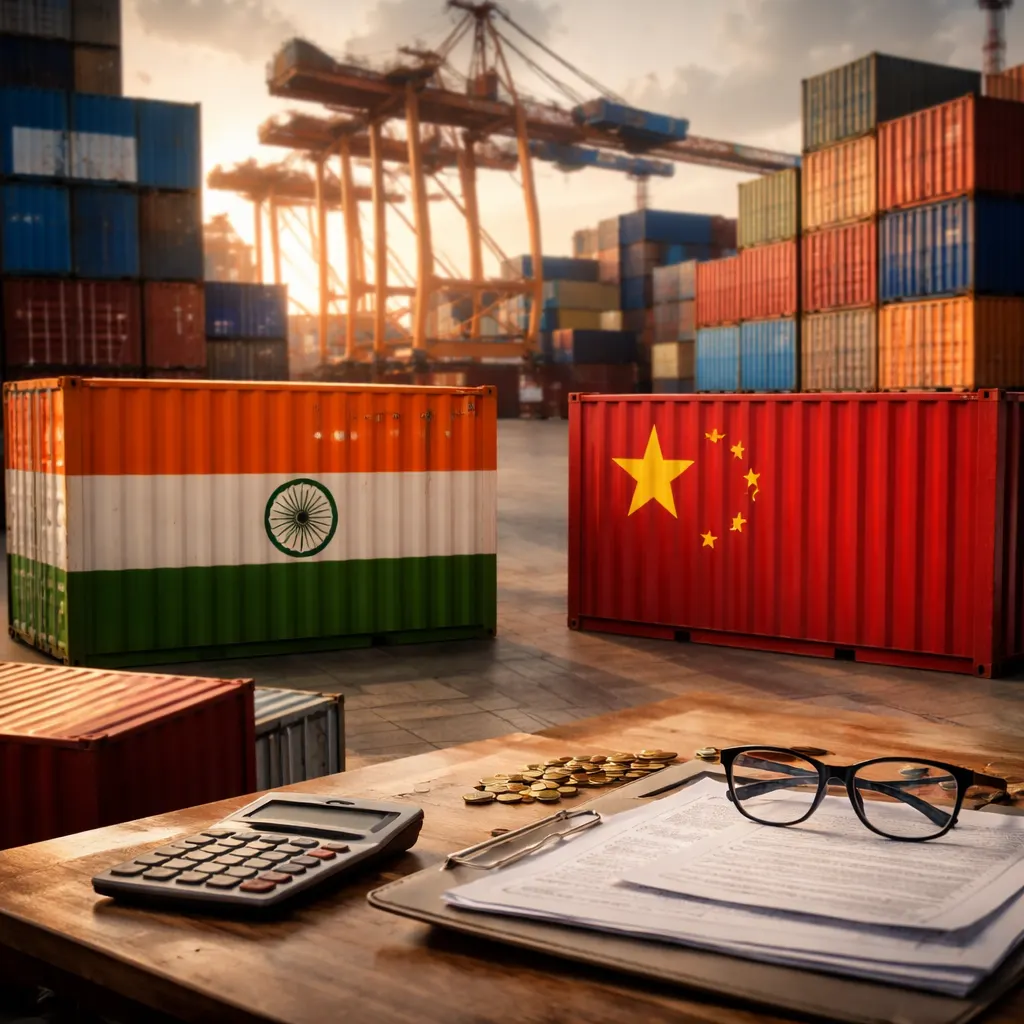
India's trade deficit with China reached $112.16 billion in 2025, climbing from $99.12 billion the previous year as bilateral commerce totaled $151.1 billion, according to a new analysis published by the Foundation for Economic Education. The report examines why China has now surpassed the United States as India's top goods-trading partner and identifies three major roadblocks preventing India from closing the gap—only one of which Delhi can control directly.
The dependency runs deep across critical sectors. Over 90% of India's rare-earth magnets and metals arrive from China, and Chinese customs records showed magnet exports to India dropped 58% starting in January 2025. Since roughly June 2026, Chinese officials have tightened visa approvals for Indian business travelers, with industry sources reporting approval rates as low as 20–40%, hitting electronics and automotive sectors hardest. In summer 2025, manufacturing giant Foxconn pulled roughly 300 Chinese engineers and technicians from its Tamil Nadu facilities, then withdrew another 300 weeks later, leaving plants and equipment but no personnel to operate them. India's exports to China did grow nearly 37% in 2025–26, but that translated to an increase from only about $14 billion to $19 billion. Twelve days before National Security Advisor Ajit Doval traveled to Beijing for border discussions in August 2026, China extended anti-dumping duties on Indian optical fiber for five more years.
The report notes that India faces pressure from Washington as well as Beijing. On August 13, 2026, the White House Office of Trade and Manufacturing Policy released findings naming over 40 economies as part of a "shadow transshipment network," with India placed in tier one alongside Canada, Japan, Mexico, Korea, Taiwan, and the European Union. According to the analysis, Mexico, India, and Vietnam were flagged as the primary channels for China-origin goods—an estimated $67 billion in 2025—and Washington has signaled it will impose retrospective duties for undeclared or misdeclared origin, with rules of origin written into February's interim framework that cut Indian tariffs from 50% to 18%. When Modi and Xi met in Delhi on September 12, their joint statement echoed demands for addressing "structural trade imbalance and supply chain issues" and ensuring meaningful, predictable market access, but no concrete commitment was attached to either goal.
The report explains that India is caught between conflicting pressures: every component it sources to build a viable manufacturing sector is a component that makes an Indian export questionable to U.S. authorities. Beijing can offer reliability and predictability of supply chains quickly and at low cost—because it's easy to promise and withdraw—and can grant selective market access in pharmaceuticals or agriculture. But the report argues that balance can't be granted by China; it can only be achieved by India expanding exports that don't rely on Chinese imports, a process likely to take years. In August 2025, Beijing eased restrictions on magnets, fertilizers, and tunnel-boring equipment after commitments from Foreign Minister Wang Yi, only to add five more elements to its rare-earth control list two months later; by December, the list had grown to twelve. The September summit between Modi and Xi yielded a 40-minute meeting officials described as extremely positive, but the economic track produced little beyond resumed direct flights between Delhi and Guangzhou—no concrete announcements on rare earths, fertilizer, joint ventures, or visas.
The report concludes that India's objective isn't negotiating away the deficit but rather shaping what that deficit looks like and how it will influence the nation's economic trajectory. India can pursue selective de-risking, opening channels where inputs are necessary while restricting areas of strategic vulnerability, but Beijing has already demonstrated how quickly dependency converts into political leverage. Each new point of integration between the two economies amplifies that risk. With a potential U.S.–China trade truce extension following Xi's September 24 White House visit, the ground beneath India may shift further still, leaving Delhi with narrowing room to maneuver between the world's two largest economies.