
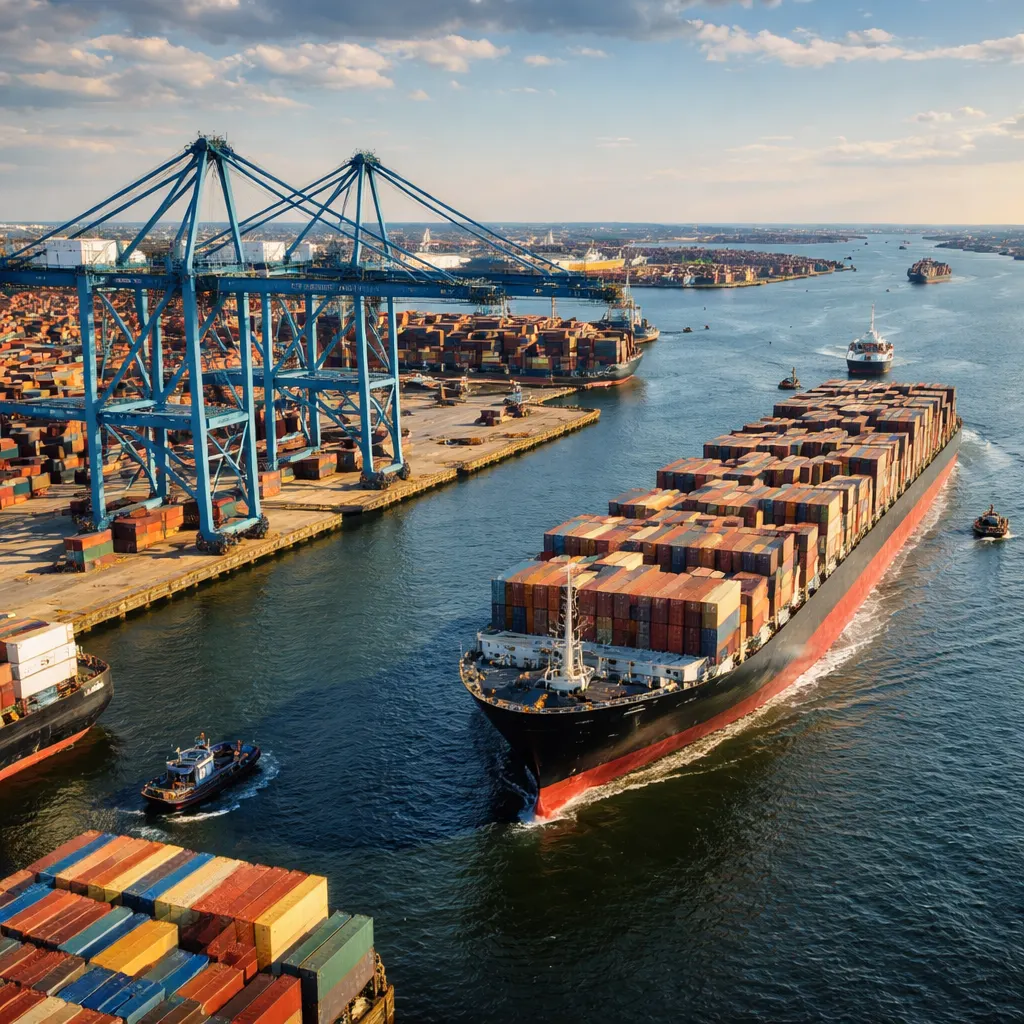
The Port of Virginia now operates the deepest commercial shipping channel on the U.S. East Coast after completing a $450 million infrastructure project that reached substantial completion on Feb. 28, 2026, according to a FreightWaves report published Monday. Gov. Abigail Spanberger celebrated the milestone before more than 200 attendees at Norfolk International Terminals, declaring the port "wide open for business." The project allows the largest cargo ships in the Atlantic trade to transit Norfolk Harbor with full loads, establishing new infrastructure capabilities that no other East Coast port can match.
The harbor deepening and widening project is the centerpiece of the Gateway Investment Program, a comprehensive capital construction campaign that began in 2023. The $450 million channel work enables two-way traffic for ultra-large container vessels with capacities ranging from 14,500 to 24,000 containers. The program also includes an $83 million rail expansion that's now fully operational and boosted annual capacity to 2 million twenty-foot equivalent units, plus a $220 million conversion of the Portsmouth Marine Terminal into a deepwater heavy-lift facility. The $650 million renovation and reconfiguration of the North Berth at Norfolk International Terminals is more than halfway complete, with a projected finish date of mid-2027. Once that work wraps up, the port's annual throughput capacity will hit 5.8 million TEUs, and it'll gain the ability to bring a fifth ultra-large container vessel berth online.
Norfolk Harbor holds a unique federal authorization from Congress—it's the only waterway channel on the U.S. East Coast that can be dredged to a depth of 55 feet. According to Virginia Port Authority Chief Executive Sarah J. McCoy, the projects aren't merely about today's needs but are designed to position the port for long-term growth, assuring users "they can expand operations and cargo volumes without concern for outgrowing the facility's capabilities for decades to come." Sen. Mark R. Warner praised the use of funding from the Bipartisan Infrastructure Law, citing its role in creating economic opportunities for the Hampton Roads region, while Sen. Tim Kaine said the project reinforces the port's status as a critical pillar of the Commonwealth's economic success.
Gov. Spanberger emphasized that the increased channel depth facilitates higher export volumes for Virginia's agriculture and forestry sectors—including soybeans, wood pulp, and lumber—while driving down shipping costs and offering manufacturers greater reliability and efficiency. The deeper harbor means ships can carry full loads rather than lightening cargo to clear shallower channels, which translates directly to lower per-container costs and fewer vessel calls needed to move the same volume. The project's accelerated timeline was made possible through collaboration between state leadership, the Virginia Congressional delegation, the Virginia Maritime Association, and the U.S. Army Corps of Engineers, with construction beginning in December 2019—nearly two-and-a-half years ahead of schedule.
The port's enhanced infrastructure positions Virginia to capture a larger share of containerized trade as global shipping lines deploy ever-larger vessels on Atlantic routes. With the North Berth modernization set to install four new low-profile ship-to-shore cranes and an expanded technology backbone by mid-2027, the Port of Virginia is betting on scale and depth as its competitive edge. The message to shippers is clear: Norfolk can handle today's mega-ships and tomorrow's growth without breaking a sweat.