
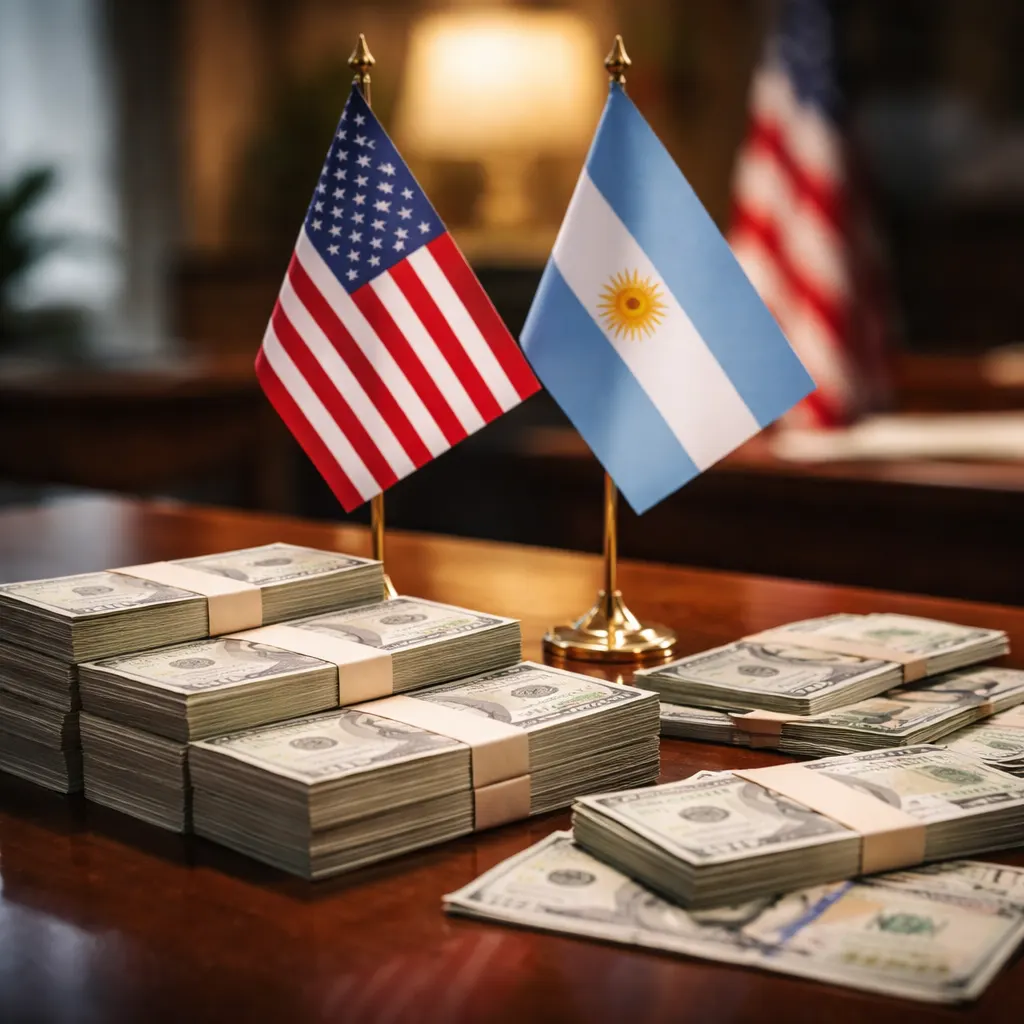
The United States loaned $20 billion to Argentina's central bank late last year through a currency swap, drawing criticism as a "bailout" but representing a calculated wager on President Javier Milei's economic reforms, according to a new commentary from the Reason Foundation. The loan, announced by Treasury Secretary Scott Bessent on Oct. 9, 2025, uses dollars from the Treasury's Exchange Stabilization Fund and sits atop an additional $62 billion in multilateral financing from the IMF, World Bank, and Inter-American Development Bank. The commentary argues the loan isn't a gift but rather a continuation of long-running international support for Argentina, this time aimed at allowing Milei to continue advancing economic liberalization.
The commentary details that by late October, Argentina had drawn just $2.5 billion of the available $20 billion swap line. The ESF held approximately $35 billion in liquid assets before the agreement. The IMF approved a separate 48-month Extended Fund Facility totaling $20 billion in early 2025—the Fund's 23rd loan program to Argentina since 1958. Milei's administration has cut Argentina's fiscal deficit from over five percent of GDP to a primary surplus within a single year and reduced monthly inflation from 25.5% in December 2023 to 1.5% by mid-2025. Argentina has defaulted on its sovereign debt nine times—more than any other large country—with major defaults in 2001, 2014, and 2020. By 2023, the country carried the world's highest inflation rate and more than half its population lived in poverty.
The report notes that neither government has publicly disclosed the swap's full terms, including duration or interest rate, creating a "lack of transparency that has drawn legitimate congressional scrutiny." The commentary describes Argentina's tax system as punishing entrepreneurship, with the combined effective corporate tax burden amounting to more than 106 percent of earnings for the average firm according to World Bank estimates—"the highest effective corporate tax rate among all large countries." The report states that 44.1% of Argentina's employed adult workforce works in unregistered, under-the-table arrangements. According to the commentary, Argentines hold an estimated $200 to $270 billion in U.S. dollars, while the dollar value of all pesos in circulation is only around $15 billion, and nearly all real estate transactions occur in dollars.
The commentary explains that Argentina's fiscal and monetary collapse created the political conditions for Milei's rise, with pre-election surveys showing 68 percent of voters between ages 16 and 24 backed him. The report describes the emergence of "mejorismo"—a generational worldview crystallized through a decade of stagnation and COVID lockdowns that represents a visceral rejection of the collectivist ideology dominating Argentina since Juan Perón's first presidency. While Milei campaigned on officially adopting the U.S. dollar as national currency, he's instead implemented a managed exchange rate band, which the commentary calls "only a half-measure." The report explains that Milei has cautioned against allowing the peso to trade freely because speculators might respond by increasing prices, leading to a self-fulfilling fear of renewed inflation. The commentary notes that billionaire investor Peter Thiel recently made headlines by moving to Argentina part-time, suggesting growing confidence in the country's reform trajectory.
The commentary concludes that IMF loans and Treasury swap lines are "just credit instruments meant to buy time" and will pay off only if liberalization reforms are sufficiently pervasive to make Argentina a new global destination for private capital. The Trump administration has made a calculated wager on an Argentine government that has demonstrated genuine willingness to absorb political pushback to achieve structural change, but success depends on whether Milei remains committed to—and can secure congressional approval for—an ambitious liberalization agenda. After nearly a century of economic collectivism, the most consequential unfinished business is fixing a tax code that has hollowed out the tax base and pushed both firms and individuals underground.