
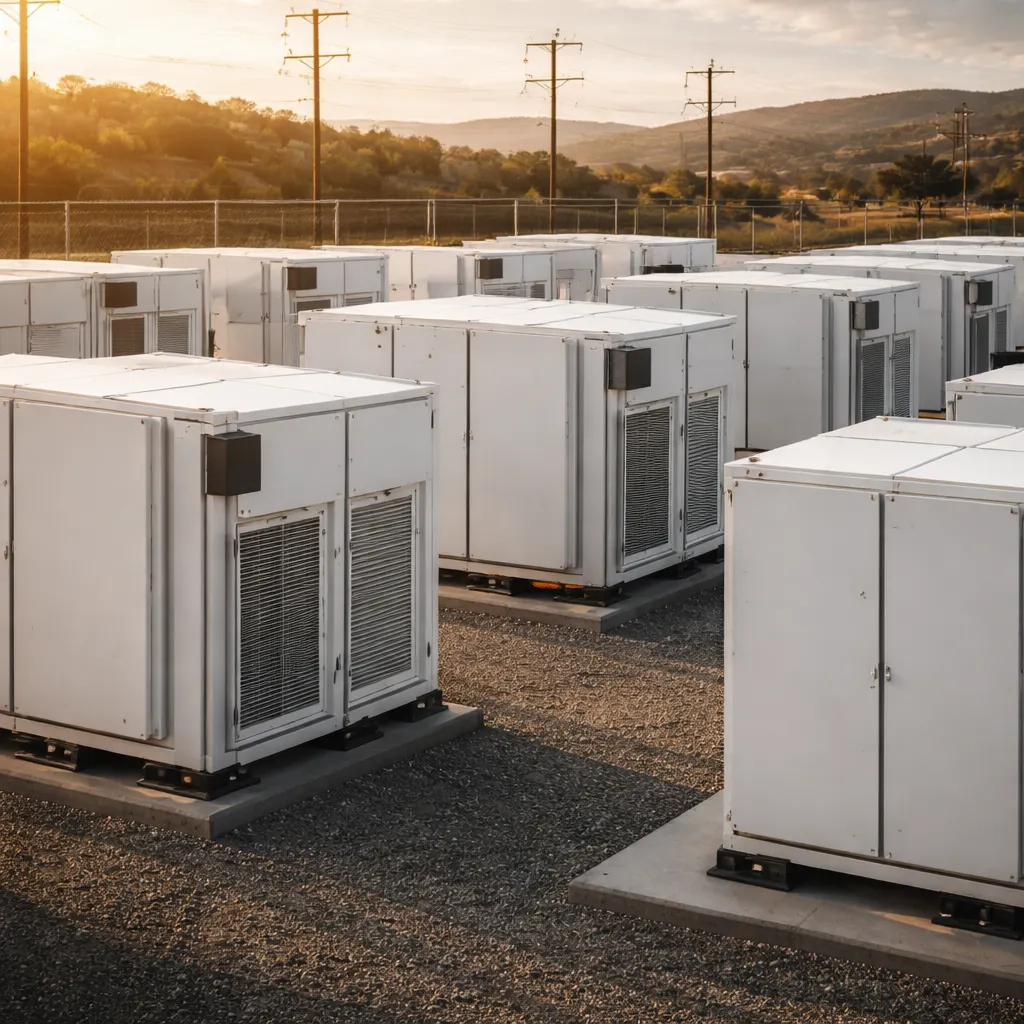
Energy storage systems delivered 13% to 19% of total generation during California's tightest grid hours in 2024, matching the performance of gas-fired peaker plants while avoiding more than $29 million in peak energy costs, according to an analysis released by RMI earlier this month. The nonprofit energy think tank's report examines how already-deployed batteries have stabilized major U.S. grids since 2022, delivering significant financial savings and community benefits even as the industry faces new policy headwinds.
In Texas, energy storage systems provided 6% to 9% of generation during the Electric Reliability Council of Texas grid's most constrained hours the following year. But a December 2025 ERCOT rule change reduced battery participation in ancillary services, adding $3.6 million to wholesale pricing over just 24 hours. During a 2022 record-breaking heat wave in California, 3.4 GW of grid batteries met 6% of the state's energy needs. Two years earlier, when California had less than 1 GW of battery capacity, the state experienced rolling blackouts during a less severe heat wave with a demand peak roughly 10% lower. RMI's review of project agreements across California, Massachusetts, Nevada and Texas found utility-scale energy storage systems contribute an average of $6,600 per MW annually in gross taxes to host communities, with some installations exceeding $10,000 per MW.
The report finds that batteries provide substantial local health benefits by replacing gas-fired peaker capacity. Using the U.S. Environmental Protection Agency's CO-Benefits Risk Assessment tool, RMI determined Suffolk County, New York, could avoid $5.3 million in annual health costs by converting its 500-MW Port Jefferson peaker to battery storage, while Harris County, Texas, could avoid $3.8 million yearly by swapping its 240-MW La Porte peaker plant for batteries. The report also highlights specific revenue examples: a 250 MW/500 MWh battery that came online in February will generate roughly $46 million over 20 years for Medway, Massachusetts, while Nevada's 400-MW Purple Sage Energy Center will deliver $3.4 million annually to local governments even after partial state property tax abatements.
RMI's forecast anticipates 30% annual growth in battery deployment over the next five years, based on a 2024 projection from energy consultancy Wood Mackenzie made when the Inflation Reduction Act was still fully in effect. That outlook now faces uncertainty: Wood Mackenzie reduced its five-year forecast for utility-scale battery deployments to 16% earlier this year, and its most recent forecast released today shows utility-scale deployment flatlining in 2026 and growing just 8% through 2031. President Trump's August executive order restricting deployment of foreign-produced bulk power components creates new challenges for the industry alongside existing headwinds like import tariffs and unfavorable tax treatment of systems using parts tied to China. Despite high-profile incidents like the January 2025 fire that destroyed most of a 300-MW Vistra array near Santa Cruz, serious battery fires remain rare and are likely to stay that way now that the more stable lithium-iron-phosphate chemistry has become the industry standard for stationary storage, the report says.
The report's bottom line is that batteries already deployed have proven their value in reducing costs, stabilizing grids during peak demand, and delivering measurable financial and health benefits to local communities, but the path forward depends on whether policy shifts reverse the momentum built under previous federal support. The gap between California's 2020 blackouts and its 2022 grid stability during worse conditions shows how quickly battery storage can transform grid reliability when scaled up.