
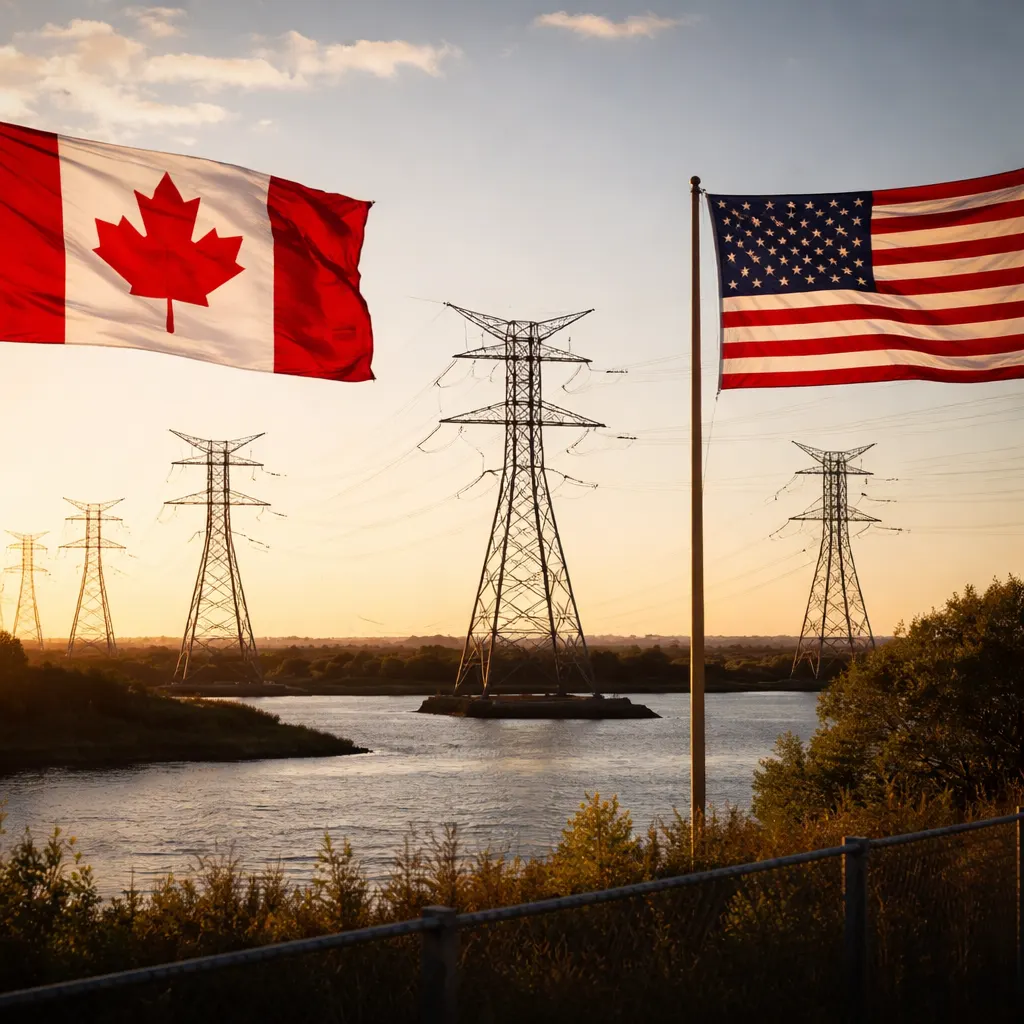
An intensifying trade conflict between the United States and Canada is threatening to disrupt electricity flows across the border, with Ontario's premier warning that cutting power exports is "on the table." The dispute follows President Donald Trump's imposition of 50% tariffs on roughly $20 billion in Canadian goods over the weekend, according to a report by Utility Dive. Canada is preparing retaliatory measures as tensions mount over cross-border energy trade that's become increasingly vital to both nations.
Electricity trade between the two countries reached $3.2 billion in 2025, with Canadian imports accounting for 67% of that total, the U.S. Energy Information Administration reported earlier this month. Ontario Premier Doug Ford told the Associated Press on Monday that he and Canadian Prime Minister Mark Carney discussed imposing a 25% tariff on power sent to the U.S. The same province enacted an identical 25% levy on electricity exports in 2025 during an earlier trade dispute, though officials removed it just one day after implementation when the two sides reached an agreement. In June, North America's longest fully-buried transmission line started delivering Canadian hydropower to New York City, with the $6-billion Champlain-Hudson Power Express projected to supply up to 20% of the city's electricity demand.
ISO New England told Utility Dive that if Canada chose to reduce or eliminate electricity trade, the grid operator "would not anticipate reliability issues tied to reduced imports, at least under typical weather conditions." However, under extreme temperatures, supplies in the region "could become tight," though that depends on numerous factors that are hard to predict, the operator added. The grid operator noted that "power flows both ways" between New England and Canadian neighbors these days, and any reduction or complete halt of Canadian electricity would likely create a "financial" impact through higher wholesale market prices, with regional emissions also expected to rise.
The report explains that while electricity trade between the nations is "relatively small compared to trade in other energy sources," the two countries' power sectors have become more interconnected in recent years. New York ISO spokesperson Kevin Lanahan said the grid operator maintains "close and regular contact" with Hydro Quebec and Ontario's Independent Electricity System Operator, and anticipates having sufficient supplies to meet expected system demand. The growing integration means disruptions could have consequences beyond simple supply shortages, particularly as major new transmission projects like the Champlain-Hudson line make U.S. cities increasingly dependent on Canadian hydropower for clean energy goals.
The report suggests that any Canadian decision to restrict electricity exports would mirror the 2025 playbook, when Ontario imposed tariffs that lasted only 24 hours before diplomatic resolution. Still, with "everything on the table" according to Premier Ford, the risk to cross-border energy flows remains real as retaliatory measures are expected Tuesday. For American consumers already stretched financially, the potential for higher wholesale prices adds another pressure point to an escalating trade war that's now reached the power grid.