
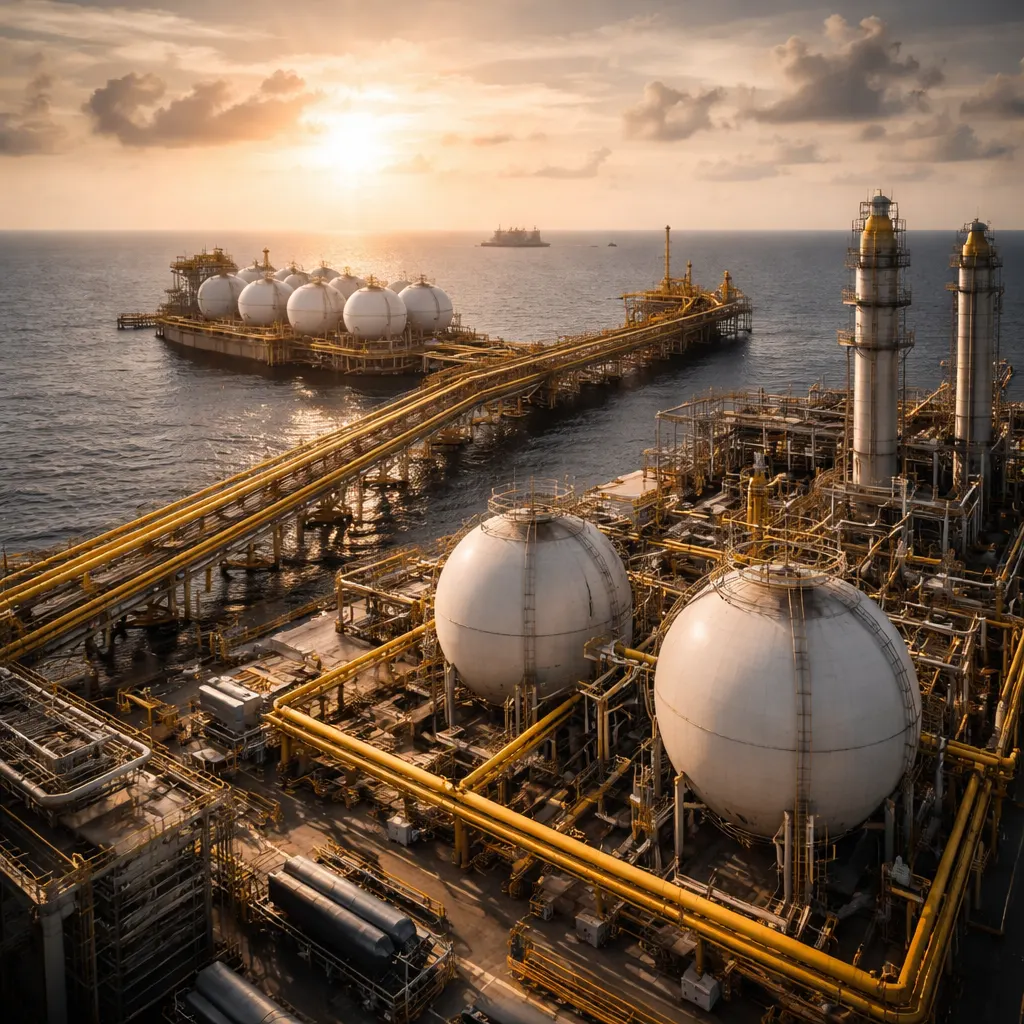
Equatorial Guinea is racing to transform its aging gas infrastructure into a regional processing hub before production from its cornerstone field runs out, according to an analysis published by Wood Mackenzie in October 2026. The country's Gas Mega Hub strategy has already brought three project phases online to commercialize previously stranded reserves, but the initiative won't survive without fresh supply from neighboring countries. The question is no longer whether Equatorial Guinea can manage the decline of the Alba field, which has anchored its gas sector for nearly three decades, but whether it can attract enough cross-border gas to keep the Punta Europa terminal competitive against floating LNG alternatives.
The Gas Mega Hub currently processes roughly 175 million cubic feet per day from Chevron's Alen field and Alba, with output expected to climb above 300 mmcfd once the Aseng project starts up. Together, the three confirmed phases are forecast to produce about 1 trillion cubic feet over the coming decade. Chevron's Yoyo-Yolanda cross-border venture with Cameroon, formalized in February 2026, could deliver as much as 350 mmcfd through a subsea connection to Alen, with startup targeted for late 2029. Smaller discoveries scattered across Alba and Blocks D, O, EG-23, EG-31, and EG-08 hold nearly 2 tcf of reserves that could serve as backfill, much of it near existing pipelines. Block EG-27, now called Ebano, carries around 3 tcf of contingent resources and could potentially justify a second LNG train at Punta Europa if a hub-centered approach proves more economical than a standalone floating facility.
The report warns that even at maximum throughput, the Gas Mega Hub's confirmed phases will fall short of the liquefaction terminal's capacity, and that shortfall will grow as the projects age. Wood Mackenzie notes that Punta Europa needs additional gas before Alba's remaining output is exhausted. The analysis describes Cameroon's end of the Hilli Episeyo floating LNG contract in July 2026 as a factor that has "intensified the need for a new outlet," with the Etinde and Sapele discoveries positioned to realistically supply Punta Europa by pipeline. Nigeria represents the most significant opportunity: a proposed Gulf of Guinea Gas Pipeline, backed by a 2024 bilateral treaty, would carry up to 2,700 mmcfd—roughly four times the current capacity of EG LNG—and could support domestic power, industrial feedstock, and new liquefaction trains rather than simply replacing depleted reserves.
Success hinges on commercial terms, committed upstream partners, and confidence that Punta Europa can draw investment away from floating LNG and other global options, the report explains. The earlier Fortuna floating LNG project collapsed in 2019 after it failed to secure financing, and the vision for the Nigerian pipeline depends on firm gas commitments, bankable cross-border agreements, and financing that hasn't materialized yet. Equatorial Guinea does hold advantages—existing infrastructure, favorable location, and two decades of operating experience—that are hard to replicate elsewhere in the Gulf of Guinea. But the window for capitalizing on those strengths is closing as Alba's legacy production fades, leaving the country with a narrow path to turn stranded gas into a lasting regional asset.