
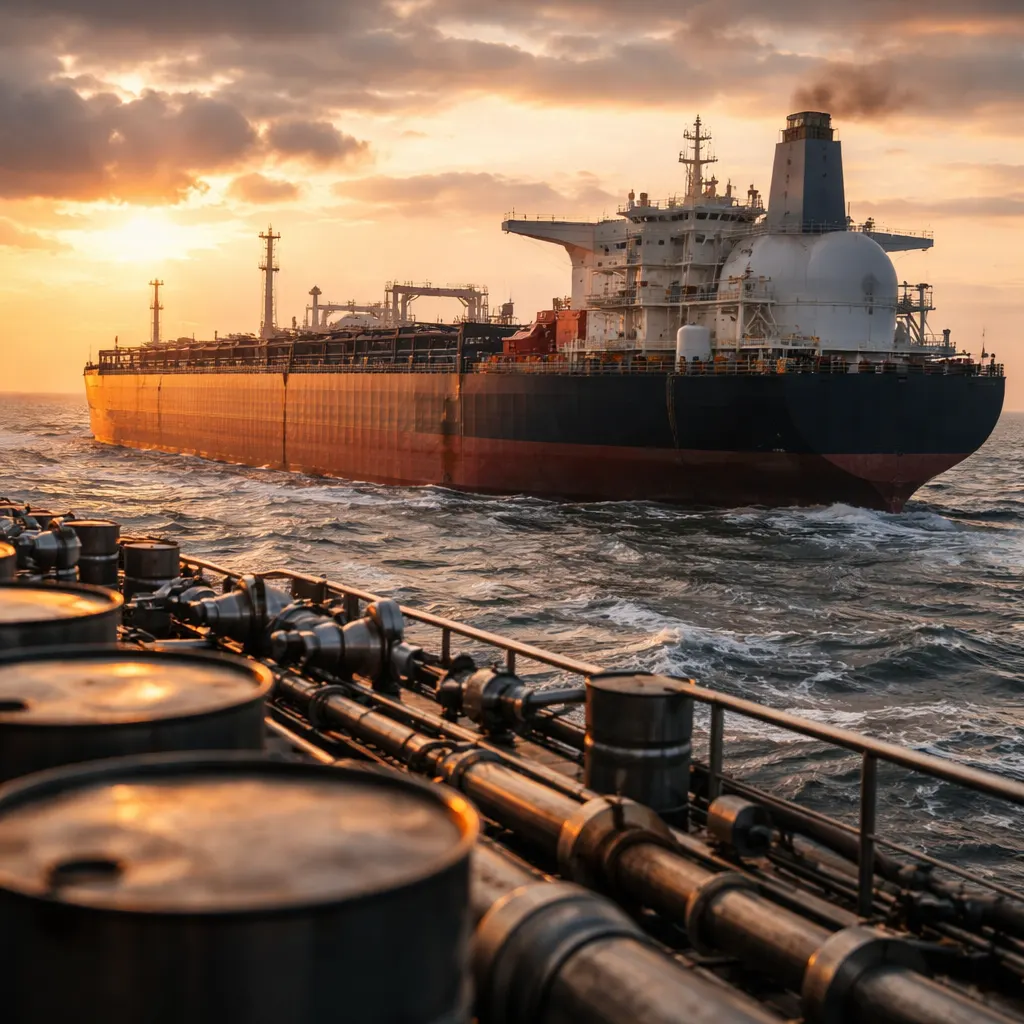
Very large crude carriers are now earning as much as $1.3 million per day—roughly 43 times their January levels—according to a report published by Energy News Beat in early October 2026. That translates to nearly $33 per barrel in freight costs alone, representing 27 percent of the delivered price of Middle Eastern crude arriving in Asia, the report notes. The analysis argues that shipping expenses have grown so extreme they're forcing refineries to cut production, pulling product prices away from paper crude benchmarks, and raising the historical question of whether an energy shock combined with Federal Reserve rate hikes ends in recession.
The spike in tanker earnings stems from logistics bottlenecks rather than a simple shortage of oil, the report explains. Crude flows through the Strait of Hormuz have climbed back toward 12 million barrels per day from a second-quarter low below 2 million, but the system relies heavily on shuttle tankers, ship-to-ship transfers off Oman, longer Cape routes, and extended Atlantic hauls. At times, roughly 15 percent of the global VLCC fleet has been tied up in those transfer operations. Voyages that previously took weeks now consume far more vessel-days, and war-risk insurance has added to costs. Average VLCC earnings have run between $450,000 and $660,000 in recent weeks, with Suezmaxes also hitting record levels; a year earlier, $50,000 per day was considered solid and $100,000 exceptional. The Baltic TD3C Middle East–China assessment crossed $1 million daily in September for the first time, with broker and exchange reports subsequently citing peaks near $1.2 million to $1.3 million. Poten & Partners calculates that the same voyage cost roughly $1.73 per barrel in January, about 3 percent of the delivered price.
Demand for immediate vessel availability has pushed ten-year-old VLCCs above newbuilding prices for the first time in Braemar's records, the report states, with pre-2016 vessels changing hands at $150 million or more against newbuild quotes around $131 million to $135 million. Five-year-old tankers have been valued as high as $172 million to $215 million, with some prompt resales approaching $200 million. The ordering response has been historic but late: Maritime Strategies International counted 177 VLCC orders in the first half of 2026 alone, and Veson Nautical places the VLCC orderbook-to-fleet ratio near 37 to 38 percent after roughly 198 orders year-to-date, up from the low teens a year earlier. Most of those ships will be delivered in 2028–2029, and major yards in China, Korea, and Japan are effectively full through 2030. According to the report, Poten concludes that rates will remain strong while crude demand exceeds available supply and can cool rapidly once the oil market loosens; Veson doesn't expect full restoration of normal Middle Eastern flows before at least mid-2027.
The report emphasizes that refined products—diesel, gasoline, and jet fuel—represent the binding constraint, having hit or approached record levels while crude benchmarks remain well below 2008 peaks. The analysis contrasts 2008, when crude neared $147 and U.S. diesel was around $4.76, with 2026, when crude trades near $95 but U.S. diesel has climbed above $6.50. J.P. Morgan has observed that Persian Gulf crude exports have largely normalized while product exports remain roughly 40 percent below pre-war levels. The International Energy Agency has pointed to global oil demand falling by about 2.5 million barrels per day in 2026, driven by record fuel prices and continued Gulf disruptions, calling 2026–27 essentially a lost period for demand growth. High freight is already showing up in refinery behavior: Chinese independents have trimmed runs, and Indian buyers have shifted toward longer-haul Atlantic grades, tying ships up for 30 to 40 days. The report explains that only two durable paths can bring diesel, gasoline, and jet fuel prices down—demand destruction large enough to rebalance the product market, or a material addition of refining capacity—and capacity has been moving the wrong way for years, with U.S. refining capacity peaking in 2017 and edging lower since.
The report draws on historical patterns to assess recession risk, noting that energy shocks combined with Federal Reserve tightening have repeatedly produced downturns. In 1973, the Fed had already raised the effective funds rate near 11 percent by the third quarter before the October OPEC embargo; oil prices then more than doubled into 1974, and the recession ran from late 1973 to early 1975. The 1979 Iranian disruption more than doubled oil prices between April 1979 and April 1980, pushing CPI inflation near 15 percent; Paul Volcker raised the funds rate from about 11 percent to a peak near 19 to 20 percent in 1980–81, and the economy suffered two recessions, in 1980 and 1981–82, with unemployment eventually reaching 10.8 percent. The 1990 Iraq invasion of Kuwait spiked oil again, and a recession began in July, though the Fed eased rather than tightening further, making that episode shorter and milder. The report notes that as of early October 2026, the National Bureau of Economic Research hasn't declared a U.S. recession, and real-time probability models have recently printed near zero, with the Fed's June 2026 projections showing median real GDP growth of 2.2 percent in 2026 and 2.3 percent in 2027. Goldman Sachs cut its 12-month U.S. recession probability to 15 percent in June, and the IMF has global growth near 3.0 percent in 2026 and 3.4 percent in 2027.
The report concludes that for the rest of 2026, the chance of a new NBER-style U.S. recession beginning is roughly 15 to 25 percent, rising to 20 to 35 percent for 2027 if Hormuz logistics stay impaired, product prices remain extreme, and policy keeps tightening into that weakness. Europe faces greater exposure because of its dependence on gas and diesel imports, with Allianz flagging a sustained TTF spike above €120 per megawatt-hour as a euro-area recession risk. The analysis frames the $1.3 million day rate as the price signal that the downstream system is already absorbing the shock the Fed is now being asked to offset—making tanker rates no longer a shipping footnote, but a landed-cost shock large enough to force cuts, pull prices apart, and reopen the old question of whether energy plus tightening ends in recession.