
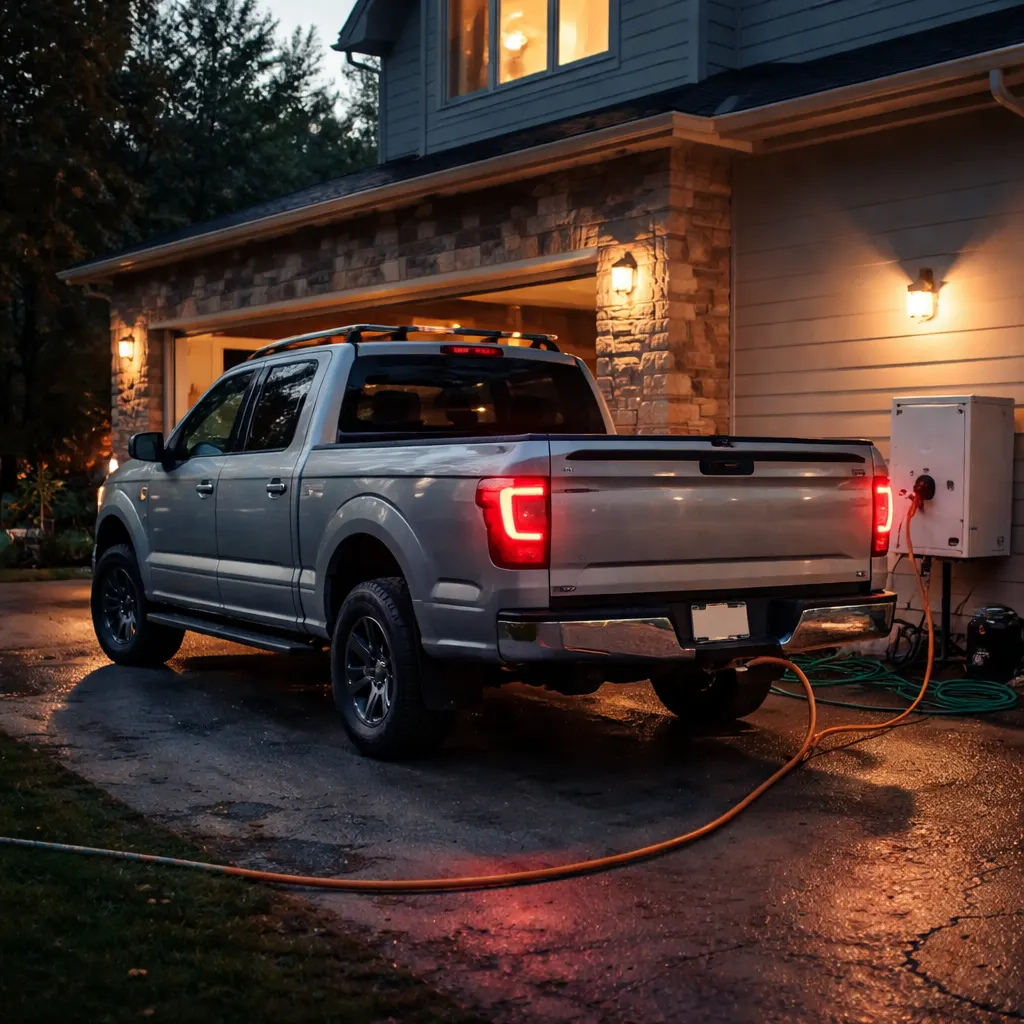
Ford Motor Company and Global Power Products have launched a connector system that lets owners of compatible Ford pickup trucks use their vehicles to supply up to five days of home backup power without expensive home modifications, the companies announced Wednesday. The Ford Vehicle Connector links F-150 Lightning and PowerBoost Hybrid trucks' 240-volt outlets with GPP's GenerLink transfer switch, enabling homeowners to power outlets and hardwired appliances during outages. The solution is designed to serve as an affordable alternative to traditional standby generators, which can run from $7,000 to $15,000 depending on size and location.
Homeowners can expect total costs between $1,350 and $1,550 for the new system, Ford said. The hardware package—comprising the GenerLink transfer switch, a 20-foot GenerLok extension cord, and the 12-inch Ford Vehicle Connector—runs roughly $1,100, while professional installation of the transfer switch typically adds $250 to $450. Over 800 utilities have approved the GenerLink transfer switch for connection to their meters, including investor-owned utilities like Commonwealth Edison and Central Maine Power, plus larger municipal providers such as Austin Energy and hundreds of smaller rural electric cooperatives. Customers whose utilities haven't yet approved the switch can connect trucks to a secondary meter box beside the main meter, though that option costs about $1,000 more after installation.
The system can deliver electricity to home outlets and hardwired equipment like well pumps, sump pumps, security systems, gas furnaces, and lighting that can't run on generator extension cords, the companies said. Nic Saeger, CEO of Global Power Products, told Utility Dive the product "greatly simplifies and reduces the cost of home backup for rural utility customers," who typically face longer outages and rely on more critical hardwired appliances. According to David McCreadie, Ford's director of EV grid energy services, the partnership with GPP offers a far more economical option than the status quo setup, which can cost upwards of $10,000 per installation. Some utilities may offer free or discounted transfer switch installations, Saeger added.
The new connector represents a strategic shift for Ford as it repositions its electrified vehicle lineup beyond pure transportation. McCreadie told Utility Dive the partnership could boost uptake of Ford's electrified models on the margins, as "people who have never bought an electrified vehicle before may not realize that these products go beyond … just transportation." The solution targets rural customers especially hard—those living in far-flung areas where reliability is a constant challenge and many lack municipal water service, making well pumps essential. Ford discontinued its all-electric full-size F-150 Lightning pickup in December after disappointing sales, choosing to redirect some battery manufacturing capacity to stationary energy storage, though the Lightning will return as an extended-range plug-in hybrid.
Ford declined to say whether the smaller, more affordable all-electric pickup it plans to start selling in 2027 will feature the same vehicle-to-load capabilities as current F-150 Lightning and PowerBoost Hybrid trucks. The announcement comes as rural customers across most of the United States face longer and more frequent power outages, according to an analysis of Poweroutage.us data cited by the companies. For Ford truck owners already dealing with unreliable power, the new system offers a path to resilience at a fraction of the cost of traditional backup options.