
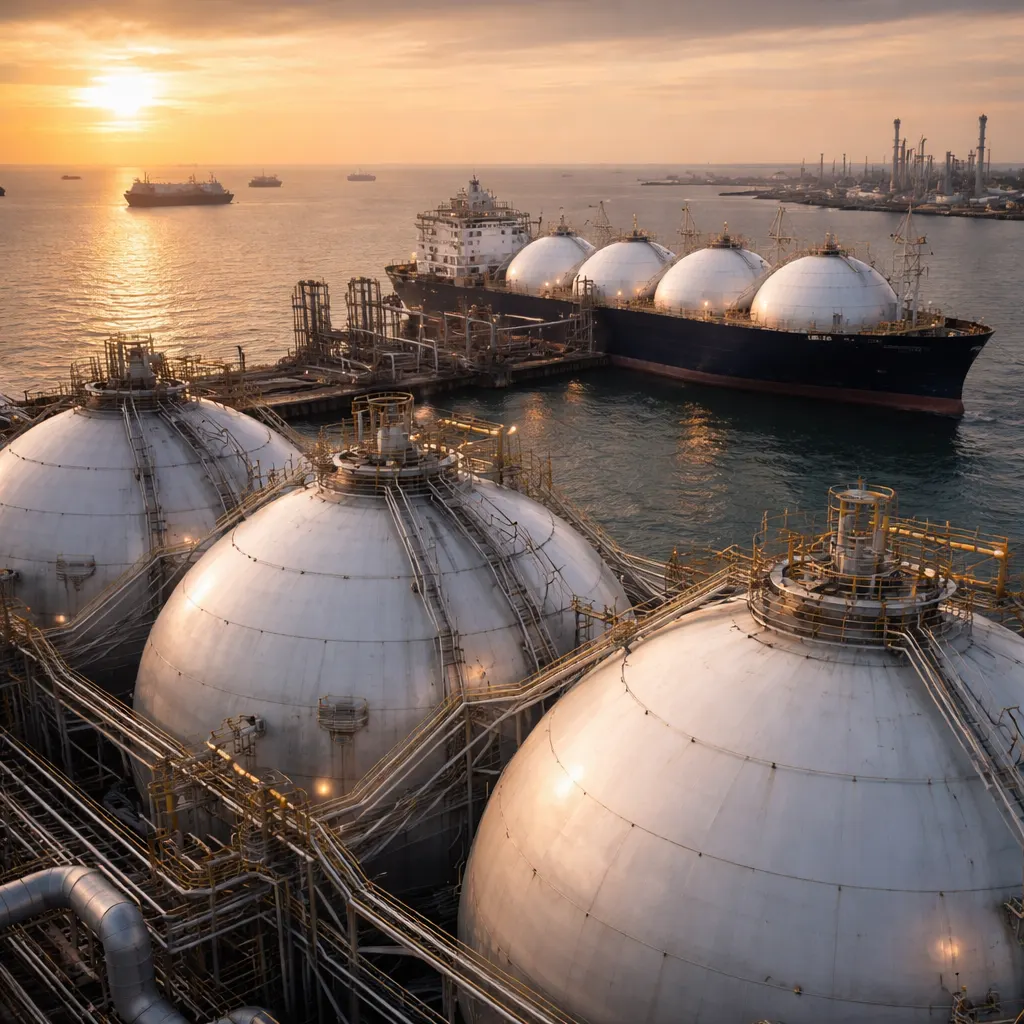
By 2030, roughly half of the world's LNG production capacity will be concentrated in just two countries, according to new research from Wood Mackenzie, the energy research and consultancy firm. If Gulf LNG supply faces an extended disruption, global availability could drop approximately 70 million tonnes per year below pre-conflict levels through 2035, the report warns. That concentration risk has driven a wave of floating LNG projects—seven sanctioned since 2023, adding 18 million tonnes per year of new capacity across six countries—representing the market's most direct attempt at diversification.
The figures show floating LNG's footprint expanding rapidly but remaining a niche technology. Global floating LNG capacity is projected to reach 37 million tonnes per year by 2031, the report states. Seven floating units sanctioned since 2023 total 18 million tonnes annually across six supply locations. All proposed new LNG capacity in South America and West Africa relies on floating designs, making it the only credible export route for producers in Argentina's Vaca Muerta and across West African gas provinces. The technology accounts for less than 10% of new global liquefaction supply. Fleet utilisation averaged 88% in 2024 and 2025, above the 85% onshore average. The pre-FID pipeline contains over 84 million tonnes per year globally across four regions, with an additional 160 trillion cubic feet of undeveloped upstream assets suited to floating LNG worldwide.
The economics confirm a cost threshold has been crossed, according to the report. The June 2026 final investment decision on Delfin LNG FLNG 1—the first floating LNG export facility in the United States and, at 4.4 million tonnes per year, the largest single floating unit sanctioned globally—came in at approximately $932 per tonne, competitive with recent onshore US LNG final investment decisions. Conversions and standardised newbuilds can reach market at or below the sector benchmark of approximately $950 to $1,000 per tonne. Plant breakevens for recent projects cluster between $2.30 and $4.60 per million British thermal units. "The cost gap with onshore has closed and floating LNG now competes on merit in the locations that matter," said Fraser Carson, Principal Research Analyst for Global LNG at Wood Mackenzie. "Cost and technology are no longer the constraints."
What distinguishes floating LNG most from fixed onshore infrastructure is redeployment potential, the report explains. Redeploying an existing vessel costs a fraction of building new: Hilli's redeployment costs to date stand at approximately $350 million, against $1.5 billion to $2 billion for a newbuild floating LNG facility. Golar LNG's Hilli vessel recovered its approximately $1.3 billion conversion cost across an eight-year Cameroon charter by 2023, generating approximately $2.1 billion in tolling EBITDA in the process. A redeployment budget of approximately $350 million and roughly one year of downtime now unlocks a 20-year charter in Argentina with Southern Energy, expected to produce approximately $5.9 billion in contracted revenues. No fixed onshore plant can replicate that sequence, the report notes. Moving within a 30 to 35-year hull life also cuts exposure to upstream resource depletion and single-country risk.
The sector's most visible structural gap is commercial ownership. Of 15 operational and under-construction floating LNG facilities, 12 are project-owned and three are lease-and-operate, all belonging to Golar LNG, which committed to a fourth vessel on a speculative basis in 2026. The lease-and-operate model transfers construction and financing risk to the vessel owner, lowering the capital barrier for frontier producers who lack the balance sheet for a fully integrated project. "One company currently provides FLNG as a service to the entire global market," Carson said. "That single provider sits opposite a pre-FID pipeline of over 80 mmtpa." With well over 80 million tonnes per year of known floating LNG proposals in the pre-FID pipeline, the report concludes, the opening for new entrants is substantial—if commercial structures catch up with the opportunity.