
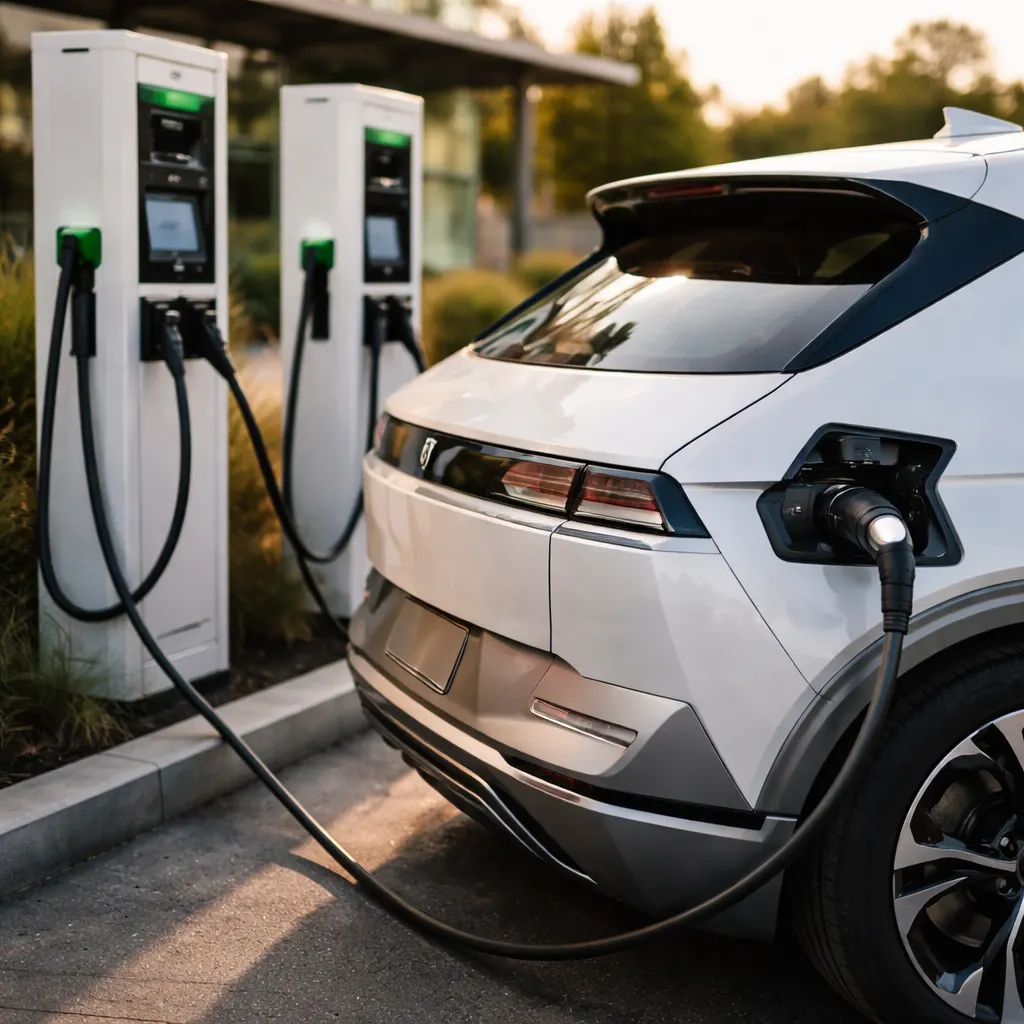
Hyundai Motor Group is consolidating its vehicle-to-everything charging services under a single worldwide entity called AllDayEnergy, which will serve as the platform for upcoming smart-charging and bidirectional-charging technologies across Hyundai, Genesis and Kia vehicles, according to a release from the automaker. The new entity promises a consistent experience across different markets and service types through unified branding and software. Drivers will access functionality through their respective brand apps.
AllDayEnergy will launch in Kia's app for UK owners during the second quarter of 2026, with expansion planned for Europe, the U.S. and Korea. The service will initially cover smart charging, allowing vehicles to charge at specific times of the day — and potentially at reduced power — that can help lower the load on public utilities, enabling them to prioritize lower-emissions sources while drivers take advantage of lower time-of-use rates. Later, the platform will add bidirectional charging to the home and to the grid, known as V2H and V2G respectively. Kia currently offers a bidirectional DC wall charger from Wallbox that, with installation of the accompanying grid disconnect switch, allows the EV9 or EV6 to function as an energy storage device capable of supplying home backup power or EV charging with solar energy.
"When we launch AllDay Energy through our Kia App later this year, we will be taking a significant step towards establishing our identity as a smart energy service provider," said Woong Taue Hwang, VP and head of the EV Energy Strategy Group at Hyundai Motor Group. The AllDayEnergy name "reflects the Group's vision of making smart energy management an integral part of customers' daily lives and advancing its transition into a smart energy solutions provider," according to the company. Hwang added that the company will continue to expand AllDayEnergy service globally, allowing customers to seamlessly optimize their energy usage, reduce their energy costs and contribute to grid sustainability.
Hyundai has pursued bidirectional charging for many years, and the E-GMP platform that underpins most EVs currently offered in the U.S. from Kia, Hyundai and Genesis was engineered for the technology, though taking advantage of it at home currently requires third-party hardware. The automaker has already conducted several pilot projects in Europe using bidirectional charging on the Ioniq 5 EV, and in November 2025 announced plans to expand smart charging and V2G in Europe plus V2H functionality in the U.S., starting soon for the Hyundai brand with the Ioniq 9. AllDayEnergy will face unique challenges in the U.S., most notably that there are about 3,000 electric distribution companies, or utilities, each with a different combination of rates, rules, regulations and permitting. In 2024, BMW Group, Ford Motor Co., Honda Motor Co. and Nissan Motor Co. launched ChargeScape, a technology and services platform intended to connect utilities with EVs from those automakers' brands and vehicles, with Rivian, Tesla and Stellantis joining since, along with several charging networks. General Motors has its own separate GM Energy business unit to oversee energy management, stationary storage and bidirectional charging technology, including its own branded hardware, though Hyundai hasn't yet said if a similar unit is part of the plan for AllDayEnergy.