
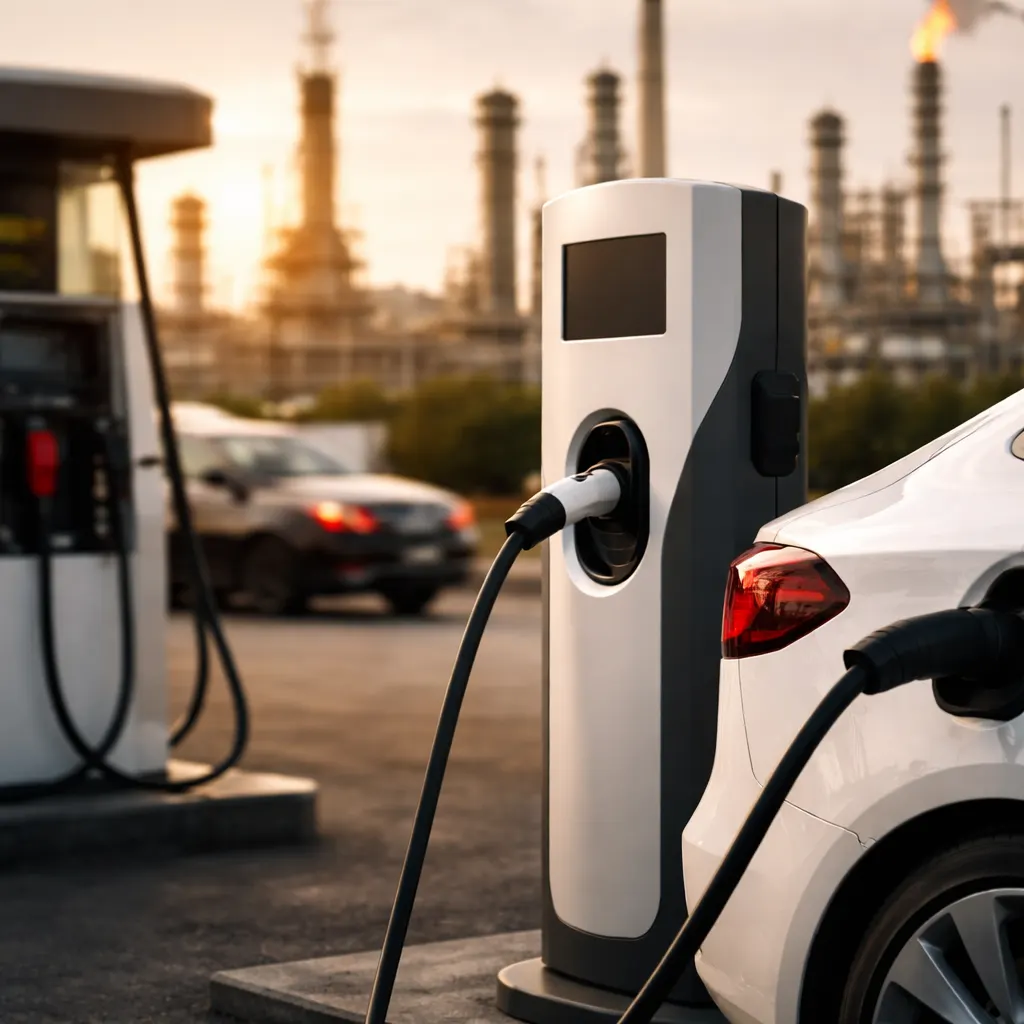
A convergence of energy market shocks, policy responses, and technological advances could push global electric vehicle adoption to 50% above current projections by 2040, according to a new analysis from Wood Mackenzie released in its latest Horizons report. The firm's baseline forecast already anticipates EVs climbing from 4% of the worldwide fleet today to 25% within sixteen years, but the "electric shock" scenario models what happens when government investment, consumer behavior, and battery innovation all accelerate simultaneously. That scenario could slash global oil demand to 99 million barrels daily by 2040—5 million barrels below the base case and roughly equal to today's consumption—potentially forcing around 40 refineries worldwide to shut down early.
China has already reached 42% EV share of car sales in the second quarter of 2026, up from 33% a year earlier, and the electric shock scenario would push annual Chinese EV sales from 8.9 million in 2025 to 29.9 million by 2040. Manufacturing capacity in China could expand by half before 2035, with cost advantages enabling aggressive growth across developing nations. By contrast, US passenger EV sales dropped 33% in the first five months of 2026 compared to the same period in 2025 following the removal of tax incentives, leaving EVs at just 3% of the American vehicle fleet. Europe announced some 60,000 auto sector layoffs in 2026 alone, though the report assumes a "grand bargain" trading tariff relief for Chinese investment in local plants, which could result in a European EV fleet 53% larger than baseline projections by 2040.
"If these forces converge all at once, the effect on EV adoption could be dramatic," said David Brown, Director of Energy Transition Research at Wood Mackenzie. The report quantifies the implications for commodity and power markets, noting that additional policy measures in China—including new gasoline consumption limits, full purchase tax exemptions, and larger credits—could cut EV total cost of ownership by roughly 30%. According to Brown, securing critical mineral supplies and technological expertise will deliver lasting strategic advantage for OECD countries, particularly as battery supply chains face surging demand from the global artificial intelligence boom and energy storage needs.
Supporting the accelerated EV growth would require an additional $45 billion in greenfield metals supply over the next decade, with copper presenting the most significant constraint. Annual mine capacity additions would need to climb from the long-term average of roughly 850,000 tonnes per year to approximately 960,000 tonnes through 2040, absorbing about $25 billion of that total investment. Much of this capital would flow into higher-risk countries including Argentina, the Democratic Republic of Congo, and Pakistan, and if established mining regions like Chile, Peru, and the United States don't streamline permitting and maintain competitive tax structures, a larger portion of future production will shift toward state-backed Chinese companies. Charging infrastructure presents a parallel hurdle: China would need an additional 4 million public ports by 2040, representing roughly $200 billion in new investment, while Europe would require an extra $108 billion to build 2.7 million ports above baseline assumptions. The world's 7 million existing public charging ports currently operate at just 15% capacity, but the electric shock scenario would consume that slack rapidly.
The report emphasizes that managed charging—programs shifting EV charging to times when grids have ample supply and costs are lowest—will prove essential to accommodate higher power demand without destabilizing electricity systems. Western Europe already manages 50% of EV charging this way, and under the electric shock scenario that proportion would climb to 85% across the continent by 2040. The United States, where managed charging currently accounts for only 5% of sessions, would need to follow suit to keep pace with faster adoption. For the US auto sector, targeted policy support could attract foreign direct investment into EV supply chains and new greenfield plants using modular technologies, bringing total cost of ownership parity with gasoline vehicles forward to 2031—two years ahead of the base case—and leaving the American EV fleet 51% larger than baseline by 2040, though without advanced battery technologies and competitive supply chains, the sector risks losing its home market to international rivals.