
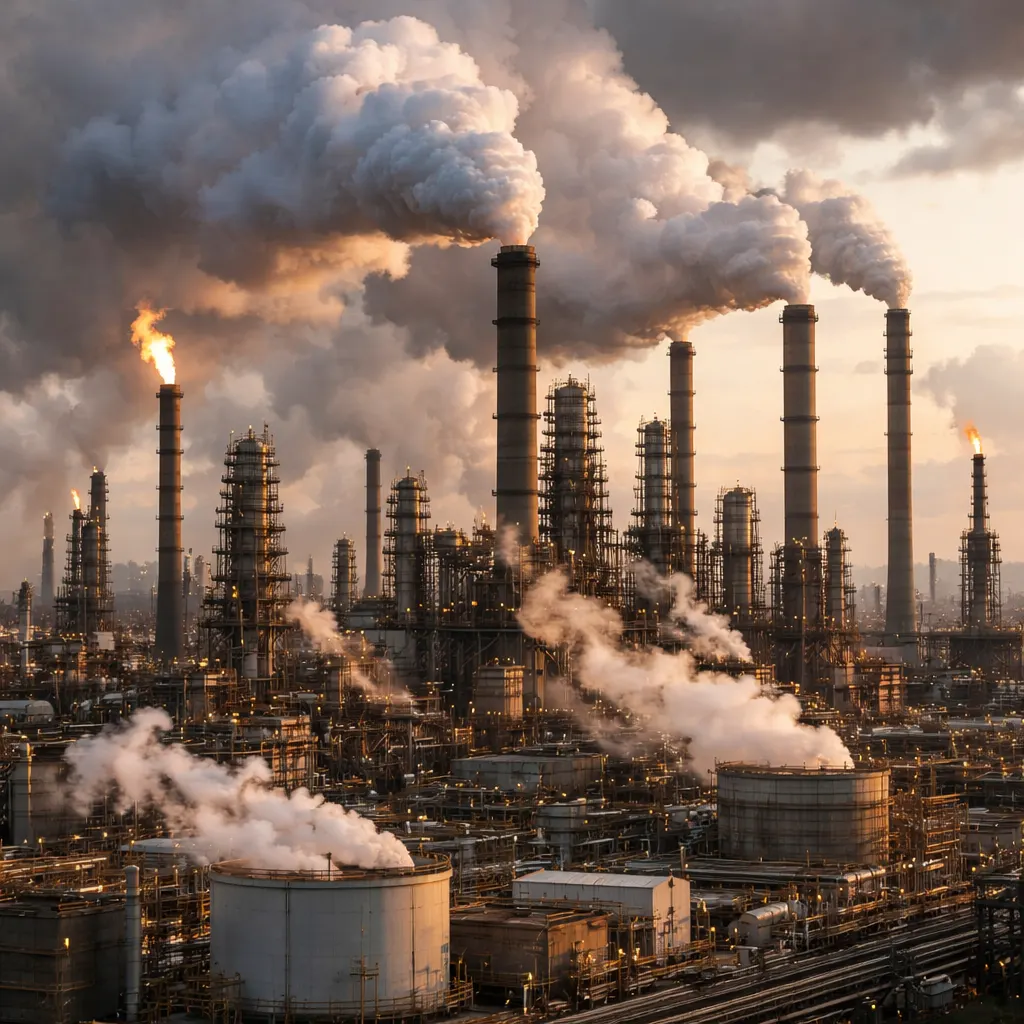
Global petrochemical production released 1.8 billion tonnes of carbon dioxide equivalent in 2020, according to a study published in *Nature Sustainability*. The research, which tracked emissions from 37,379 facilities worldwide, provides the first facility-level breakdown of greenhouse gas emissions across the chemical industry. The authors found that just 10% of plants account for 53% of total emissions, presenting what they call a major opportunity for targeted climate action.
China dominates global petrochemical emissions, responsible for 37% of the worldwide total at 660 million tonnes of CO2 equivalent in 2020. Most of the sector's emissions are indirect: 45% come from electricity and other energy used by facilities, while 34% stem from extracting and processing fossil feedstocks like oil and gas. Thermoplastics alone account for 75% of indirect emissions, totaling 1.3 billion tonnes. Carbon dioxide makes up 74% of the industry's climate impact over a century, but methane and nitrous oxide contribute 15% and 11% respectively despite lower volumes, due to their stronger warming effects. Over a 20-year timeframe, methane's share jumps to 33% of total warming potential. The top nine producing countries generated 76% of emissions in 2020, a figure projected to rise to 79% by 2050 under current trends.
The study reveals that 83% of emissions attributed to final chemical products are embodied emissions from producing the upstream primary and intermediate chemicals used as building blocks. Adipic acid production, used mainly in nylon manufacturing, releases 210 million tonnes of CO2 equivalent annually, with 90% coming from direct nitrous oxide emissions during the chemical reaction itself. For methanol, China accounts for 65% of production emissions, and 62% of those emissions concentrate in a single facility. The authors write that decarbonizing primary and intermediate chemical production should be the priority for cutting the overall carbon footprint of petrochemical products.
Even under highly optimistic scenarios, the petrochemical industry won't reach net zero by 2050, the report finds. The researchers modeled pathways that combined complete grid decarbonization, 100% deployment of carbon capture and storage at eligible facilities, and total replacement of fossil feedstocks with plant-based alternatives. Residual emissions remained in every case. Under business-as-usual projections, global petrochemical emissions will climb to 2.3 billion tonnes in 2030 and 3.0 billion tonnes by 2050. The structure of chemical production networks complicates solutions: facilities producing olefins and aromatics typically operate as tightly integrated complexes sharing feedstocks and heat flows, making it difficult to change one process without triggering costly engineering changes throughout the plant. Ammonia and methanol plants, by contrast, usually stand alone and can more easily switch to alternative feedstocks like biomass.
The report argues that prioritizing the highest-emitting facilities could dramatically accelerate progress. By targeting the top 10% of emitters first rather than spreading efforts evenly, the industry could save 23 billion tonnes of CO2 equivalent by 2050 and bring emissions below 2020 levels by 2025 instead of 2045. The authors caution that electrifying chemical plants before cleaning up electricity grids could actually increase emissions in the short term, particularly in regions that still rely heavily on coal power. Plant-based feedstocks can't scale up to replace all fossil inputs without major ecological consequences, including habitat destruction and competition with food crops. No single solution can deliver net-zero petrochemicals, the study concludes, and demand reduction may prove more effective than any supply-side measure for achieving substantial cuts.