
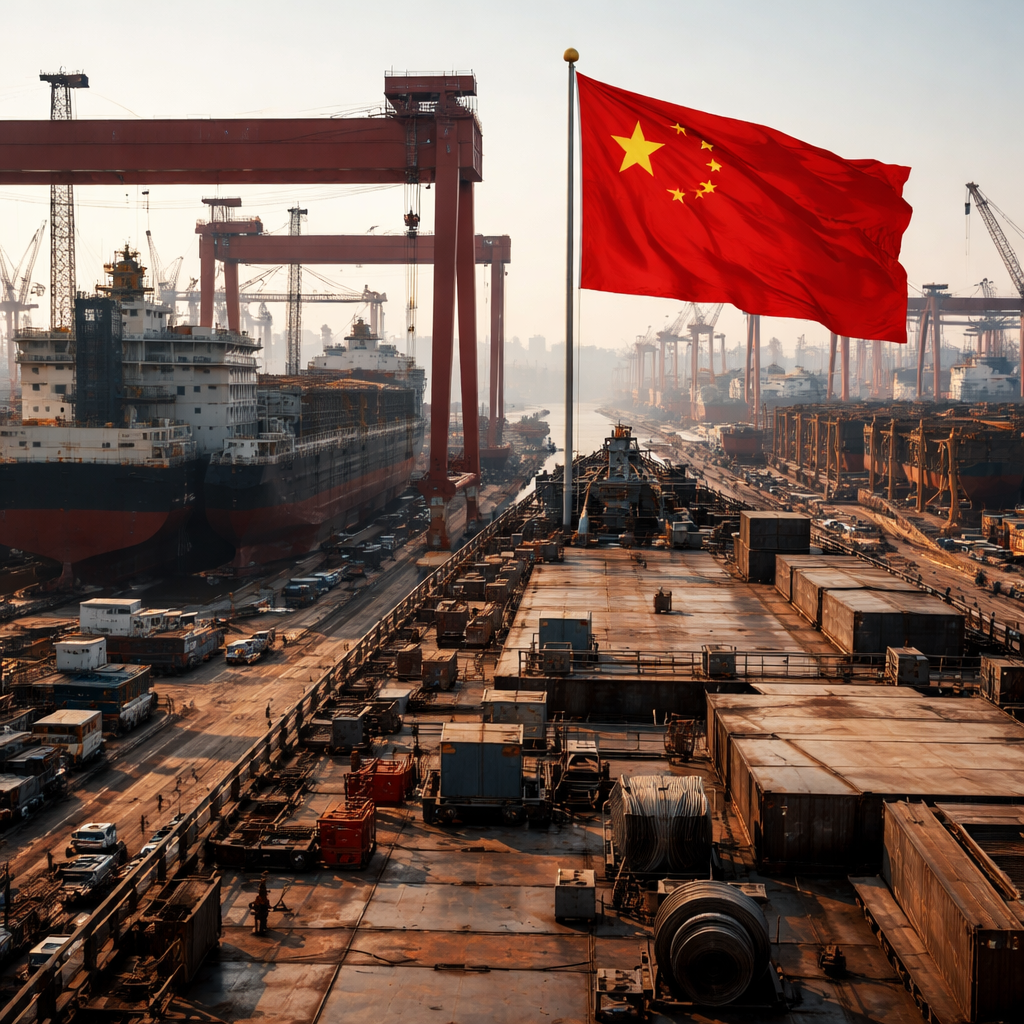
China accounted for more than half of all ships delivered worldwide in 2025, cementing its position as the dominant force in global shipbuilding while OECD economies face declining market shares, widespread yard closures, and mounting job losses. The findings come from a new analysis published June 8, 2026, by Laurent Daniel, Head of the OECD Shipbuilding Unit, examining how China's rapid rise has reshaped competition in an industry that underpins more than 80% of global goods transport. The pressure on traditional shipbuilding nations has intensified over two decades, forcing painful restructuring across Europe, Japan, Korea, and the United States.
The data paint a stark picture of decline. The European Union's share of global ship deliveries, measured in compensated gross tonnage, collapsed from over 20% in 2000 to about 10% by 2007, and has since fallen to just 4–5%, with Germany, the United Kingdom, and Nordic countries seeing widespread yard closures. In Japan, sectoral employment crashed from roughly 250,000 workers in the 1980s to about 71,000 in 2024 as production consolidated into fewer builders. Korea, the second-largest shipbuilding economy globally, has weathered recurring financial crises among its three largest shipbuilders, triggering periodic restructuring and layoffs. The United States lost more than 70% of its active commercial shipyards since 1975, shedding over 70,000 jobs in the process.
China's dominance extends beyond volume to price. An OECD analysis of 1,777 ship orders placed between January 2020 and December 2024 reveals that Chinese-built vessels consistently undercut competitors across market segments. For intermediate-size containerships, Chinese prices run nearly 10% lower than ships from other major economies. The gap widens to around 14% for the largest product tankers, and even in higher-value segments like liquefied natural gas carriers, Chinese shipyards maintained an average price advantage of roughly 5% over four years. More than two-thirds of China's 2025 shipbuilding output was sold to foreign owners, demonstrating that this capacity serves global demand, not just domestic needs.
The report finds that China's manufacturing labour costs remain more than three times lower than Korea's and nearly twice as low as Japan's, though the gap has narrowed since the early 2000s when Chinese costs were roughly 20 times lower. Government support reinforces this advantage: new analysis from the OECD MAGIC database shows total subsidies to the global shipbuilding sector exceeded $1.5 billion in 2023 and 2024, with Chinese companies accounting for $1.3 billion—84% of the total—in 2024 alone. Those subsidies represented about 2.5% of Chinese firms' revenues in 2024, compared to just 0.2% for OECD companies. Over 2010–2024, China received $21.3 billion in subsidies versus roughly $4 billion for the rest of the world combined.
The cost differential stems from both wage gaps and extensive government backing. While China's labour cost advantage has eroded over time, it remains substantial enough to underpin persistent price competition. The subsidies flowing to Chinese shipbuilders dwarf support in OECD countries, and that advantage extends upstream: the OECD Steel Outlook 2026 showed China's steel subsidisation rate is fifteen times higher than OECD nations. Many OECD shipyards responded by pivoting to high-value niches like LNG carriers, cruise ships, and offshore platforms, where technology and customisation matter more than price. The EU concentrated heavily on cruise ships, which accounted for around 65% of its deliveries over the past decade. But the report notes that shelter is eroding: China has diversified beyond conventional vessels into gas carriers and cruise ships, and captured 68.5% of alternative-fuelled vessel orders in 2024.
The outlook remains challenging. According to the report, China's structural cost advantages show no sign of abating, and government support continues undiminished even as competitive pressures extend into niche markets once dominated by OECD builders. The OECD Shipbuilding Committee provides the only dedicated international platform for cooperation among shipbuilding economies, working to promote fair and open competition. For governments facing rising economic security concerns, the stakes reach beyond shipbuilding itself—how they respond will shape their industrial competitiveness and strategic autonomy for years to come.