
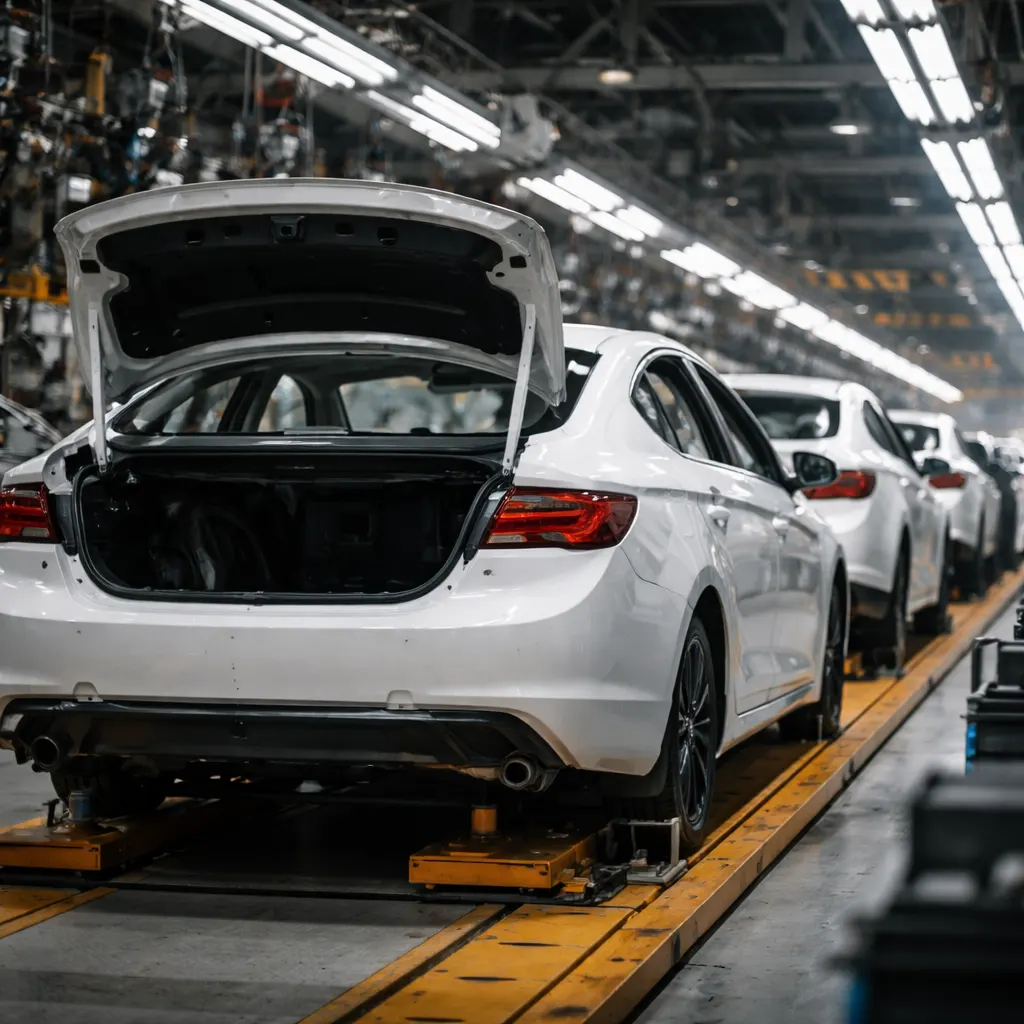
The European Union's passenger car production has fallen by roughly 2.6 million units since 2019, a 19 percent drop, as the automotive sector confronts electrification, Chinese competition and stagnant consumer demand. A new policy brief published by Bruegel in September 2026 finds that the EU's response—centred on tariffs, local-content requirements and regulatory relief—attempts to satisfy three incompatible objectives simultaneously: maintaining the shift away from combustion engines, shielding domestic supply chains from imports, and keeping vehicles affordable for European consumers. The report argues that these objectives are in tension, with tariffs and EU-origin requirements raising consumer prices while the electric transition reshapes domestic production.
Despite the production decline, the EU remained a net exporter of vehicles in 2025, with exports totalling €157 billion against imports of €75 billion. However, exports dropped from a 2023 peak of €168 billion, driven largely by declining sales of internal combustion engine vehicles—the EU's traditional strength—as global demand shifted toward electric vehicles. Chinese-built EVs passed 20 percent of total EV sales in the EU in 2026, equivalent to over 5 percent of all vehicle sales, with more than half of those being western-branded cars manufactured in China. EU electric vehicle exports in 2025 generated a €14 billion trade surplus, with the United Kingdom, United States and Norway accounting for 63 percent of those exports. Meanwhile, Europeans bought 2.2 million fewer new cars in 2025 than in 2019, though it's unclear whether this reflects a temporary dip or a structural shift tied to greater public transport use and waning car ownership among young people. The sector still employs 14 million Europeans across the full value chain and accounts for 7 percent of EU GDP, with employment concentrated in Germany, France, northern Italy and central Europe.
According to the authors, the EU should pursue a balanced strategy to support transformation at a critical phase of the climate transition, keeping costs to consumers and taxpayers proportionate to the benefits of preserving industrial capacity and jobs while maintaining an ambitious pace of decarbonisation. The report states that any support should be temporary and linked to industry efforts to improve competitiveness in manufacturing affordable electric vehicles. The authors recommend that economic-security concerns be tackled through resilience criteria rather than local-content requirements, and by prioritising structural competitiveness enablers like labour costs, energy prices, skills and charging infrastructure. The brief also notes that since 2017, more than €76 billion has been invested in battery and EV manufacturing facilities across Europe, with about €3 billion per quarter continuing to flow into new production sites, demonstrating that the sector "remains a large net exporter, records historically high profit margins and continues to invest."
The report explains that the shift in EU automotive policy amounts to an implicit pact: the EU shields European producers from external pressures, and in exchange, producers Europeanise their value chains through local-content requirements and foreign investment conditions, with consumers and taxpayers bearing the costs through higher vehicle prices, subsidies and revenue foregone from reduced competitive pressure. This creates two fundamental trade-offs—one short-term, one long-term—that policy must confront. The short-term trade-off pits the speed of a clean transition against economic security, because protection and local-content requirements raise the cost of EVs, with each "Made in EU" requirement for batteries, green steel and other components adding a per-vehicle cost premium that falls disproportionately on entry-level segments and less-wealthy consumers. The long-term trade-off sets competitiveness and innovation against resilience: when competitive threats from abroad are blunted and regulatory pressure reduced, producers have less reason to accelerate electrification, invest in autonomous-driving software or close the cost gap with Chinese rivals. The authors point to historical precedents, including Europe's 1991 agreement with Japan that capped car exports until 1999, which bought European producers breathing space but also raised consumer prices and encouraged Japanese investment in European plants.
The report concludes that rather than focusing mainly on protections, the EU should complement autonomous trade instruments with a negotiated sectoral arrangement with China. Such an agreement could combine Chinese export quotas covering both battery and plug-in hybrid electric vehicles, commonly agreed principles on inward investment, a Chinese commitment not to restrict exports of critical EV inputs, and a standstill on new EU trade-defence investigations while the agreement is in force. The authors emphasise that any such arrangement should be strictly temporary—progressively increasing quota size and limited to a maximum duration that maintains the incentive for EU producers to close the competitiveness gap. The fundamental problem, the brief states, is the need to adjust to a new competitive environment with Chinese producers assuming a growing share of global automotive sales, which calls for a time-limited safeguard linked to industry efforts to adjust rather than indefinite protection.