
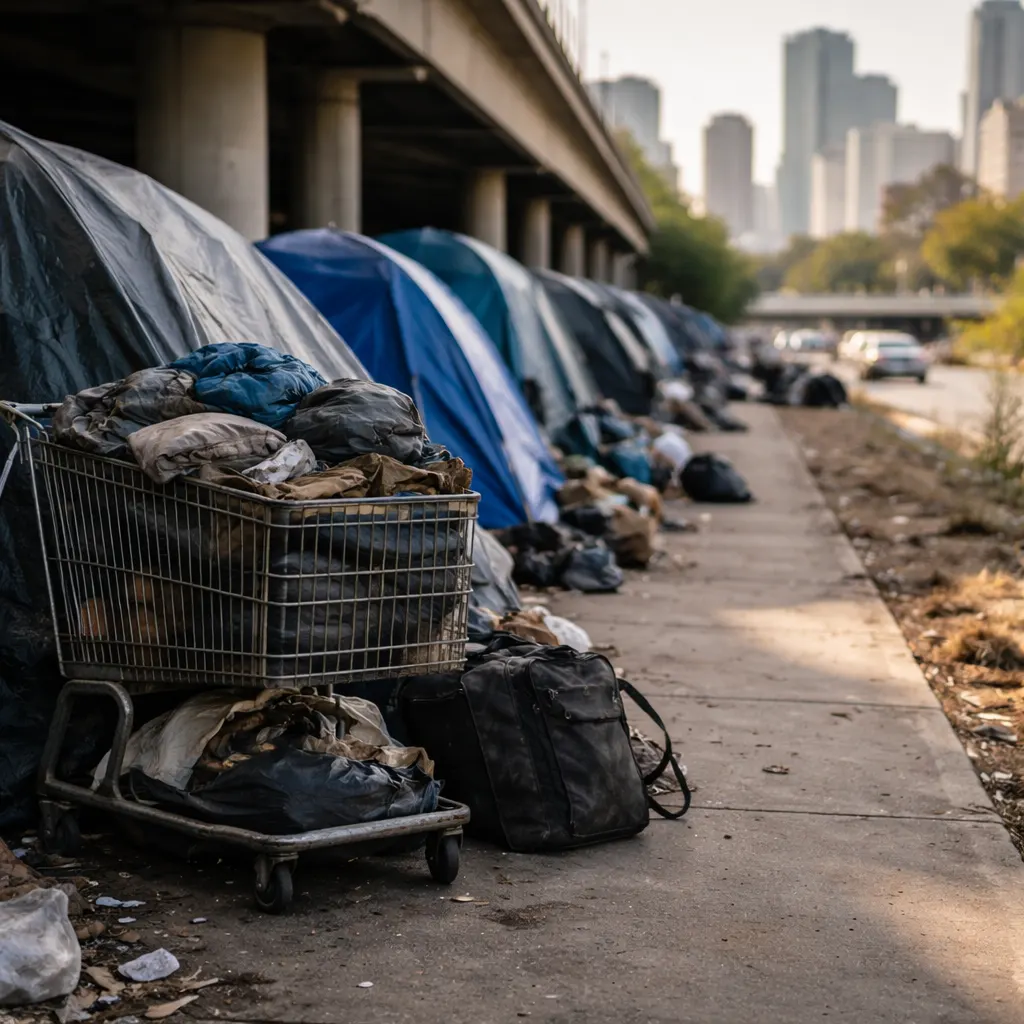
Austin has spent roughly $1.5 billion on homelessness over the past six years, yet for the tenth consecutive year, the city's homeless population has continued to rise, according to a new report from Austin Reform published by the Texas Public Policy Foundation. The analysis tracks how city and county dollars flow through what the report calls the "homeless industrial complex"—a sprawling network of government agencies, nonprofits, and public-private partnerships that together pour roughly $304 million annually into services that have failed to reduce unsheltered homelessness. The report concludes that the current strategy isn't working and that the real issue isn't the amount of money spent, but how it's allocated.
The spending breaks down into five major streams, many of which operate off the city's official ledger. The city's general fund allocates $35 million annually for basic shelter operations, the Marshalling Yard, and street outreach contracts. Travis County operates a parallel system that funnels an estimated $60 million per year into the same nonprofit network through its $110 million ARPA allocation and healthcare contracts. Another $45 million flows annually from voter-approved housing bonds and the Austin Housing Finance Corporation to buy and convert hotels like Pecan Gardens—capital infrastructure spending that never appears on operational budget sheets. The federal government contributes $14 million through stable Continuum of Care grants administered by ECHO, bypassing city financial reporting entirely. Finally, the "Finding Home ATX" public-private initiative claimed to have raised $450 million before its website went dark, operating with no unified public ledger and zero centralized oversight. According to city budget data, homelessness spending has climbed from roughly $35 million in fiscal year 2017 to over $80 million in 2025, even as Point in Time counts show the homeless population growing from about 2,200 to more than 3,200 over the same period.
The report finds that roughly two-thirds of Austin's fiscal year 2025 homelessness budget—about $55 million of $82 million—goes to emergency shelter and housing vouchers, which "all have their place in the CoC environment but are not long-term solutions to homelessness." Supportive services like workforce development account for just over 5% of spending. The authors write that this imbalance shows "homelessness spending does not need to increase; it only needs to be reapportioned to achieve better results." The report also notes that from 2007 to 2013, Austin's homeless population actually fell during one of the worst economic periods in recent U.S. history, when the city maintained a balance between emergency and transitional housing beds. But from 2015 onward, as spending increased, so did homelessness.
The report argues that the current model follows federal dollars without questioning whether those programs work, creating a cycle where rising homeless populations justify more spending on the same failing services. Continuum of Care programs currently operate without accountability, the authors say, and privacy rules prevent police, EMS, and outreach teams from sharing data on homeless individuals—even though such data sharing helped Waikiki reduce unsheltered homelessness by 78% and crime by 18% over three years starting in 2022. The report points to Austin as a cautionary tale for Texas's other major cities: San Antonio, Dallas, Fort Worth, and Houston all rank among the five most populous Continuum of Care regions in the state, with homeless populations ranging from 2,594 to 3,625 people.
The report recommends four major reforms: third-party audits of all Texas CoC programs to expose fraud and waste, legislation to allow data sharing between law enforcement and service providers, expanded crisis service centers to provide space for people cleared from encampments without clogging jails or hospitals, and enforceable accountability measures—including withholding city sales tax revenue—for cities that fail to make reasonable progress on clearing encampments. The authors conclude that although homelessness can't be solved by policy alone, the state can use its authority to assess the problem's scope, realign resources, and create conditions that move Texas closer to ending homelessness. The bottom line: throwing more money at a broken system won't fix it.