
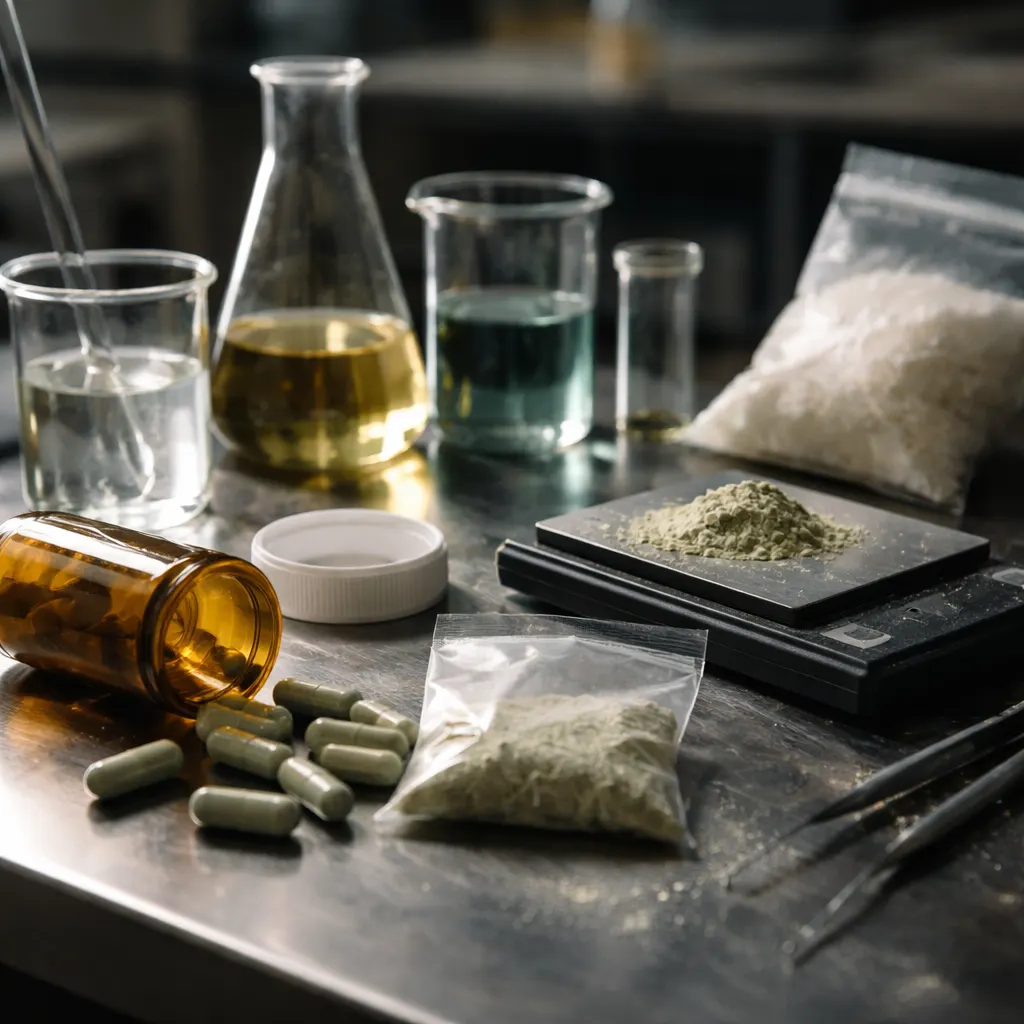
The Drug Enforcement Administration wants to place products containing 7-hydroxymitragynine (7-OH)—a derivative of kratom tree leaves—on Schedule I of the Controlled Substances Act, the strictest category under federal drug law. A new analysis from the R Street Institute argues that prohibition will likely do more harm than good, blocking medical research while pushing consumers toward unregulated illegal markets. The report questions whether the DEA's proposed ban addresses the real problems in the 7-OH market, which center on product quality and consumer information rather than the substance itself.
Laboratory testing reveals serious quality-control issues in the current market. One study found that more than 98 percent of tested 7-OH products were semisynthetic, meaning manufacturers chemically converted kratom compounds to make them more powerful. The same research uncovered differences between labeled and measured amounts, plus unwanted chemicals created during processing. Another study found products falsely labeled as "kratom extracts" contained 22 to 75 milligrams of 7-OH per gram—far more potent than natural kratom leaf. Even websites run by vendors following voluntary manufacturing standards scored poorly on explaining benefits and risks to consumers.
The report finds that Schedule I classification creates major obstacles to understanding 7-OH's risks and benefits. Researchers can study Schedule I substances, but they face extra federal requirements for registration, research plans, storage, recordkeeping, and access to study material—hurdles that studies of cannabis and psychedelics found delayed projects, raised costs, and restricted research materials. According to the analysis, a review of kratom research identified major gaps in safety data, patterns of use, and product testing, yet stricter scheduling would make filling those gaps harder. The report also notes that federal "temporary" scheduling often becomes permanent: the DEA temporarily placed five synthetic cannabinoids and three synthetic cathinones on Schedule I in 2011, and by 2013 all had become permanent Schedule I drugs.
The case for prohibition over regulation is weak, the report argues, because no study has yet measured what a federal 7-OH ban would do to consumers or sellers. A systematic review found that 14 of 15 studies linked stronger drug-law enforcement with more violence in illegal markets. State comparisons showed fewer reported kratom poisonings and kratom-positive overdose deaths in ban states, though studies couldn't prove the bans caused these differences and didn't measure illegal sales, arrests, or substance switching. Meanwhile, the DEA states that unauthorized possession, manufacture, or sale of covered products would face federal civil and criminal penalties—meaning people who now buy 7-OH legally for pain or withdrawal could face prosecution, along with problems securing employment, housing, and healthcare access.
The report recommends that the Department of Health and Human Services and the DEA skip temporary scheduling and work with the Food and Drug Administration and Congress on enforceable product standards instead. Proposed safeguards include requiring labels to state the 7-OH amount in each serving, mandatory batch testing for strength and contaminants, child-resistant packaging, minimum purchasing age, warnings about dependence and drug interactions, limits on youth marketing, and reporting of serious adverse events. The bottom line: a legal market gives regulators a place to inspect, test, and enforce rules, while Schedule I control creates research barriers and could push demand into unregulated markets where sellers have no reason to verify age, use accurate labels, or recall defective products.