
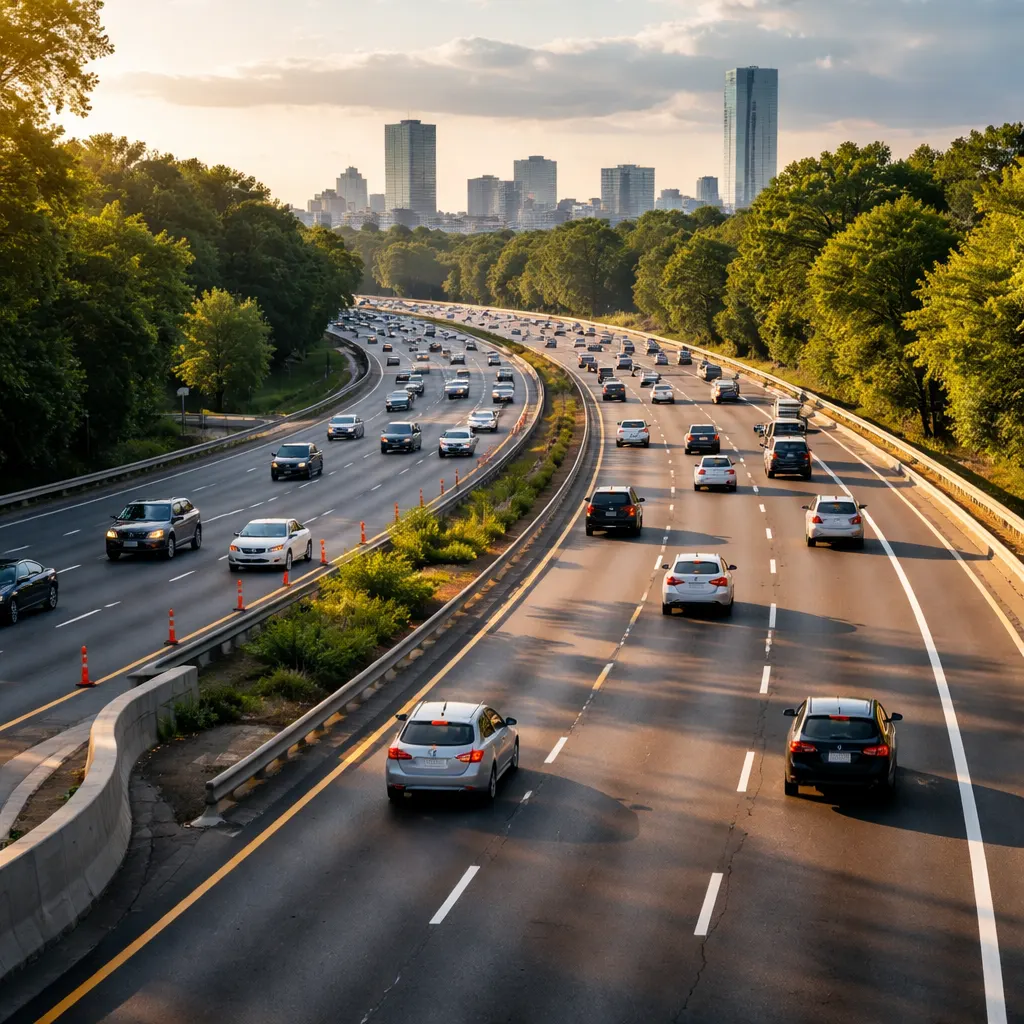
Massachusetts' highway system jumped 23 positions in national rankings, climbing from 40th to 17th place for overall cost-effectiveness and condition. According to the 29th Annual Highway Report published by Reason Foundation, the state's dramatic improvement reflects stronger performance in maintenance spending efficiency and rural safety, even as urban congestion remains a persistent challenge. The report evaluates state-controlled highways across 13 categories, including pavement and bridge conditions, traffic fatalities, congestion, and spending.
The state's highway performance varies sharply across different measures. Massachusetts ranks 2nd nationally in rural fatality rate and 3rd in urban fatality rate, demonstrating exceptional safety outcomes. However, the state places 49th out of 50 in traffic congestion, with drivers spending roughly 64 hours annually stuck in traffic. Pavement condition rankings show similar contrasts: the state ranks 17th for rural arterial pavement condition and 20th for urban interstate pavement condition, but falls to 46th for urban arterial pavement condition. Bridge infrastructure ranks 38th for structurally deficient bridges. On spending, Massachusetts ranks 6th in capital and bridge disbursements—the costs of building new roads, bridges, and widening existing ones—and 15th in maintenance disbursements such as repaving and pothole repairs. Administrative disbursements, which include office spending that doesn't reach roads, rank 38th nationwide.
The report's lead author, Baruch Feigenbaum, identified specific priorities for the state moving forward. "Massachusetts should focus on improving its Urban Arterial Pavement Condition and reducing Urbanized Area Congestion," said Feigenbaum, senior managing director of transportation policy at Reason Foundation. He noted that "the state performs strongly in fatality rates and spending efficiency," but emphasized that "its poor rankings in congestion and urban pavement condition remain significant challenges." The most dramatic improvements since last year's report came in maintenance disbursements, which rose from 41st to 15th, and rural fatality rate, which climbed from 24th to 2nd. The state's biggest decline occurred in urban other principal arterial pavement condition, dropping from 41st to 46th.
The report positions Massachusetts ahead of several neighboring states including Vermont (38th), Rhode Island (43rd), and New York (47th), but behind Connecticut (7th) and Maine (16th). Among similarly populated states, Massachusetts outperforms Indiana (18th) but trails Tennessee (12th). The rankings use federal data primarily from 2023, with performance categories ranking states from 1 (best outcome, such as lowest fatality rate) to 50 (worst outcome), while cost-effectiveness categories rank from 1 (lowest spending) to 50 (highest spending). The state's safety achievements stand in sharp contrast to its congestion crisis, suggesting that while Massachusetts has made progress on keeping drivers alive, it hasn't solved the problem of keeping them moving.
The report's findings point to a state at a crossroads between competing infrastructure priorities. Massachusetts' strong safety record and improved maintenance efficiency demonstrate capacity for targeted improvements, yet urban congestion and deteriorating city arterial roads signal gaps in metropolitan infrastructure investment. With drivers losing nearly three full workdays per year to traffic delays, the economic and quality-of-life costs of congestion are mounting even as fatal crashes decline. The state's challenge will be maintaining its safety gains while addressing urban mobility—a balancing act that will require both strategic spending and focused attention on the arteries that carry city traffic.