
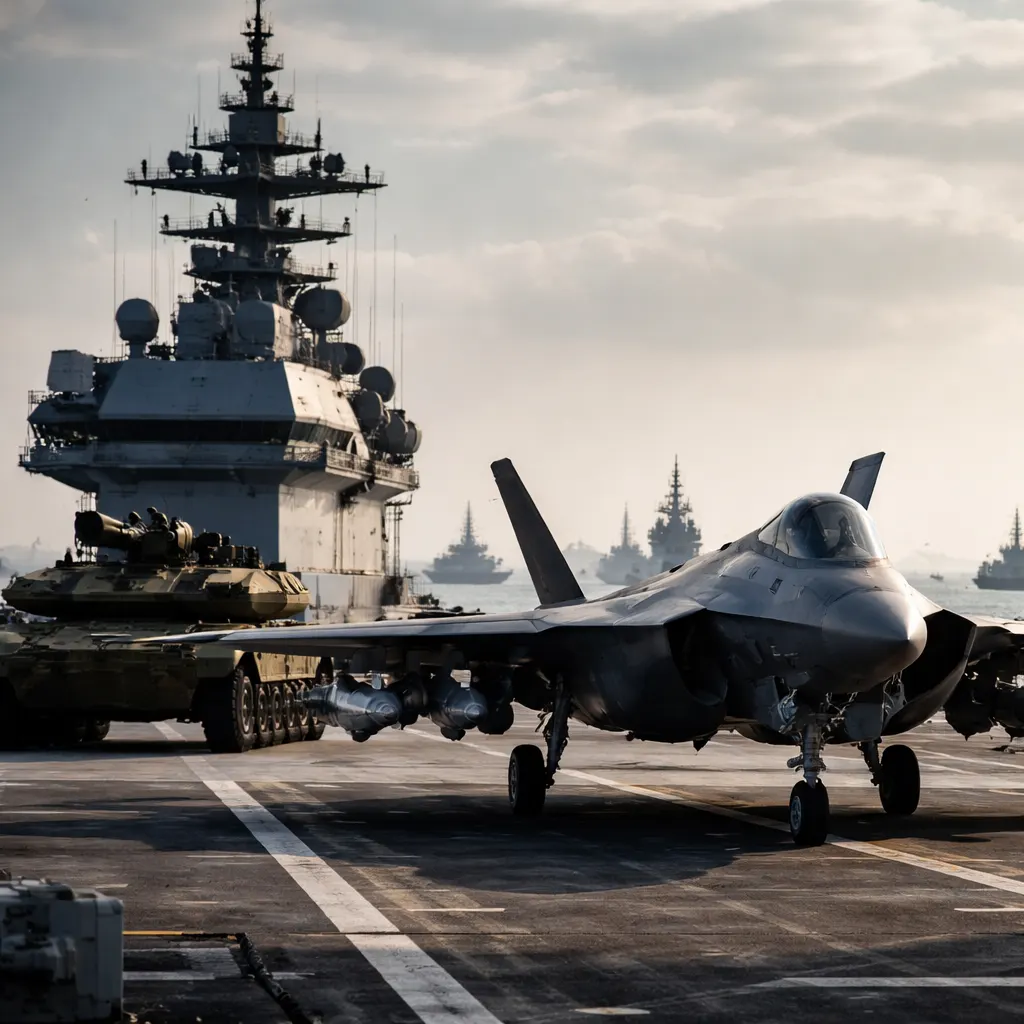
For nearly eight decades following World War II, Japan refused to wage war, project military might, or acquire offensive arms, relying instead on the United States to fight while it focused solely on homeland defense. That era has ended. A new report from the Hoover Institution finds that Japan has quietly executed the most sweeping overhaul of its defense doctrine since 1945, transforming itself from a constitutionally pacifist nation into one of the Indo-Pacific's most forceful proponents of military deterrence. The shift began under Prime Minister Shinzo Abe, gained momentum under Fumio Kishida, and is now being fully carried out by Prime Minister Sanae Takaichi.
Japan has launched the largest defense expansion in its modern history, abandoning a decades-long informal cap that held military spending to roughly one percent of GDP and moving toward NATO-level expenditure standards. The nation is now developing long-range cruise missiles, hypersonic arms, precision-guided strike systems, and counterstrike capabilities designed specifically to hit military installations deep within China's territory—including command centers, logistics hubs, missile bases, naval facilities, and airfields. Weapons procurement has been completely reorganized, shifting from small batches of highly sophisticated platforms to mass production of cheaper, expendable autonomous systems such as drones, unmanned surface vessels, autonomous underwater vehicles, AI-enabled reconnaissance tools, electronic warfare platforms, rail guns, and other next-generation arms. The country has formally identified China—not North Korea or Russia—as its primary long-term national security threat, marking a dramatic departure from Cold War-era strategic thinking.
According to report author Miles Yu, Japan's Self-Defense Forces were designed almost exclusively for homeland defense for decades, with offensive strike capability remaining politically taboo and military doctrine assuming Japan would absorb an attack while American forces conducted offensive operations. "That assumption has disappeared," the report states. The document argues that Abe grasped earlier than nearly any democratic leader that China's challenge was fundamentally different from traditional threats Japan had prepared for throughout the Cold War, possessing the economic, industrial, technological, and military capacity to overturn the strategic balance in East Asia. The report concludes that the purpose of Japan's new strike systems is deterrence through denial: Chinese planners must now calculate that aggression against Taiwan or Japan could expose critical military infrastructure on the Chinese mainland to immediate and devastating counterstrikes.
The transformation reflects an uncomfortable reality that the Ukraine war made clear: modern warfare is ultimately an industrial competition where stockpiles, production rates, and manufacturing resilience matter enormously. The report explains that any future conflict with China would pit Japan against the world's largest industrial manufacturing base, making quantity nearly as important as quality. Rather than trying to match China platform for platform, Japan's emerging Unified Integrated Defense System seeks to exploit specific vulnerabilities in the People's Liberation Army—including relatively limited combat aviation range over the Pacific, dependence on fragile command-and-control networks, uncertain combat experience, logistical challenges beyond the First Island Chain, and engineering weaknesses that accompany rapid weapons development. Japanese planners are combining integrated air and missile defense, space-based surveillance, cyber operations, electronic warfare, unmanned systems, distributed maritime operations, resilient command networks, and long-range precision fires into a single operational architecture designed to disrupt the PLA's strengths while magnifying its weaknesses.
The report concludes that history may ultimately remember Abe not simply for the Free and Open Indo-Pacific, the Quad, or the revitalized U.S.-Japan alliance, but for something more enduring: he changed how Japan thinks about war. For generations, Japan believed that avoiding offensive capability was the surest path to peace. Abe concluded that in an age of revisionist authoritarian powers, peace depends not on the absence of military power but on the credible ability to use it. Kishida institutionalized that insight, Takaichi is implementing it, and together they've completed a strategic revolution that no previous postwar Japanese government dared even contemplate. The nation once constitutionally committed to renouncing war has become one of the Indo-Pacific's strongest advocates of deterrence through strength—not because Japan abandoned pacifism, but because China made passive pacifism strategically obsolete.