
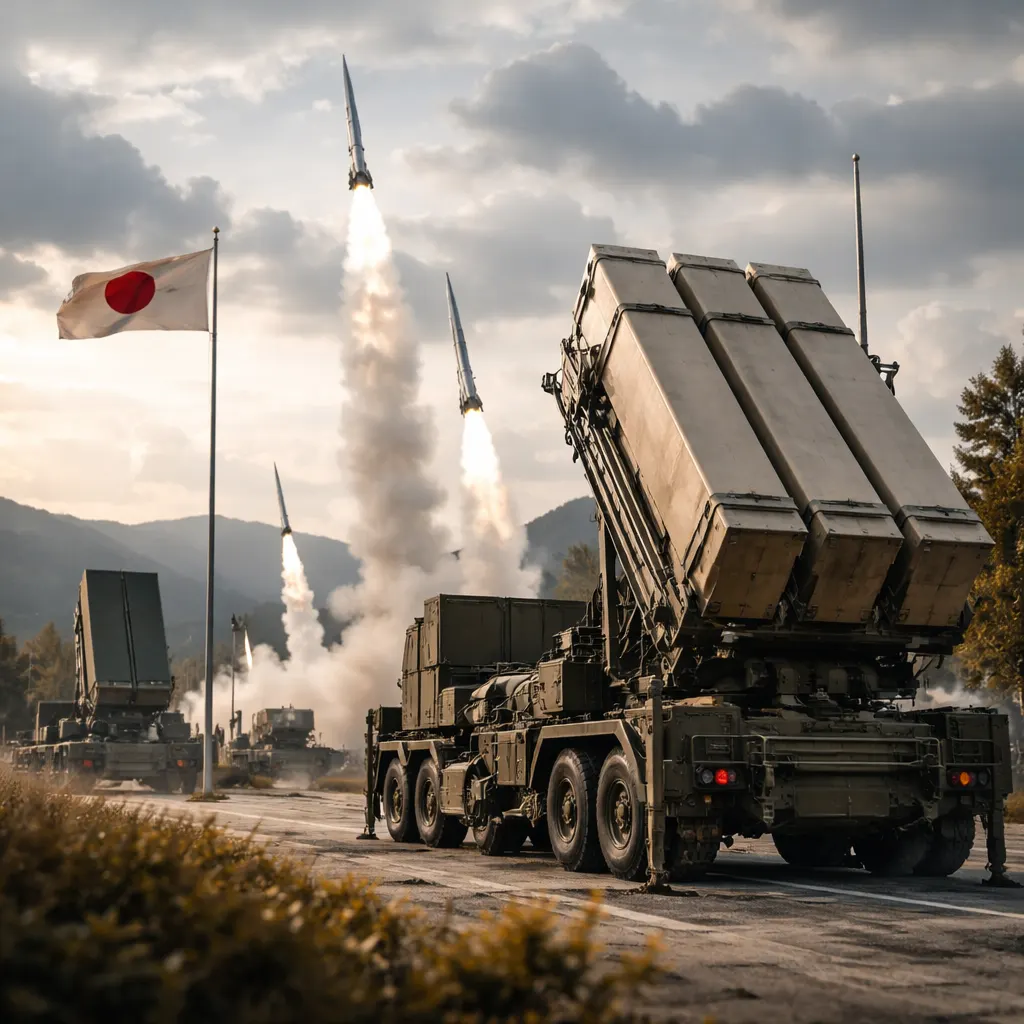
Japan's current stockpile of missile interceptors would be depleted within days of high-intensity combat with China, according to a new Hudson Institute report published June 26, 2026. Wargames simulating a Taiwan contingency in the late 2030s showed Japanese forces consumed between 105 and 318 PAC-3 MSE interceptors in just three to seven days of fighting—levels that would exhaust existing inventories almost immediately. The report calls for Japan to dramatically expand munitions procurement and adopt an integrated missile defense strategy as it prepares to update its national security documents at the end of 2026.
The threat facing Japan has grown massively in scale and sophistication. China's People's Liberation Army Rocket Force now maintains approximately 1,850 ground-launched missiles capable of reaching the Japanese home islands—550 intermediate-range ballistic missiles (primarily DF-26) and 1,300 medium-range ballistic missiles including the DF-21 and DF-17. An additional 900 short-range ballistic missiles are oriented primarily toward Taiwan, though some can reach Japan's Southwest Islands. But the real danger extends far beyond these ground-launched weapons. The report notes that most of China's strike capacity against Japan resides in air-delivered munitions, with H-6K/N bombers able to launch cruise missiles from standoff distances and tactical fighters like the J-16 conducting repeated attacks with cheaper glide bombs. The combined volume of ground-launched missiles and air-delivered munitions that China and its allies can direct against Japan could reach several times current levels by the late 2030s.
Japan's FY2026 budget request included zero new procurement for PAC-3 MSE interceptors, the terminal defense layer of its multilayered air defense architecture. According to the report's authors, Masashi Murano and William Chou, this gap is especially troubling because "even the license-produced PAC-3 MSE faces supply bottlenecks similar to those of pure FMS items" due to dependence on Boeing-supplied seekers. The recent Iran conflict consumed massive quantities of these interceptors—up to 1,000 Patriot rounds fired in less than a month during Operation Epic Fury—and the report warns that "any interruption in procurement risks lowering Japan's priority in the production line" as the US and its allies worldwide compete for limited stocks. Though Lockheed Martin is working to increase PAC-3 MSE annual production from approximately 600 to 2,000 interceptors by around 2032, near-term supply relief will take years.
The wargame findings reveal why Japan can't rely on interceptors alone. In one simulation, China launched 364 DF-17 hypersonic glide missiles and 144 CJ-1000 hypersonic cruise missiles—a total of 508 missiles—against Japan over roughly one week. But the real lesson wasn't just interceptor consumption. The report found that "destroying strike platforms before they could launch (shoot the archer), not merely intercepting incoming missiles (shoot the arrow), proved critical to sustaining overall operational effectiveness." When wargame participants used very-long-range surface-to-air missiles and uncrewed systems to destroy Chinese bombers and early-warning aircraft at ranges exceeding 300 nautical miles, it prevented those aircraft from conducting future sorties and forced surviving bombers to launch from longer ranges—giving air defenses more time to intercept cruise missiles. This compounding effect was essential to keeping Japanese airbases operational and fighters flying.
The report recommends Japan adopt a three-part integrated air and missile defense posture: prelaunch destruction of bombers and strike aircraft, layered interception of incoming missiles across multiple tiers, and passive defenses like dispersal and hardened shelters. It also calls for continuous procurement of PAC-3 MSE interceptors to maintain Japan's position in production queues, deeper US-Japan co-production arrangements through mechanisms like the Defense Industrial Cooperation working group, and expanded public communication about why these investments matter. The strategic stakes are clear: if Japan's air defense remains inadequate, the report argues, defending Taiwan and the First Island Chain becomes untenable and could render US defense commitments in the Western Pacific unsustainable.