
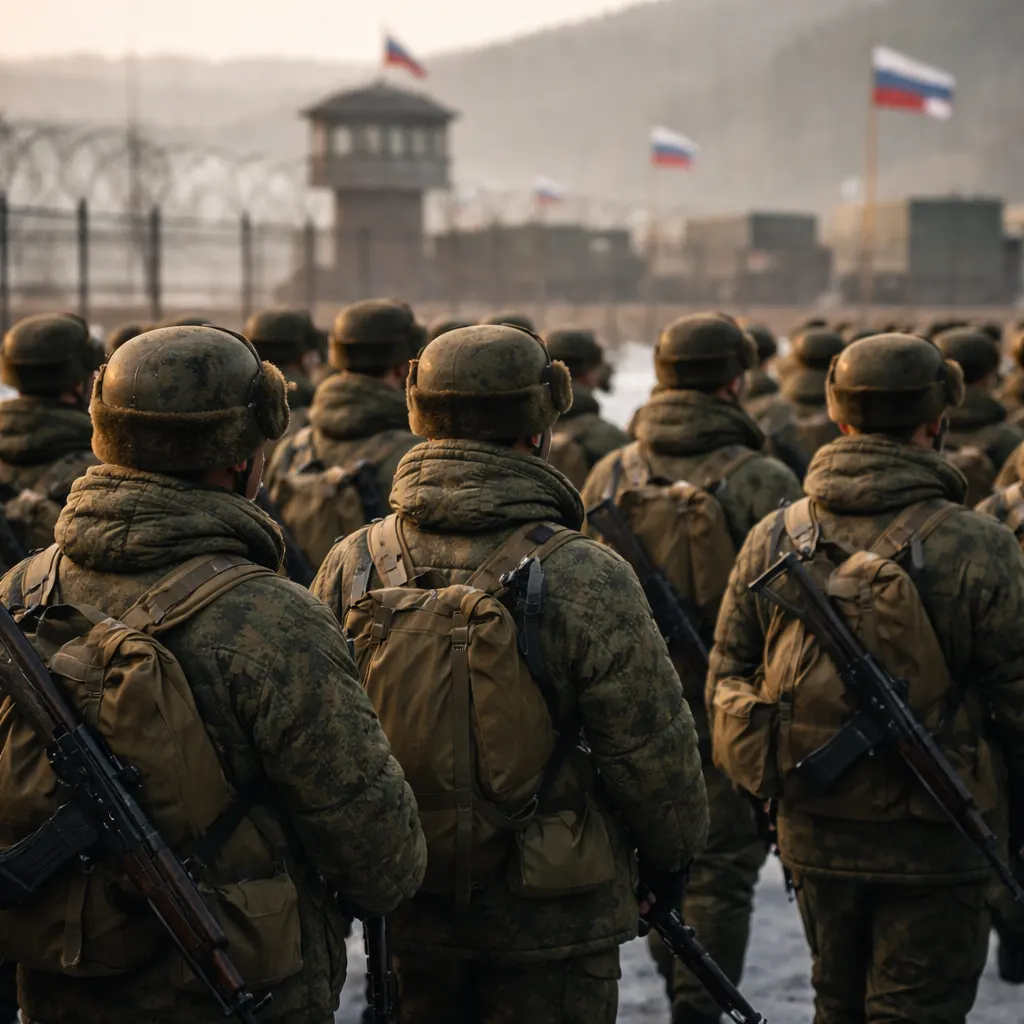
Russia is preparing to receive another 30,000 troops from North Korea alongside additional ballistic missiles, Ukrainian President Volodymyr Zelenskyy warned last week, according to a new military situation report published by the Hudson Institute on July 29. The deployment would represent a major expansion of the military partnership between Moscow and Pyongyang and comes as Russian forces maintain an offensive posture across Ukraine's main conflict zones while absorbing roughly 1,500 casualties each day. The report also details Russia's transformation of Iranian-designed Shahed drones into a sophisticated family of networked weapons and Ukraine's new strikes on Iranian supply routes through the Caspian Sea.
North Korean forces have already paid a steep price for their involvement in the conflict. According to the report, approximately 6,000 North Korean personnel have been killed or wounded while fighting primarily in Russia's Kursk region, where they helped recapture most of the territory Ukraine seized in August 2024. These troops, believed to be drawn largely from the elite 11th Corps of the Korean People's Army, operate under strict rules of engagement—many reportedly choose suicide over capture. Beyond manpower, Pyongyang has supplied Moscow with KN-23 short-range ballistic missiles, long-range artillery, multiple-launch rocket systems, and what South Korean intelligence estimates as more than 12 million artillery rounds of the 152mm class. Ukrainian military intelligence now assesses that North Korea supplies roughly half of Russia's artillery ammunition, with some Russian formations nearly dependent on North Korean-made munitions.
Russia has also evolved its drone arsenal into what the report describes as a modular family of reconnaissance-strike systems. The Geran-2, Russia's domestic version of Iran's Shahed-136, now features heavier warheads, hardened navigation systems, mobile-network and Starlink terminals, and artificial intelligence-assisted targeting. New jet-powered variants—the Geran-3, Geran-4, and Geran-5—have replaced the original piston engine with turbojets, complicating Ukraine's air defense efforts. The Geran-5 incorporates a Chinese-origin turbojet that provides a maximum range of about 590 miles and a top speed of roughly 373 miles per hour while carrying a 198-pound payload. Russia's newest Seeker configurations add a machine-vision suite based on Raspberry Pi computers that provides automatic target recognition and terminal guidance, allowing drones to complete attacks even if their command links are disrupted.
The combat experience North Korean forces are gaining may ultimately prove as consequential as any weapons transfer. Notes recovered from a killed North Korean special forces officer contained instructions for evading artillery fire and countering hostile drones, illustrating how quickly Pyongyang's troops are absorbing lessons in electronic warfare, counter-drone operations, fiber-optic first-person view systems, and long-range unmanned strikes. President Zelenskyy warned earlier this year that these personnel will eventually return home with operational knowledge that could reshape North Korea's military capabilities and affect the balance of power on the Korean Peninsula. Meanwhile, Ukraine's recent strikes on maritime supply lines linking Iran and Russia across the Caspian Sea prompted Tehran to assert it has the right to take "appropriate action" in defense of its interests, raising the prospect of a more direct confrontation between Kyiv and Tehran. The war's expansion beyond its initial theater now exposes the logistical networks of the Russia-Iran partnership—and the risk that attacks on those networks could provoke wider escalation.