
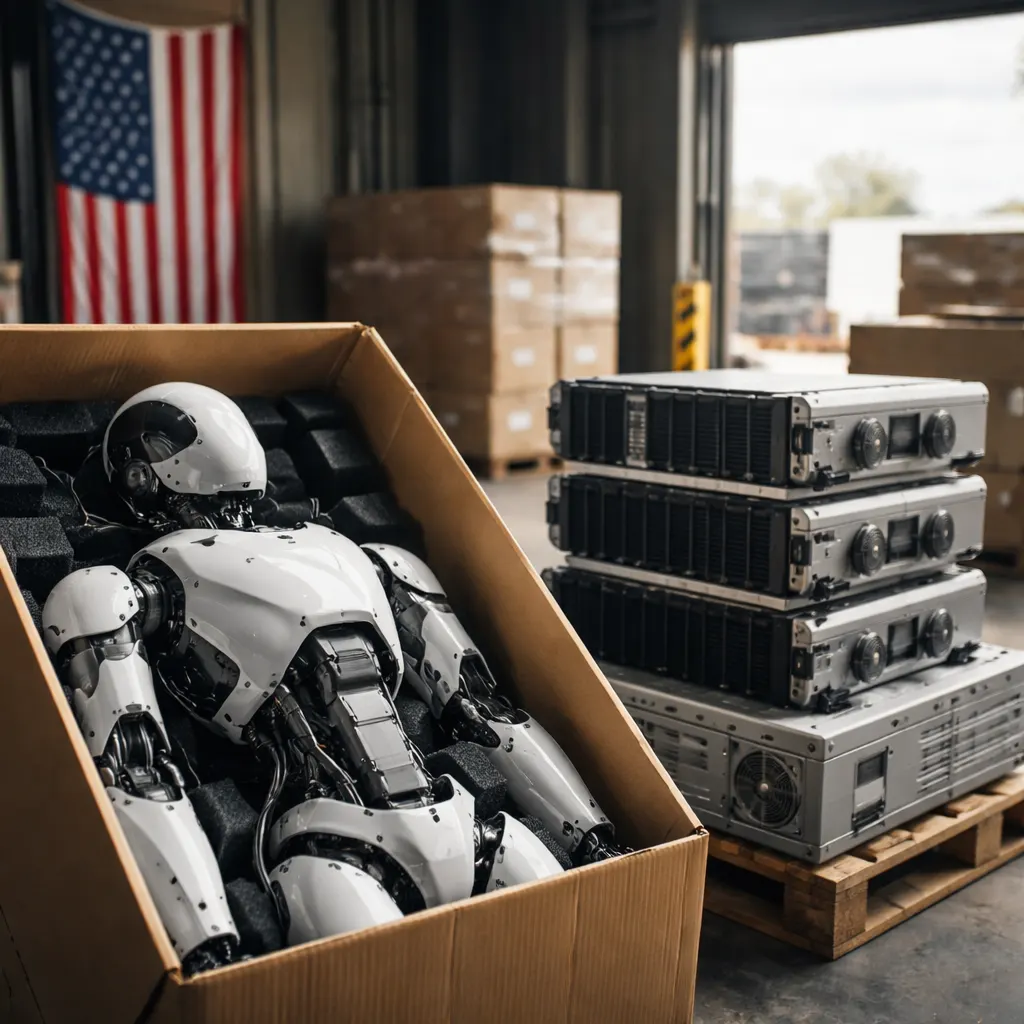
The United States government has imposed a new import ban on advanced robotic devices and power inverters manufactured in foreign countries, the Federal Communications Commission announced Tuesday, according to a report by The Verge. The FCC says the prohibition applies to mobile robots including humanoid and quadruped models, though it's not restricted to robots that walk. While the agency claims the measure isn't aimed at any particular nation, it will significantly affect China as the country accelerates its humanoid robot manufacturing, with recent viral videos showing Chinese-made robots dancing to Michael Jackson, competing in mixed martial arts, and even performing on America's Got Talent.
The FCC defines an advanced robotic device as any machine weighing more than 4.4 pounds (including its docking station) that can perform locomotion, obstacle avoidance, navigation, or ground movement; includes sensors to perceive its surroundings; and contains a chip for network connectivity. By this standard, even future robot vacuums would face an automatic ban unless they secure a waiver. The ban also targets power inverters, which are commonly used in solar panel arrays and other renewable energy systems. China is home to the world's top power inverter manufacturers, including Sungrow and the already-blacklisted Huawei. Products already in the United States won't be subject to the restriction, so individuals and companies can continue using existing robots and inverters.
The FCC cites "unacceptable risks to the national security of the United States or the safety and security of United States persons" as justification for the ban. The agency's National Security Determination explicitly references The Verge's earlier reporting on security vulnerabilities in DJI's Romo robotic vacuum. Companies can request waivers to continue importing new products into the US, similar to the government's ban on foreign-made routers, but the waiver application doesn't require any improvements to the security of those robots or inverters. According to sources cited by Reuters, the FCC is expected to exempt many non-Chinese suppliers from the restrictions.
The waiver process reveals the ban's underlying focus on manufacturing location rather than security improvements. Every applicant must provide a detailed plan to begin manufacturing their devices in the United States instead of abroad. The FCC announced that all robots and power inverters can continue receiving security and compatibility updates through January 1, 2029, under an additional waiver. However, The Verge notes the agency is misleading the public about how those updates work, since companies currently aren't required to inform the FCC when they push security updates to their devices. The move comes as Tesla has discontinued its Model S and Model X vehicles to make space for production of its Optimus humanoid robot, signaling intensifying competition in the robotics sector between US and foreign manufacturers.