
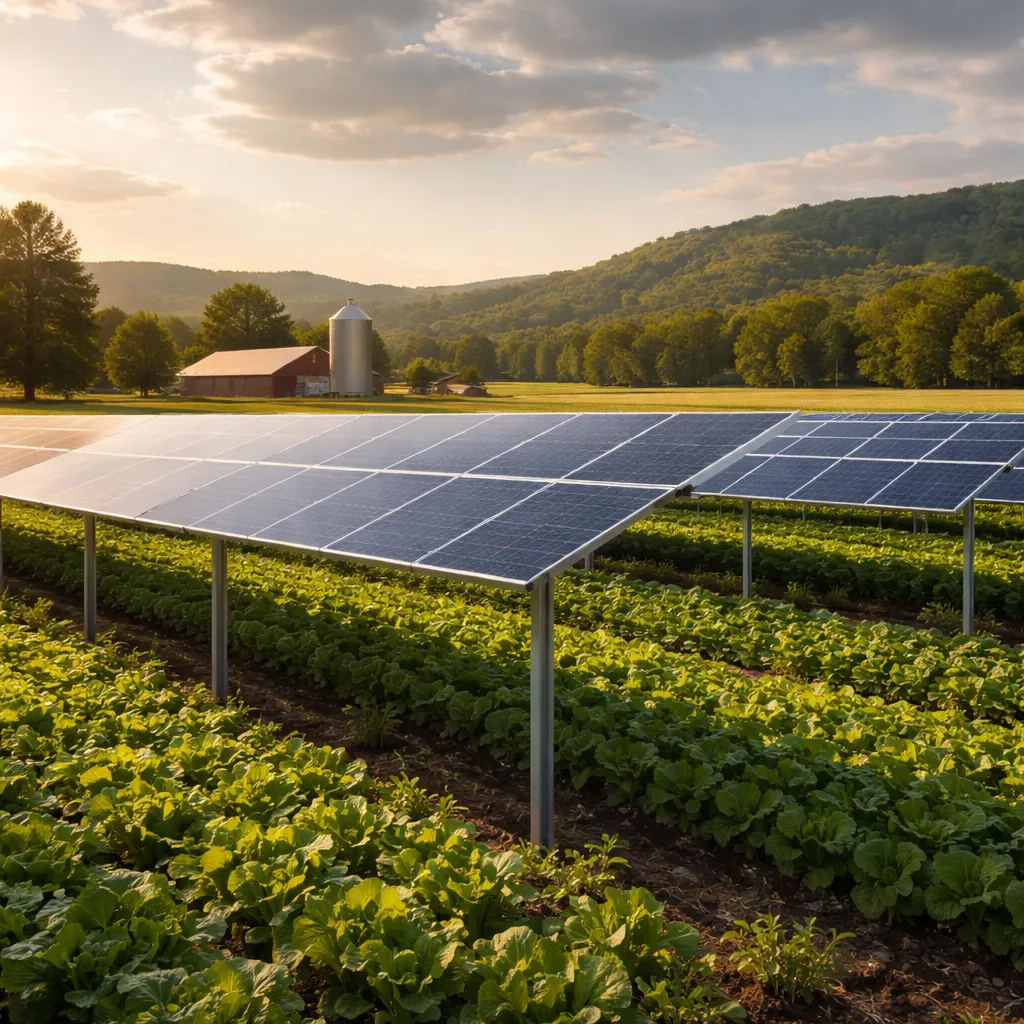
Virginia has become the first state to legally define agrivoltaics, after Gov. Abigail Spanberger signed a bill on June 17 that establishes the practice as the "intentional co-location of agricultural production and solar energy generation on the same land." The new law arrives as the state grapples with concerns over solar projects consuming prime farmland, with proponents hoping the framework will expand distributed generation and potentially revitalize abandoned agricultural land across Virginia.
According to the National Renewable Energy Laboratory, Virginia currently has 13 agrivoltaic projects. Only one of those — the Piedmont Environmental Council's Community Farm at Roundabout Meadows in Loudoun County — is crop-based, generating 17 kWdc of capacity, enough to meet about 130% of the farm's energy needs. The remaining 12 projects are either grazing or habitat-based operations. The largest is the Skipjack Solar Center, a 175-MWdc sheep-grazing project spanning 2,200 acres, while the 108-MWdc Foxhound Solar represents the biggest habitat project at 580 acres, designed to provide pollinator habitat. A 2024 Virginia Commonwealth University report found that 41% of solar-disturbed land in the state — 12,541 acres — was designated as prime farmland, though that accounts for just 0.25% of Virginia's total prime farmland. Meanwhile, Virginia lost 488,292 acres of farmland between 2017 and 2022, according to the USDA's 2022 Census of Agriculture.
The law requires that agrivoltaic projects must be "designed to prioritize and sustain agricultural productivity while simultaneously integrating renewable energy generation," allow agriculture to continue over the life of the solar project, and include provisions for decommissioning to protect agricultural resources. Projects must also "ensure flexibility for farmers to adapt to market conditions and support operational needs," according to the legislation. Lauren Glickman, VP of policy and communications for Encore Renewable Energy, said the state is in the "early stages" with agrivoltaics, noting that the bill's signing ceremony took place at Virginia's first crop-based project, which only launched in October. "That gives you a lot of opportunity to set a really strong foundation for how we can build this up across Virginia," Glickman told Utility Dive.
The new definition comes against the backdrop of 2022's HB206, which Virginia's Department of Environmental Quality describes as legislation "enacted to address adverse impacts of small renewable energy solar projects in Virginia on prime agricultural soils and forest lands." In 2024 comments on that law's implementation, the Virginia Association of Soil and Water Conservation Districts recommended the state "incentivize solar development on brownfields and existing structures rather than prime agricultural and forest lands." Glickman said she's optimistic the state could use agrivoltaic projects to revitalize brownfield sites and abandoned farmland, pointing out that farmers across the U.S. are abandoning their land — "they either become fallow, they're selling, or they're just unable to actively farm them." She hopes abandoned cropland could be revitalized through grazing projects, moving Virginia toward "not just preserving farmland, we're actually growing farmland."
Though the final version of the bill dropped language about creating a stakeholder advisory panel, Gov. Spanberger's administration will establish the group on an executive basis, according to the Virginia Mercury. Glickman expects the panel to convene this summer with representatives from conservation groups, solar developers, and — "critically most important" — crop farmers and grazers. "We need to have a joint agricultural voice that includes both crops and grazing to ensure that this definition works for all parties," she said. "This partnership between the agricultural community and the solar community is a really powerful one, but it has to have meaning, it has to be real, and I think when there is standardization, it creates the bridge to make these local partnerships real."