
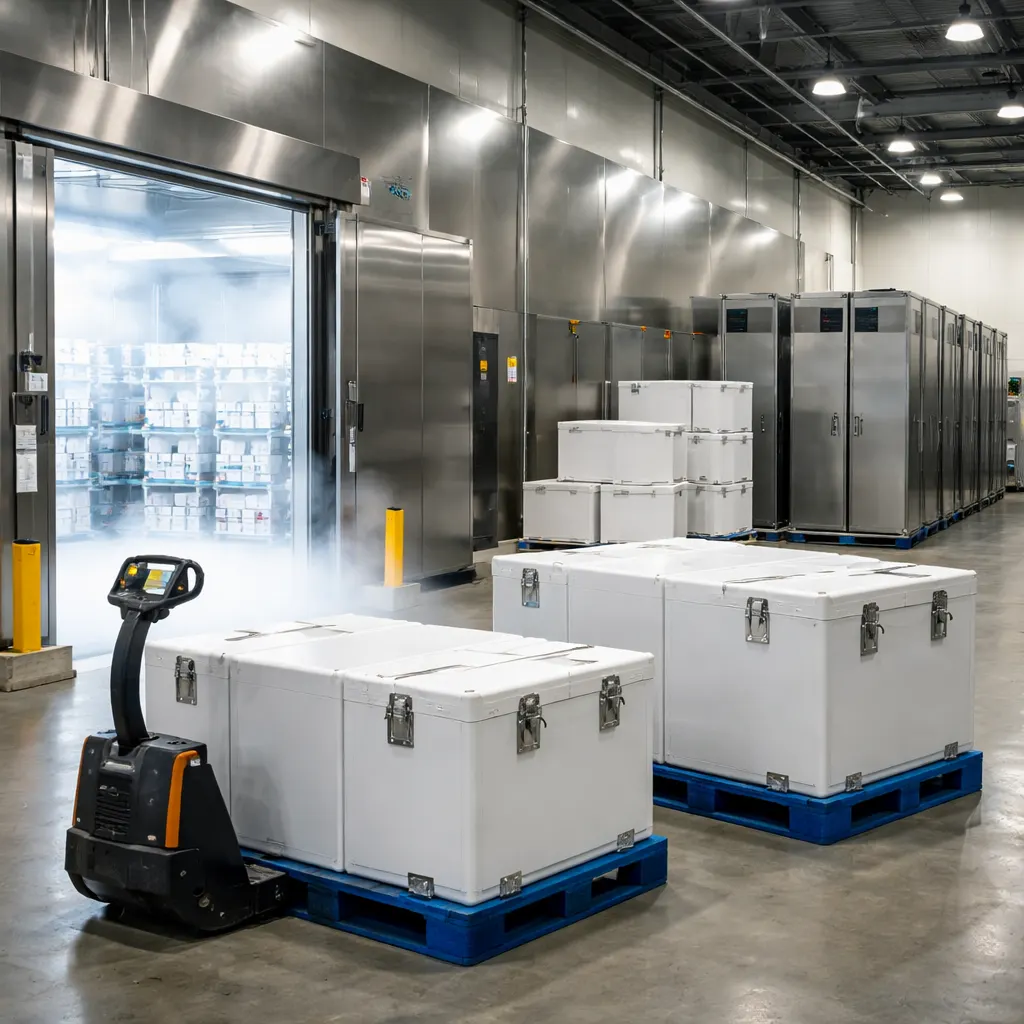
United Parcel Service has invested $48 million to open 27 temperature-controlled truck cross-dock facilities around the world, the company announced Monday. The new facilities, located in Europe, Asia and the Americas near major air and multimodal hubs, are designed to support rising demand from pharmaceutical manufacturers, medical labs and biotech companies for logistics services that maintain product integrity during transit. All 27 facilities comply with pharmaceutical handling standards established by the International Air Transport Association, and they're built for rapid air-to-ground and ground-to-ground transfer while minimizing traditional warehouse storage.
The facilities come as demand for temperature-sensitive biologics is projected to expand at an 8.3% compound annual growth rate through 2033, reaching an estimated $39.1 billion, according to Growth Market Reports cited in the UPS announcement. The fast-growing popularity of advanced therapies—including cell and gene treatments, mRNA vaccines and GLP-1 weight-loss drugs—has driven the need for precision cold-chain services. Temperature deviations remain a major concern: cold-chain failures cost up to $35 billion per year and contribute to as much as 50% of global vaccine waste, according to World Health Organization estimates. Each shipment moving through UPS's new cross-docks is continually monitored with sensors, allowing staff to quickly intervene if there are signs of temperature changes.
"What's new here is greater network integration across air and ground flows, more control at handoff points, historically a major risk area, and faster, more consistent movement of temperature-sensitive freight," said Kiel Harkness, UPS vice president of healthcare strategy, in an email. The investment is part of UPS's broader pivot toward healthcare logistics as a primary growth avenue, with the company targeting customers willing to pay a premium for complex services required to maintain ultra-sensitive medicines and biologics at optimum temperatures throughout the supply chain. Two years ago, UPS said it planned to double revenue in healthcare logistics to $20 billion through organic growth and acquisitions by the end of 2026, and the company recently topped $3 billion in healthcare revenue for a quarter for the first time, management said during the first-quarter earnings presentation on April 28.
The strategy reflects UPS's hard pivot away from traditional, low-yield parcel delivery as profit margins erode. Next-generation medicines have a much higher value and far less tolerance for shipping errors, and the best practice in healthcare logistics has shifted toward fewer handoffs, more integrated networks and greater door-to-door accountability, UPS officials say. The company has backed that strategy with aggressive investments: in November it completed the $1.6 billion acquisition of Andlauer Healthcare Group, a major Canadian provider of logistics and temperature-controlled transportation. It also acquired Italian healthcare logistics provider Bomi Group in 2022 and two German-based temperature-controlled providers—Frigo-Trans and BPL—in January 2025. With integrated logistics rivals FedEx and DHL also competing aggressively for healthcare business, UPS is betting that its expanded network of cross-dock facilities will close critical gaps at handoff points where temperature excursions and visibility losses have historically posed the greatest risk to high-value pharmaceutical shipments.