
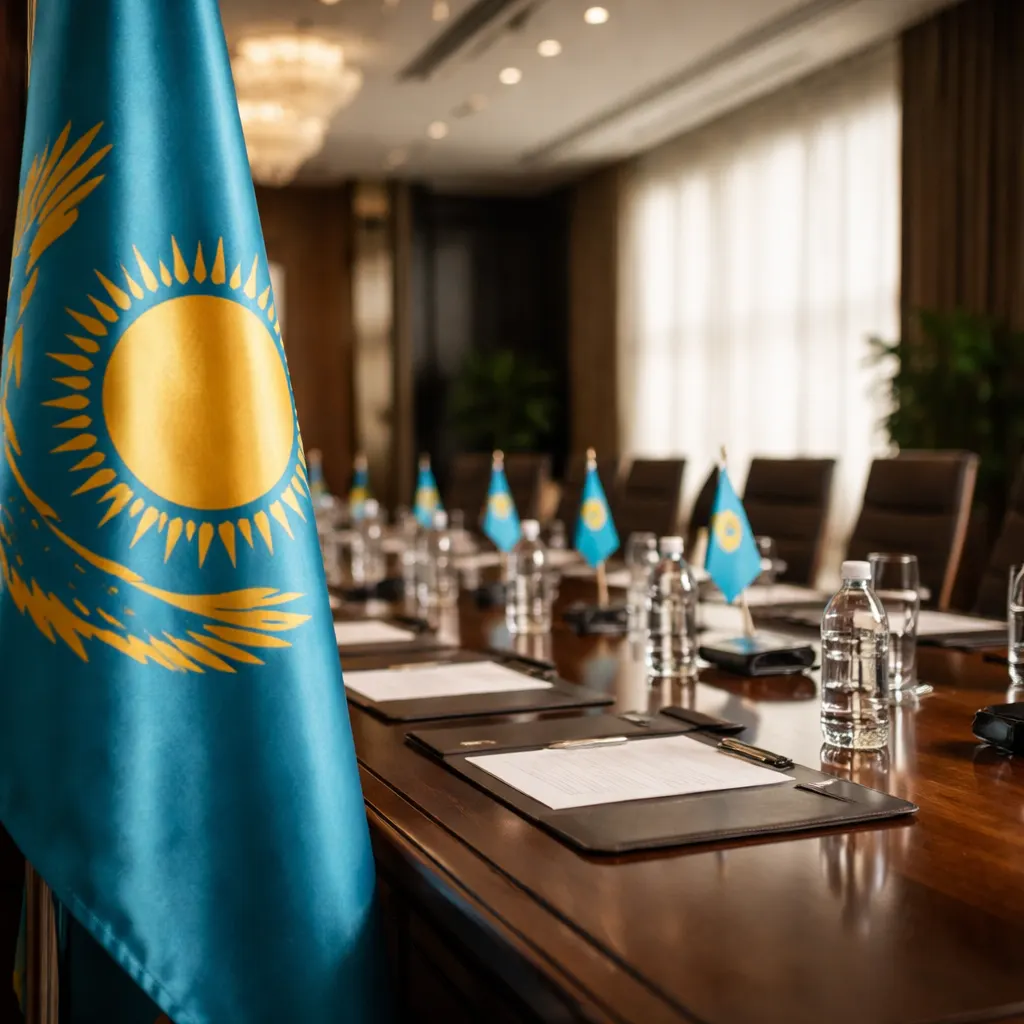
Kazakhstan's pro-presidential Adilet party secured 71.17% of the vote in the country's Aug. 23 parliamentary elections, according to preliminary results cited in an analysis published by the Hudson Institute. The highly choreographed election featured seven parties on the ballot, all of them pro-government, while opposition parties were barred and critical journalists faced mounting pressure. The analysis, written by Ken Moriyasu, argues that Kazakhstan's political consolidation isn't about democratic progress but about preparing for intensifying geopolitical competition among China, Russia, and the United States.
The election followed constitutional reforms that took effect July 1, which replaced the bicameral parliament with a 145-member Kurultai, named after the assemblies where Turkic and Mongol peoples historically deliberated major decisions including the selection of rulers. The constitution creates a vice president position for the first time, with President Kassym-Jomart Tokayev expected to nominate a candidate after the new Kurultai convenes. Shortly before the vote, the Constitutional Court ruled that the new constitution reset Tokayev's presidential clock, theoretically permitting him to run again after his current term ends in 2029. Kazakhstan shares a 7,600-kilometer border with Russia and a 1,780-kilometer border with China, making political stability essential to its multi-vector foreign policy of maintaining relationships with all three major powers without subordination to any.
According to the analysis, the reforms point toward an attempt to engineer an orderly political transition essential to preserving Kazakhstan's diplomatic balancing act. A source close to the government told the author that the court ruling shouldn't be interpreted as evidence Tokayev intends to stay beyond 2029, but rather as a way to avoid becoming a lame duck by keeping that option available. Deputy Foreign Minister Arman Issetov stated that "stability remains one of Kazakhstan's main priorities" as the international system becomes more complex and unpredictable. Scholar Andrei Kazantsev described Kazakhstan as "the only post-Soviet state that has managed to open up to society without experiencing a broader political and institutional regression."
The analysis explains that Kazakhstan's leaders worry about a fragmented political system becoming vulnerable to domestic factionalism or outside pressure just as great-power competition intensifies. The January 2022 anti-government riots, reflecting a power struggle between Tokayev and longtime predecessor Nursultan Nazarbayev, demonstrated how quickly elite ruptures can translate into foreign dependence. To stabilize the situation, Tokayev had to request help from the Russia-led Collective Security Treaty Organization, giving Russia tremendous, though temporary, military leverage. For China, railways and pipelines across Eurasia offer alternative connections to markets if maritime chokepoints become vulnerable, while Washington views Central Asia as a source of critical minerals that can reduce American dependence on Chinese supply chains.
The analysis concludes that Tokayev's wager is that Kazakhstan can consolidate the state without closing society, arrange a succession without triggering a succession struggle, and maintain its multi-vector foreign policy regardless of how geopolitical winds shift. The competition will soon be visible across Kazakhstan's border in Kyrgyzstan, where Chinese President Xi Jinping and Russian President Vladimir Putin are due for a Shanghai Cooperation Organization summit at the end of August, while U.S. Special Envoy Sergio Gor will celebrate Kyrgyzstan's Independence Day with meetings planned with Tokayev and other regional leaders. As Tokayev suggested in his pre-election television address, whether the process worked may only become apparent years from now.