
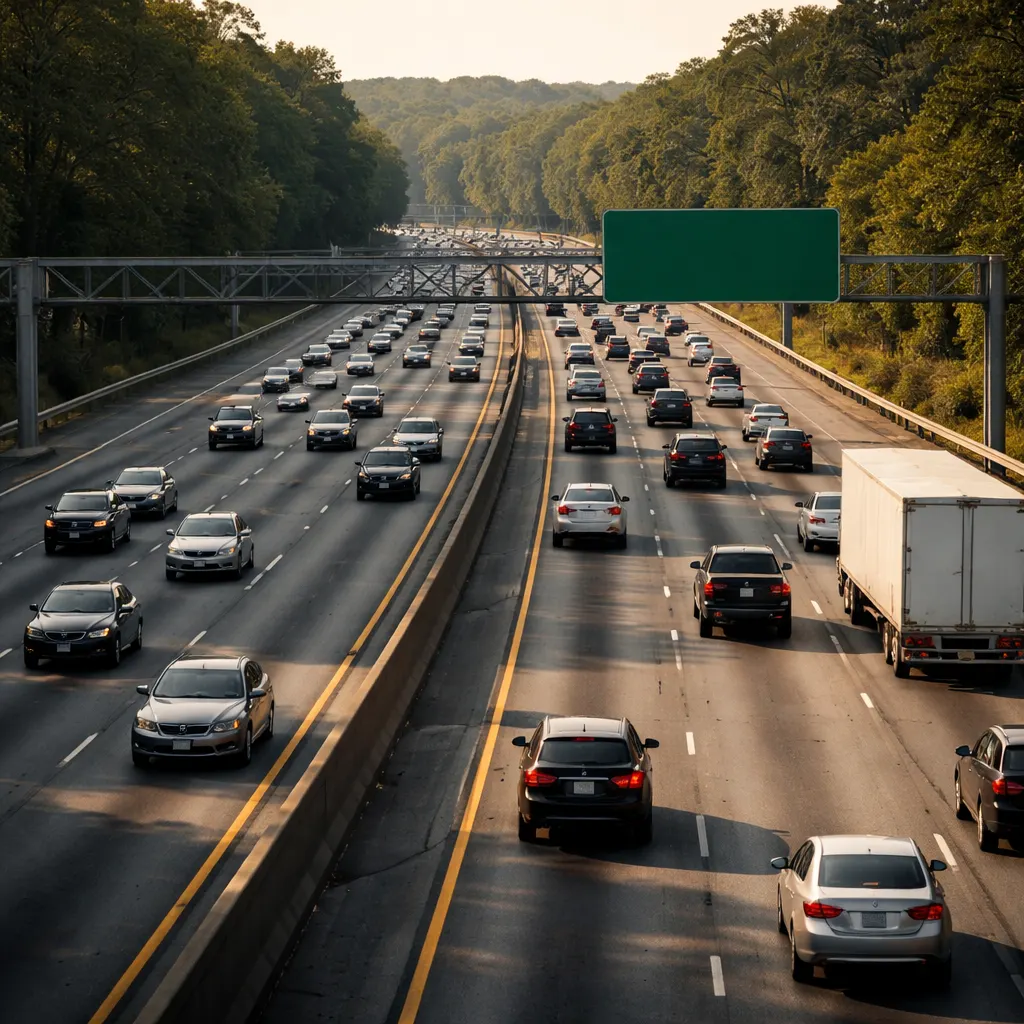
Maryland's highway system dropped two positions to 34th place nationwide in overall cost-effectiveness and condition, down from 32nd the previous year, according to the 29th Annual Highway Report released by Reason Foundation. The state's road network struggles with poor urban pavement quality and severe traffic congestion, though it excels in rural safety. Maryland drivers lose roughly 44 hours annually sitting in traffic jams, and the state ranks 43rd out of 50 in traffic congestion.
The state's performance varies dramatically between rural and urban environments across multiple pavement and safety metrics. Maryland places 30th for rural Interstate pavement quality but falls to 43rd for urban Interstate pavement. Rural arterial roads rank 30th while urban arterials sit at 43rd. The state performs well in certain safety measures, claiming first place nationally in rural fatality rate and 13th in structurally deficient bridges, but drops to 32nd for urban fatality rate. On spending, Maryland ranks 20th in capital and bridge expenditures for new construction and widening projects, 32nd in maintenance spending like repaving and pothole repairs, and 36th in administrative costs that don't directly reach roads. The state showed improvement in other disbursements, climbing from 47th to 42nd, and in rural arterial pavement condition, moving from 35th to 30th. However, administrative spending performance deteriorated sharply, falling from 22nd to 36th.
Lead author Baruch Feigenbaum, senior managing director of transportation policy at Reason Foundation, emphasized specific areas needing attention. "Maryland should focus on improving its Urban Interstate Pavement Condition, improving its Urban Arterial Pavement Condition, and reducing its Urbanized Area Congestion," he stated. The report notes that despite strong showings in rural fatality rate and structurally deficient bridges, "its persistently poor urban pavement condition and congestion rankings remain significant challenges." When measured against neighboring states, Maryland trails Virginia (1st), West Virginia (30th), and Delaware (32nd), though it outperforms Pennsylvania (36th) and New Jersey (40th). Among similarly populated states, Maryland lags behind Missouri (9th) and Wisconsin (31st).
The persistent gap between Maryland's rural and urban highway performance reflects the different challenges facing each environment. The report's evaluation system examines 13 separate categories covering pavement and bridge conditions, traffic deaths, congestion, and spending, with data primarily drawn from what states reported to the Federal Highway Administration for 2023. In performance measures, a first-place ranking indicates the best outcome—such as the lowest death rate or highest-quality pavement—while 50th represents the worst. For cost-effectiveness, first place means the state spends the least, while 50th signals the highest relative expenditures. Maryland's top ranking in rural fatality rate demonstrates success in keeping drivers safe on less-traveled roads, but the combination of deteriorating urban pavement and mounting congestion suggests infrastructure investment hasn't kept pace with metropolitan area demands.
The report's findings point to a need for targeted urban infrastructure investment and congestion reduction strategies. Maryland's decline in administrative spending efficiency—a 14-position drop in a single year—raises questions about whether overhead costs are consuming resources that could improve road conditions. With drivers spending nearly two full workweeks per year stuck in traffic and urban road surfaces ranking in the bottom fifth nationally, the state faces pressure to address metropolitan infrastructure quality. The data suggest that Maryland's highway system works well for rural communities but leaves urban and suburban drivers navigating deteriorating pavement while losing substantial time to gridlock.