
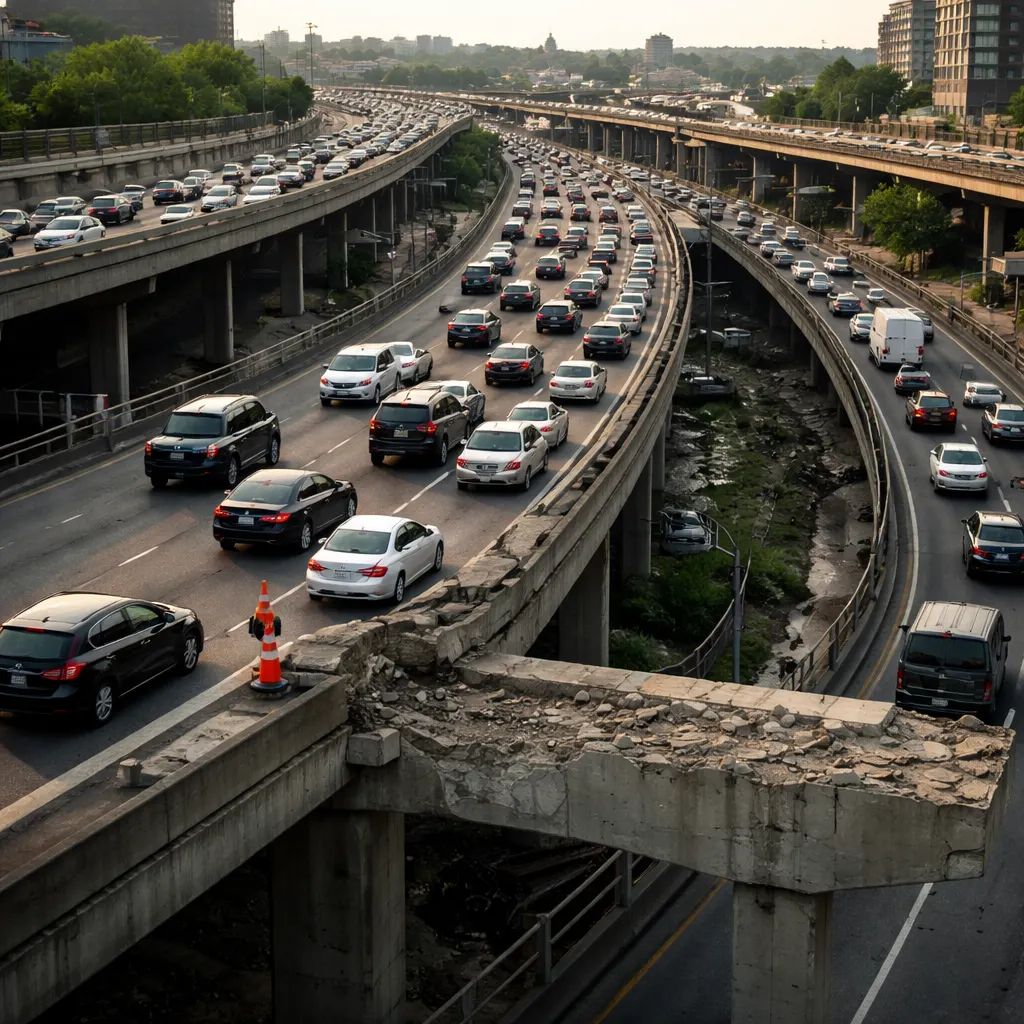
Massachusetts received a "C" on the 2025 Infrastructure Report Card published by the American Society of Civil Engineers, despite the state's reputation for extensive public spending. According to analysis by Pioneer Institute's DataLabs platform, the mediocre grade reflects longstanding infrastructure problems that have become significantly harder to fix in the wake of the pandemic, with rising costs and changing commute patterns creating new challenges for the state's transportation network.
The numbers paint a troubling picture for Massachusetts roads and bridges. The state ranked 38th nationally, with only 74.3% of its roads in acceptable condition compared to the national average of 81.2%. Massachusetts also ranks 4th highest in the share of bridges in poor condition. Currently, around 15.6% of Massachusetts' workforce remains remote based, still elevated from pre-pandemic levels of 5%. The T's operating budget took a hit as fare revenue, which originally supported 33% of operations, dipped to as low as 22% in 2025. The state bridged its 2025 budget gap of roughly $700 million with a $535 million surtax spending bill, but only $40 million could be directed to infrastructure due to rising costs. Despite shifting commuting patterns, almost 70% of Massachusetts workers still choose to commute primarily by driving or carpooling, and poor road conditions cost drivers almost $700 annually in vehicle damages.
The report finds that infrastructure problems have plagued Massachusetts since well before the pandemic, but the past several years have made maintaining and improving the systems much more difficult for many metropolitan centers. According to the analysis, rising costs are due in large part to inflationary pressures from the pandemic, with an increase in construction costs specifically due to supply chain disruptions. The report notes that higher prices for goods like steel and concrete, paired with a compounding labor shortage, have thrown unexpected wrenches into state budgets and delayed project timelines.
The pandemic's legacy explains much of the current crisis. Rising inflation, labor shortages, and changing commute patterns have uniquely affected transportation infrastructure in ways that create a vicious cycle. The rise of remote work shifted commuting behaviors and reduced transit agency revenue at precisely the moment when repair costs skyrocketed. The resulting increase in the cost-to-revenue ratio has made operation and repair difficult, leaving the state struggling to address increasingly expensive infrastructure issues with diminished resources. MassDOT just launched its FY2027-2031 investment plan, which will invest upwards of $20.5 billion into infrastructure improvements with main goals to prioritize safety and accessibility. Top of mind for policymakers is the recent death of State Trooper Kevin Trainor after an incident of wrong-way driving along Route 1 on May 6th, and the report notes that the number of vulnerable road users with fatal or serious injuries is trending upwards again.
The approved projects will have statewide impacts on EV charging infrastructure, railroad crossing improvements, and pedestrian and cyclist pathways. By improving infrastructure for all travelers, the Massachusetts transportation network becomes more interconnected, reliable, and cost-effective in the long term. With 70% of workers still driving and road damage costing each driver hundreds of dollars annually, the question isn't whether Massachusetts needs to invest—it's whether the state can afford not to.